
ZeroDivisionError in Python occurs when you try to divide a number by zero. It is triggered in expressions that use /, //, or % with a denominator of zero. To fix it, validate the denominator before division or use a try/except ZeroDivisionError block.
ZeroDivisionError is one of the first runtime errors beginners face in Python. Whether you’re building calculators, dashboards, or data-driven apps, this error can crash your program instantly. Understanding why it happens — and how to prevent it — saves time, avoids bugs, and improves code reliability. This article breaks it down in a simple, real-world way.
Key Takeaways: ZeroDivisionError in Python
- Happens when the denominator becomes 0 in
/,//, or%. - Common causes: empty lists, bad user input, incorrect calculations.
- Fix using:
if denominator != 0try/except ZeroDivisionError- Input validation
- Best practice: always guard division operations in user-facing apps.
What Is ZeroDivisionError in Python?
A ZeroDivisionError in Python occurs when you try to divide any number by zero using the /, //, or % operators. Python immediately stops execution and throws this runtime error because dividing by zero is mathematically undefined.
Here’s what the error looks like:
result = 10 / 0
Traceback:
Traceback (most recent call last):
  File "main.py", line 1, in <module>
    result = 10 / 0
ZeroDivisionError: division by zero
Why Does Python Not Allow Division by Zero?
Python blocks division by zero because the operation has no valid mathematical result. Allowing it would cause unpredictable or unstable behavior in programs.
By raising an exception instead, Python ensures:
- Program stability
- Predictable error handling
- Safer numerical operations
Almost every programming language handles division-by-zero the same way to maintain logical consistency and avoid silent f
Common Causes of ZeroDivisionError in Python
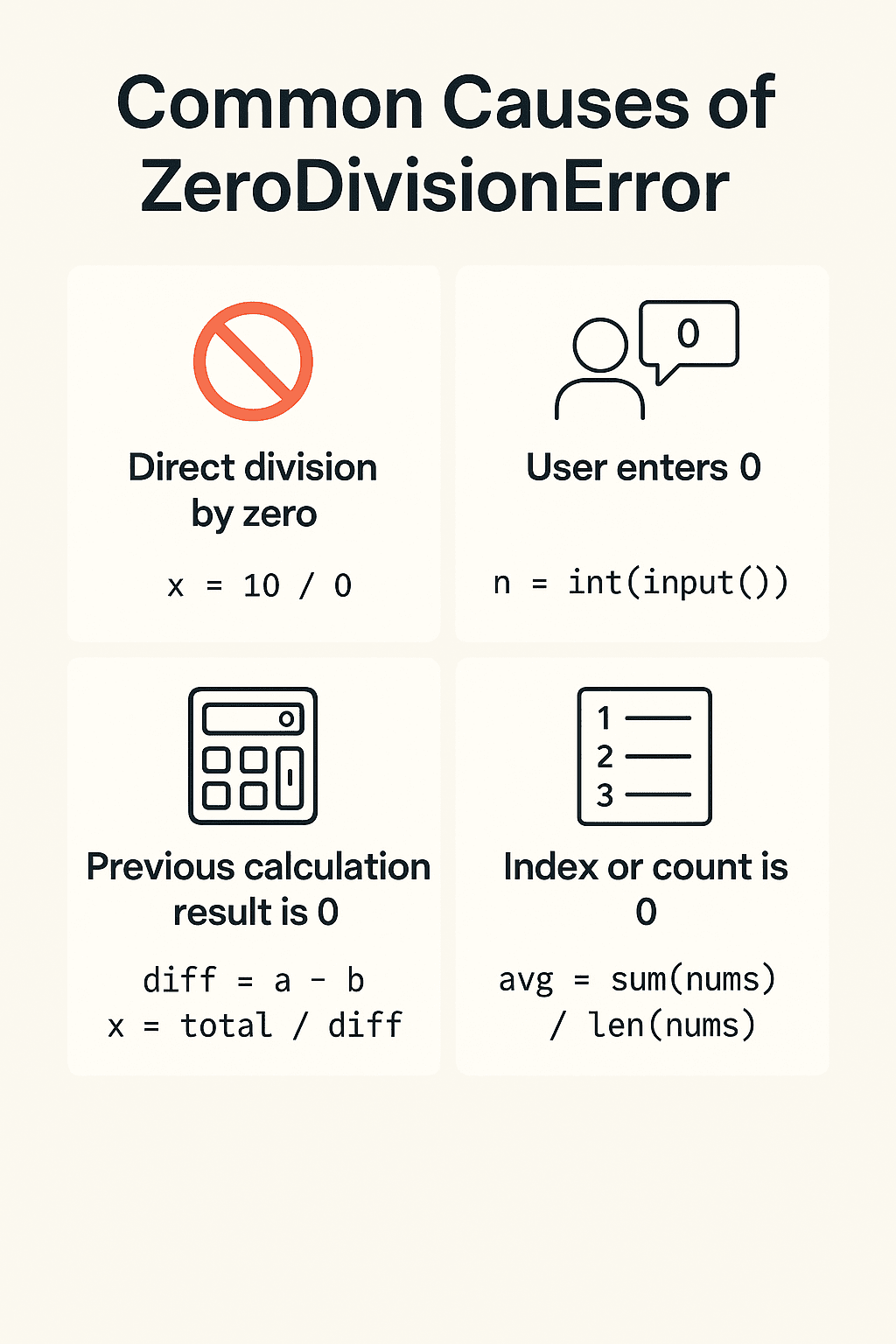
ZeroDivisionError commonly appears in beginner and production code for many small but easy-to-miss reasons. Below are the most frequent causes with micro examples.
1. Direct Division by Zero
This is the simplest case—hardcoding the denominator as zero.
x = 10 / 0
Instant ZeroDivisionError.
2. User Input Becomes 0
When a user enters 0, the program still tries to divide, leading to an exception.
n = int(input("Enter a number: "))
result = 50 / n   # Error if user enters 0
3. Calculations Resulting in 0
Even if you didn’t write “0”, a calculation might produce zero unexpectedly.
a = 12
b = 12
diff = a - b   # diff = 0
result = 100 / diff   # ZeroDivisionError
This is common in formulas involving differences.
4. Average of an Empty List
Empty lists have a length of zero. Using len() in division causes the error.
items = []
avg = sum(items) / len(items)   # len(items) = 0 → Error
This is a very common real-world bug, especially in data science scripts.
5. Zero Modulus (%)
Modulus by zero is not allowed either.
x = 10 % 0 # ZeroDivisionError: integer modulo by zero
All division-like operations behave the same.
How to Fix ZeroDivisionError in Python (Step-by-Step)
Using a Simple Denominator Check
You can prevent the error by checking that the denominator is not zero before performing the division.
a = 10
b = 0

if b != 0:
    result = a / b
else:
    result = 0   # or handle differently

print(result)
This is the simplest and fastest fix.
Using try/except ZeroDivisionError
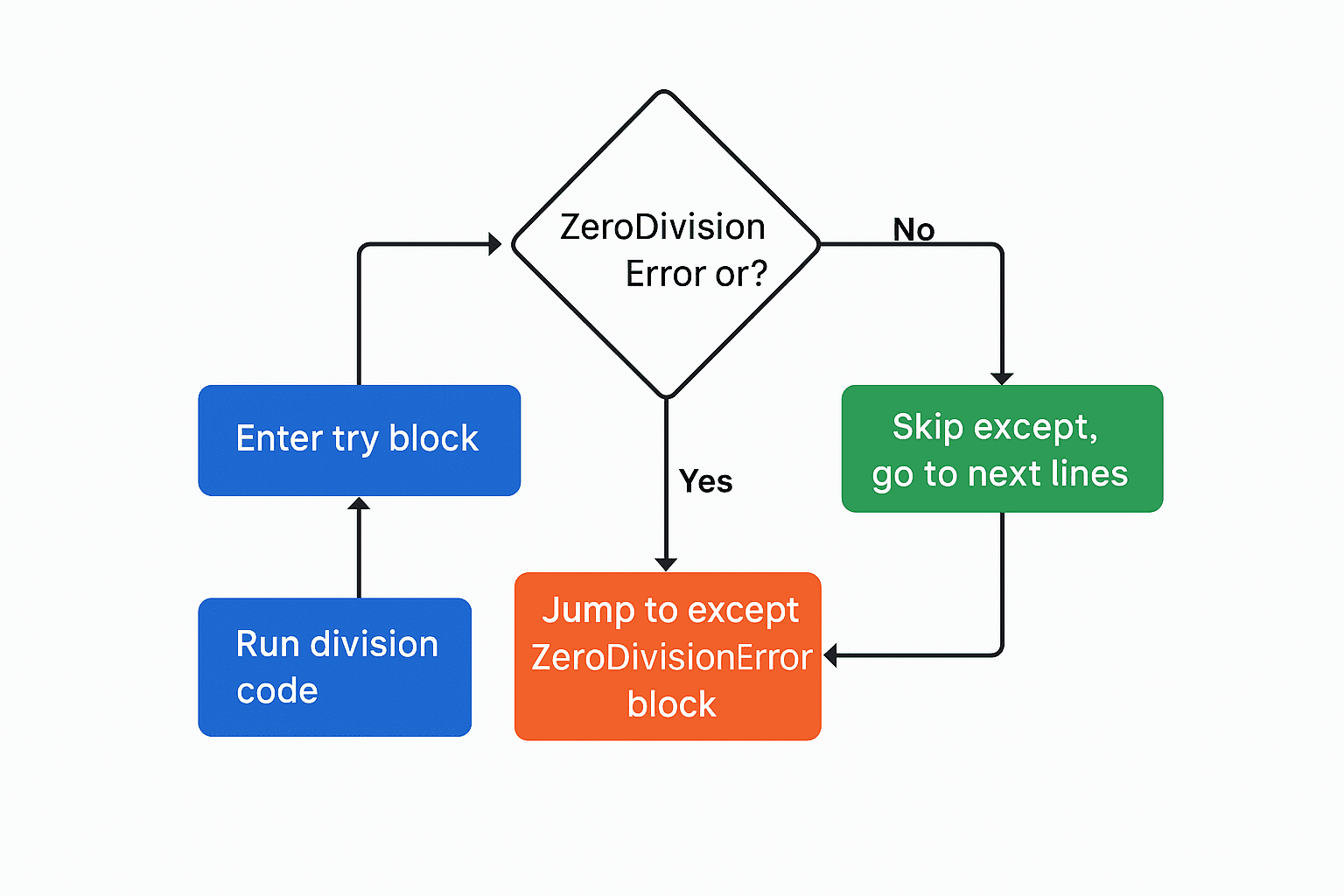
Try/except is ideal for production-level applications, user interfaces, APIs, and any situation where you don’t want your program to crash.
try:
    result = a / b
except ZeroDivisionError:
    print("Cannot divide by zero!")
    result = None
This approach ensures the program continues running safely.
Validating User Input
For CLI, GUI, and web apps, validate user entries before using them in calculations.
n = int(input("Enter a denominator: "))

if n == 0:
    print("Please enter a non-zero value.")
else:
    print(100 / n)
This avoids errors caused by unexpected or incorrect input.
Avoiding ZeroDivisionError in Python
python
def divide_numbers(num1, num2):
    try:
        result = num1 / num2
    except ZeroDivisionError as e:
        print(f"Error: {e}. You can't divide by zero!")
    else:
        print(f"The result is {result}")
    finally:
        print("Division attempt complete.")

# Example usage:
divide_numbers(10, 0)
divide_numbers(10, 2)
Explanation of the Code
Let’s dive into the code snippet which handles division in Python, guiding you effectively through its workings. Here’s how it flows:
- The `divide_numbers` function takes two inputs, `num1` and `num2`, and attempts to divide `num1` by `num2`. This is the part where things might go awry if `num2` is zero.
- Within the `try` block, the operation `num1 / num2` is performed. If all goes well, we proceed to the `else` block, printing the result of the division.
- If `num2` is zero, it triggers a `ZeroDivisionError`. The `except` block catches this error, preventing the program from crashing, and prints an error message explaining the problem.
- The `finally` block runs regardless of whether an error occurred or not, ensuring that you’ll always see the “Division attempt complete” message at the end.
Output
Error: division by zero. You can't divide by zero!
Division attempt complete.
The result is 5.0
Division attempt complete.
Pros & Cons of ZeroDivisionError in Python
Table: Denominator Check vs Try/Except
| Method | Pros | Cons | Best Use Case |
|---|---|---|---|
| if check | Simple, fast | Must handle manually | Small scripts |
| try/except | Prevents crashes, scalable | Slight overhead | Apps, APIs |
| Input validation | Professional, safe | More code | User-facing programs |
Real-Life Applications of Handling ZeroDivisionError in Python
- Financial Calculations in Banking Systems: Banks like Barclays might use Python scripts to calculate interest rates or APRs. A common scenario is dividing by zero if an account balance is zero which might lead to a
ZeroDivisionError.def calculate_apr(balance, interest): try: return interest / balance except ZeroDivisionError: return "Balance can't be zero!" print(calculate_apr(0, 5)) # Output: Balance can't be zero! - Statistical Analysis in Data Science: A company like Spotify could encounter a
ZeroDivisionErrorduring user engagement analytics when dividing total listens by zero active users.def average_listens(total_listens, active_users): try: return total_listens / active_users except ZeroDivisionError: return "No active users to calculate the average!" print(average_listens(1000, 0)) # Output: No active users to calculate the average! - Game Development in Tech Firms: A gaming company like Ubisoft might use it in physics simulations for games. For instance, dividing force by mass in a situation where mass might inadvertently be zero.
def calculate_acceleration(force, mass):
    try:
        return force / mass
    except ZeroDivisionError:
        return "Mass can't be zero!"

print(calculate_acceleration(10, 0))
# Output: Mass can't be zero!
Interview Q&A: ZeroDivisionError in Python
- How can I avoid ZeroDivisionError in Python without using exception handling?
You can avert a ZeroDivisionError by checking if the denominator is zero before performing the division operation. Here’s a simple example:def safe_divide(numerator, denominator):
if denominator == 0:
return "Cannot divide by zero."
else:
return numerator / denominator
result = safe_divide(10, 0)
print(result) # Output: Cannot divide by zero. - What’s the difference between a ZeroDivisionError and a TypeError in Python?
A ZeroDivisionError occurs when you attempt to divide a number by zero, whereas a TypeError arises when an operation or function is applied to an inappropriate type. For instance, trying to add a string and an integer will result in a TypeError. - Can division using complex numbers trigger a ZeroDivisionError?
No, dividing complex numbers will not trigger a ZeroDivisionError. Complex numbers handle division by zero as infinity in Python and won’t throw this exception. - Why doesn’t ZeroDivisionError occur with floating-point division?
In floating-point arithmetic, dividing by zero results in ‘inf’ (infinity) rather than raising an exception. Python’s float division handles this gracefully. - Does using numpy for division prevent ZeroDivisionError?
Yes, using numpy allows division operations to bypass ZeroDivisionError by returning infinity (‘inf’) instead of raising an error:import numpy as np
result = np.divide(1, 0)
print(result) # Output: inf - How do you simulate a ZeroDivisionError for testing purposes?
You can deliberately cause a ZeroDivisionError by executing division with zero as the denominator in a controlled test case
Discover our AI-powered python online compiler, where you can instantly write, run, and test your code effortlessly. The compiler simplifies coding by offering intelligent suggestions and error checking in real-time, ensuring a seamless experience. Dive into coding with confidence using this efficient, user-friendly tool!
Conclusion
Completing ‘ZeroDivisionError in Python’ gives you the confidence to tackle common coding errors with ease. You’ll feel accomplished and empowered to write better code. Ready to explore more? Visit Newtum for insights into Java, Python, C, C++, and beyond.
Edited and Compiled by
This article was compiled and edited by @rasikadeshpande, who has over 4 years of experience in writing. She’s passionate about helping beginners understand technical topics in a more interactive way.
About The Author