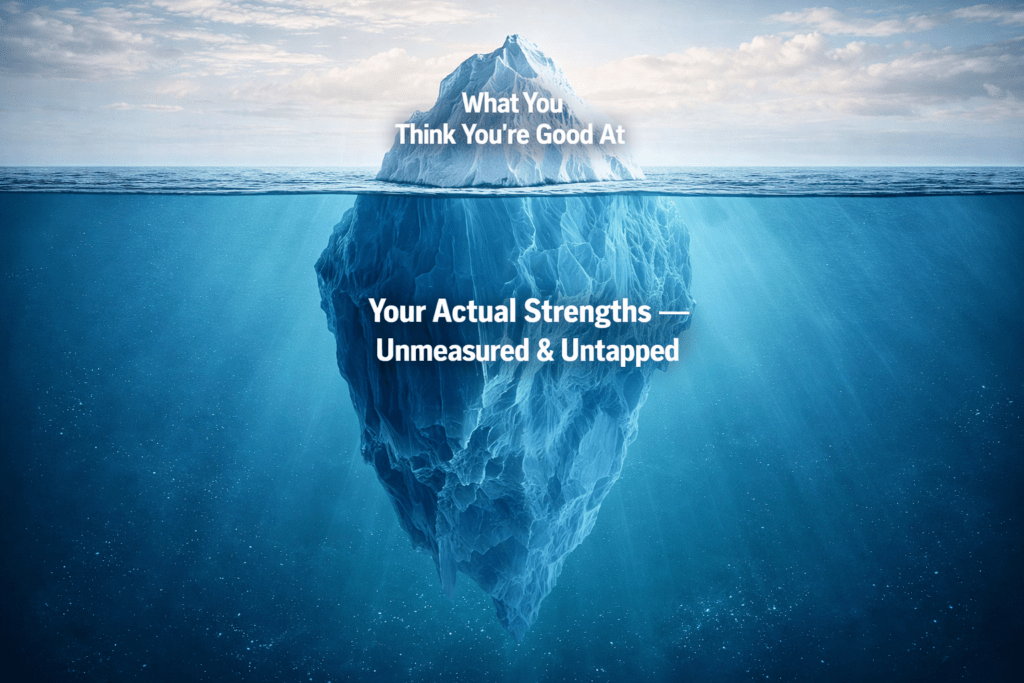
Most people move through their careers making decisions based on what they think they are good at, not what they have actually verified. That gap — between assumption and evidence — is where opportunity quietly disappears. Until you genuinely know your strengths, every career decision you make is essentially a guess dressed up as a plan.
The cost of that guesswork is higher than most people realize, and it compounds silently over time.
You Cannot Grow What You Cannot See
There is a difference between being capable and knowing you are capable. Plenty of people walk into the wrong roles, apply to the wrong jobs, or spend years upskilling in the wrong direction — not because they lack ability, but because they never took the time to know your strengths at a foundational level.
Think about the last time you made a major career choice. Was it based on data about yourself, or was it based on a gut feeling, someone else’s opinion, or simply what was available? For most people, it is the latter. And while intuition is not useless, it is a deeply unreliable primary strategy when your livelihood is on the line.
When you do not know your strengths, you tend to undervalue what you are actually exceptional at and overinvest in areas that will never be your competitive edge. This creates a slow-drain effect on your time, energy, and career momentum.
The Hidden Price Tag of Self-Uncertainty
Not knowing where you excel carries a set of very real, measurable costs.
- Missed opportunities are the most obvious. Roles that would have been a natural fit get passed over because you did not recognize the match. Promotions go to peers who were no more talented but far clearer about what they brought to the table. Confidence is a currency, and not knowing your strengths leaves you perpetually underfunded.
- Wasted learning investment is equally damaging. The average professional today spends significant time and money on courses, certifications, and workshops. Without a clear picture of your existing strengths and gaps, much of that investment goes toward reinforcing weaknesses rather than building on natural advantages. You work harder but move slower.
- Career drift is perhaps the most invisible cost. When you do not know your strengths, you tend to follow external signals — job trends, peer choices, recruiter suggestions — rather than an internal compass. Over time, this creates a career that feels like it belongs to someone else. Engagement drops. Performance plateaus. The work starts to feel like effort rather than momentum.
The common thread across all of these costs is the same: a lack of verified, specific, honest self-knowledge.
Why Traditional Self-Assessment Falls Short
Most people have tried some version of self-assessment. A personality quiz here, a career interest inventory there. Maybe a mentor conversation or a performance review that offered generic praise. The problem is not effort — it is methodology.
Traditional methods of trying to know your strengths rely heavily on self-reporting, which is vulnerable to exactly the biases that cause the problem in the first place. You tend to rate yourself based on how you feel on a given day, how recently you succeeded or failed, and what you think you are supposed to be good at based on your background or education. Feelings are not data.
Additionally, traditional tools are largely static. They give you a snapshot answer based on a fixed questionnaire and do not account for your actual performance patterns, how you respond under pressure, or how your skill set compares against real-world benchmarks in your industry.
To genuinely know your strengths, you need a system that goes beyond what you can observe about yourself.
How AI Assessment Changes the Equation
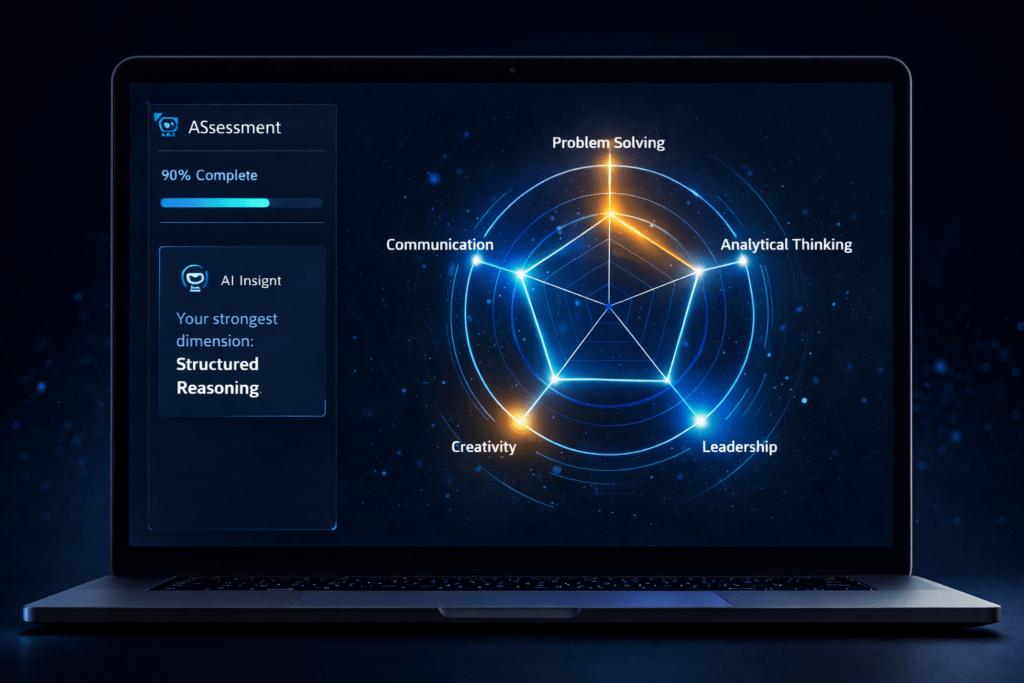
This is precisely where AI-powered assessment introduces something categorically different. Rather than asking you to describe yourself, an AI assessment observes, measures, and analyzes your performance across multiple dimensions simultaneously. It evaluates how you think, not just what you know.
When you use an AI assessment to know your strengths, you are not filling in a survey — you are engaging with an adaptive system that tracks your reasoning patterns, decision-making approaches, and performance under varied conditions. The result is not a generic personality label. It is a precise, evidence-based profile of where your abilities actually sit relative to real benchmarks.
This matters enormously. When you know your strengths with the specificity that AI assessment provides, you can align your career decisions to that data rather than to assumption. You stop guessing at fit and start engineering it.
AI assessment also surfaces what self-reflection cannot: strengths you were never aware of. Many professionals carry exceptional capabilities — in pattern recognition, structured communication, systems thinking, creative problem-solving — that they have consistently underestimated simply because no one ever measured and named them. An AI assessment does exactly that, giving you language and evidence for value you have always had but never been able to articulate.
From Insight to Action: What Changes When You Know Your Strengths
When you finally know your strengths with clarity and confidence, the effect on decision-making is immediate.
Job applications become more targeted. Instead of applying broadly and hoping, you apply strategically to roles where your verified strengths create real alignment. Your confidence in interviews changes because you are no longer presenting assumptions — you are presenting evidence.
Skill development becomes more efficient. Once you know your strengths, you understand which capabilities to amplify and which gaps to close. Learning stops being random and becomes purposeful. You invest where it actually moves the needle.
Perhaps most importantly, career ownership shifts. When you know your strengths at this level, you stop waiting for someone else to recognize your potential. You walk into conversations — with managers, recruiters, or collaborators — knowing exactly what you offer and why it matters.
The Right Time to Know Your Strengths Is Now
Every week you spend without a clear, data-backed picture of your capabilities is a week where decisions are being made on incomplete information. Whether you are a student entering the workforce, a professional eyeing a transition, or someone who simply wants to grow faster and smarter — the foundation is the same. You have to know your strengths before you can fully deploy them.
Newtum is launching an AI Assessment tool designed to do exactly this: give you the clarity, specificity, and confidence that come from truly knowing what you are exceptional at. Because the careers that compound — the ones that feel both successful and meaningful — are built on self-knowledge, not self-assumption.
Stay tuned. The tool that helps you know your strengths is almost here.
About The Author