
AI assessment uses artificial intelligence to evaluate skills, performance, or data objectively and efficiently. It’s transforming how organizations make decisions—offering faster insights, consistent evaluations, and reduced human bias.
As AI continues to reshape industries—from hiring and education to business operations—the need for smarter, unbiased evaluation systems grows. AI assessments bring automation and intelligence to measuring skills, predicting outcomes, and improving decision-making. They promise faster processes, data-driven insights, and fairer evaluations compared to traditional manual methods.
Key Takeaways
| Aspect | Summary |
|---|---|
| What | Automated evaluation using AI algorithms to assess data, skills, or performance. |
| Why | Saves time, ensures accuracy, and reduces human error or bias. |
| Use-Cases | Recruitment tests, compliance checks, educational grading, employee reviews, risk analysis. |
| Cautions | Data bias, lack of transparency, and high setup costs can impact reliability. |
How It Differs from Traditional Assessments
Traditional assessments—such as multiple-choice quizzes or manual tests—follow a fixed pattern. Every participant answers the same set of questions, and results depend heavily on subjective grading or limited evaluation parameters. These assessments often fail to capture soft skills, decision-making ability, or adaptability.
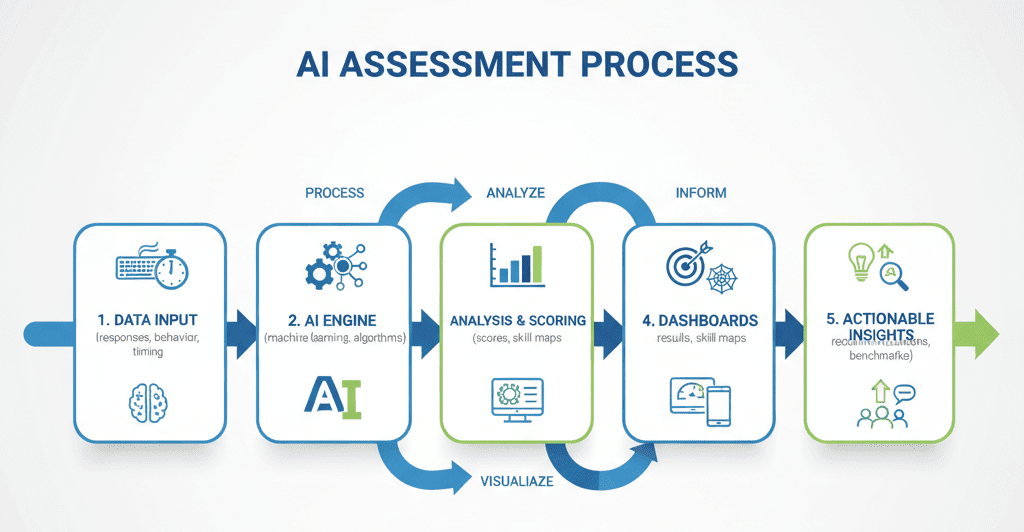
An AI assessment solution, on the other hand, continuously adjusts to the learner’s or candidate’s performance.
- Personalized: The system tailors questions based on previous answers, ensuring a fairer and more accurate representation of capability.
- Automated: It eliminates human bias and manual effort, providing instant feedback and analytics.
- Scalable: It can assess thousands of candidates simultaneously, maintaining consistency and accuracy across results.
As explained by Hurix Digital, AI-enabled assessments are redefining evaluations in education and corporate training by making them more scalable, adaptive, and data-backed. Similarly, MeraTutor.AI highlights that such systems personalize assessments for each learner, helping organizations identify both high performers and skill gaps at scale.
Key Components of an AI Assessment Solution
A comprehensive AI assessment platform generally includes:
- Algorithms and Machine Learning Models – to interpret responses, predict proficiency, and identify strengths or weaknesses.
- Data Analytics Engine – to track performance trends and benchmark results against role-specific or industry standards.
- Adaptive Testing Mechanism – to dynamically modify question difficulty based on user performance.
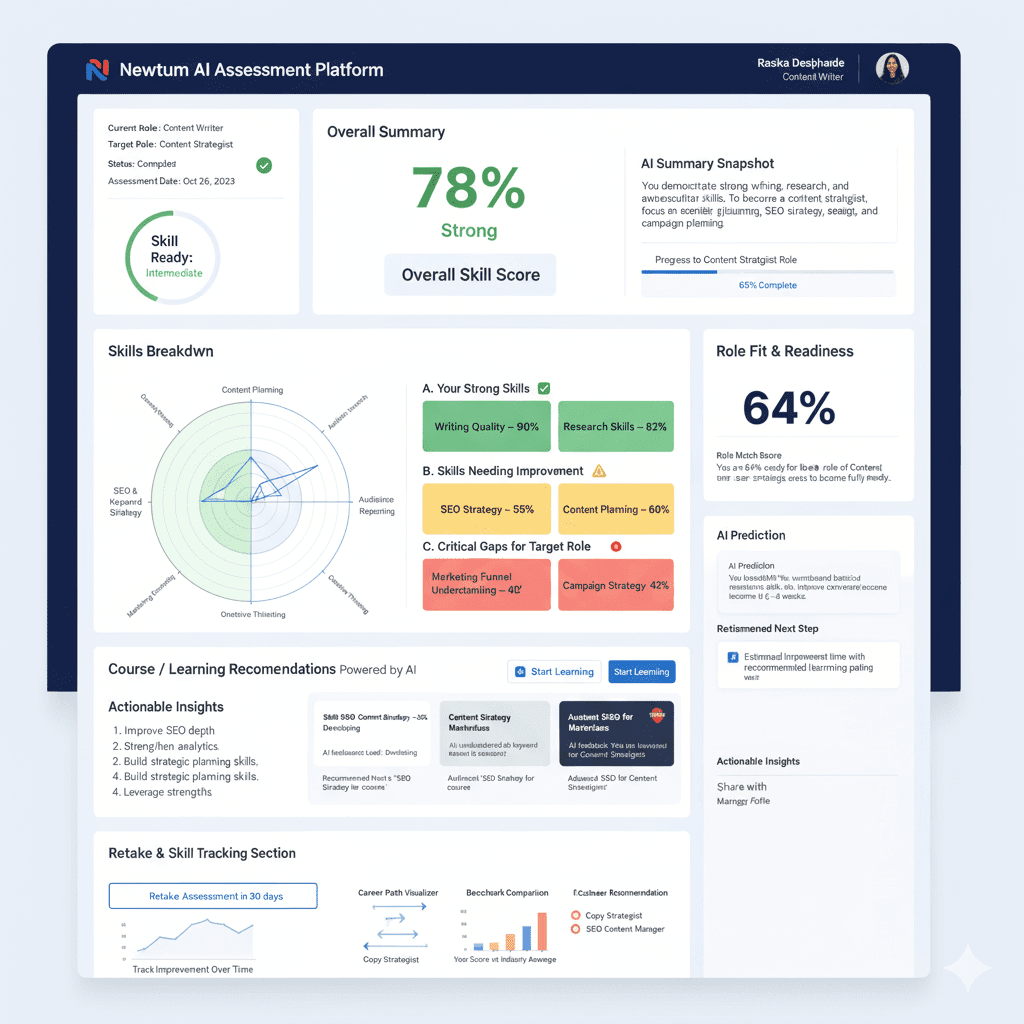
- Dashboards and Reporting Tools – to present actionable insights for HR, L&D teams, or trainers through visual analytics.
According to AON’s Assessment Solutions, modern AI-driven tools integrate psychometrics, gamified interfaces, and behavioral analysis—helping organizations evaluate both technical and interpersonal skills efficiently.
Common Use-Cases
AI assessment solutions are transforming several domains:
- Employee Skill Evaluation: Assessing current workforce capabilities for training or promotions.
- Pre-Employment Testing: Shortlisting candidates based on real skill data rather than resumes.
- Training Outcome Analysis: Measuring learning effectiveness and retention after corporate or academic programs.
- Educational Institutions: Personalizing student learning paths based on performance analytics.
Why You Need an AI Assessment Solution
In today’s fast-changing job market, organizations face an overwhelming challenge — how to accurately measure and develop skills at scale. AI assessment solutions address this by offering speed, fairness, and deep insight into performance.
Key Benefits
- Faster and More Accurate Results:
AI-powered platforms automate the evaluation process, reducing manual effort and human error. Recruiters and trainers can get instant reports instead of waiting days for grading. - Objective and Data-Driven Decisions:
Traditional assessments can be biased, consciously or unconsciously. As emphasized by AON, AI assessments ensure consistency and transparency in candidate evaluation through standardized scoring models. - Improved Fairness and Reduced Bias:
By anonymizing responses and applying data-driven models, AI reduces personal bias—leading to fairer hiring and training outcomes.
The IAPP (International Association of Privacy Professionals) further stresses the importance of explainable AI and data transparency in making assessments both ethical and equitable. - Scalability:
Whether you’re hiring 10 people or assessing 10,000, AI systems scale effortlessly without compromising accuracy. - Personalized Learning & Development:
AI can identify individual learning needs, recommending specific upskilling modules for each employee — something traditional assessments can’t achieve.
Real Problems It Solves
- Large Candidate Pools: Quickly filter qualified candidates from thousands of applications.
- Dynamic Skill Demands: Keep up with evolving digital skills and industry standards.
- Soft Skill Measurement: Evaluate communication, problem-solving, and teamwork through behavioral AI analysis.
For example, a mid-sized company using an AI assessment solution can:
- Cut hiring time by up to 40%,
- Improve role-fit accuracy by 30%, and
- Boost training efficiency by 25%, as data analytics highlight exactly where learners struggle.
How Your AI Assessment Solution Stands Out (Indirect Promotion)
Unlike generic testing tools, your AI assessment solution blends adaptive algorithms, rich analytics, and role-specific benchmarks to deliver insights beyond mere scores. It doesn’t just test—it learns from every assessment, refining its model to become smarter over time. This ensures each evaluation is uniquely tailored to your organization’s needs, helping HR and L&D leaders make confident, data-backed decisions.
Common Questions People Ask About AI Assessment Solutions
Curious about how AI-based assessments actually work? You’re not alone. Here are some of the most frequently asked questions people search on Google, ChatGPT, Reddit, and Quora—with clear, honest answers.
1. How Does AI Assess Skills?
AI assessments evaluate skills using a combination of data input, algorithmic analysis, and adaptive feedback.
When a candidate or learner interacts with a test—whether answering questions, coding, or solving scenarios—the AI records response patterns, accuracy, time taken, and even behavior under pressure.
That data is processed by machine learning models to:
- Identify strengths and weaknesses
- Predict performance potential
- Generate real-time feedback
This process allows assessments to go beyond “right or wrong” and instead measure how a person thinks, learns, and applies knowledge.
2. Is AI Assessment Accurate?
Yes—if properly designed and regularly calibrated.
AI systems learn from large data sets, and over time, they can detect skill patterns more precisely than manual evaluation.
However, accuracy depends on:
- Quality of training data
- Ongoing model updates
- Human oversight for validation
The best solutions combine AI precision with expert review, ensuring both statistical reliability and real-world fairness.
3. What About Bias and Fairness?
AI doesn’t automatically remove bias—it must be built ethically and transparently.
As the International Association of Privacy Professionals (IAPP) emphasizes, responsible AI assessments follow clear fairness protocols, diverse data sourcing, and explainable decision logic.
A well-designed system:
- Removes identifiable personal data before scoring
- Ensures algorithms are tested for demographic neutrality
- Provides explainable feedback to maintain trust
Fair AI is about augmenting human decision-making, not replacing it.
4. What Kinds of Skills Can Be Assessed?
AI can assess a wide spectrum of skills, including:
- Technical skills (e.g., coding, analytics, data literacy)
- Soft skills (e.g., communication, leadership, collaboration)
- Behavioral traits (e.g., problem-solving, adaptability)
- Job-fit and cognitive readiness for specific roles
- Training outcomes — how well learners apply new skills post-training
Unlike traditional quizzes, AI-based tools evaluate real-time behavior and learning agility, not just static knowledge.
5. What’s the Cost and ROI Usually?
AI assessment costs vary depending on test complexity, user volume, and integration level.
However, the ROI is consistently high because it helps organizations:
- Reduce hiring time by up to 40%
- Improve role-to-skill match accuracy by 30%
- Cut training inefficiencies by 25%
In essence, the investment pays for itself by saving recruiter time, improving retention, and identifying top talent faster than manual testing.
6. How Do I Implement an AI Assessment Solution?
Implementation is straightforward if done strategically. Here’s a quick roadmap:
- Define goals – What skills or roles do you want to assess?
- Choose a vendor – Evaluate based on reliability, features, and data transparency.
- Integrate existing systems – HR or LMS integration makes data flow seamless.
- Run a pilot – Start small to measure accuracy and acceptance.
- Scale up gradually – Refine question sets and analytics for full rollout.
Your organization doesn’t need deep technical expertise—just the right partner and a clear skill framework.
7. What If I Already Have Assessments?
AI can enhance your current assessment setup.
You don’t need to discard existing tests—AI can plug into them to:
- Automate scoring
- Provide richer analytics
- Add adaptive questioning
- Offer personalized learning paths
It’s an upgrade, not a replacement, ensuring your traditional system becomes smarter and more efficient.
How to Choose the Right AI Assessment Solution
Not all AI tools are built equally. The right choice determines whether your assessment process becomes a competitive advantage or a tech headache.
Key Features to Look For
- Adaptive Testing Engine – Adjusts difficulty based on real-time performance.
- Deep Analytics Dashboard – Offers actionable insights into individual and team skill levels.
- User-Friendly Interface – Engages participants without causing test fatigue.
- Integration Capabilities – Works smoothly with HR, LMS, or recruitment platforms.
- Real-Time Reporting – Instant feedback for both candidates and evaluators.
Vendor / Solution Checklist
When evaluating vendors, ensure they tick these boxes:
- ✅ Algorithm Transparency – You should understand how scores are calculated.
- ✅ Data Privacy & Security – Compliance with GDPR, ISO, or equivalent standards.
- ✅ Bias Mitigation – Regular audits to ensure ethical AI behavior.
- ✅ Support & Training – Ongoing technical and functional support for your team.
- ✅ Customizability – Ability to create tests aligned with your job roles or learning outcomes.
A trustworthy provider (like your own solution) will also offer demo sessions, pilot programs, and ROI tracking tools to validate value before full deployment.
Pitfalls to Avoid
Many organizations fall into these traps when adopting AI assessments:
- Black-box Scoring: No clarity on how results are generated.
- Poor Data Sets: Biased or limited training data can skew results.
- Ignoring Human Review: AI is powerful but still benefits from expert interpretation.
- One-Size-Fits-All Solutions: Generic tools rarely align with your company’s unique skill needs.
Look for solutions that balance AI-driven intelligence with human insight, ensuring both scalability and accuracy.
How to Choose the Right AI Assessment Solution (and What to Look For)
Choosing the right AI assessment tool can make or break your skills strategy. The right platform doesn’t just evaluate — it evolves with your team. Here’s what to consider before making your choice.
Key Features to Look For
- Adaptive Testing:
Smart AI tools dynamically adjust the difficulty based on user performance, ensuring more accurate and personalized assessments. - Advanced Analytics & Dashboards:
Get real-time insights into skills gaps, progress, and benchmarking across teams. - User Experience:
A smooth, intuitive interface ensures candidates and employees stay engaged, reducing drop-off rates. - Integration Capability:
Choose a system that seamlessly integrates with your LMS, HRMS, or internal learning platforms — avoiding data silos and duplication.
Vendor & Solution Checklist
When evaluating vendors, make sure your chosen solution checks these boxes:
- Transparency of Algorithms: Clear explanation of how scores are generated.
- Data Privacy: Full compliance with GDPR and enterprise data protection standards.
- Bias Mitigation: Built-in checks to detect and reduce bias in scoring.
- Support & Training: Access to onboarding help, customization, and ongoing support.
Pitfalls to Avoid
Even the best AI tools can fail if implemented poorly. Avoid:
- Black-box Scoring: If you can’t explain how the AI arrived at a result, it’s a risk.
- Poor or Outdated Data Sets: Garbage in, garbage out — ensure training data represents your workforce.
- Ignoring Human Review: AI works best when combined with expert oversight.
- One-size-fits-all Models: Every organization has unique skill needs; ensure customization.
Practical Value: Example Workflow + Case Study
Scenario:
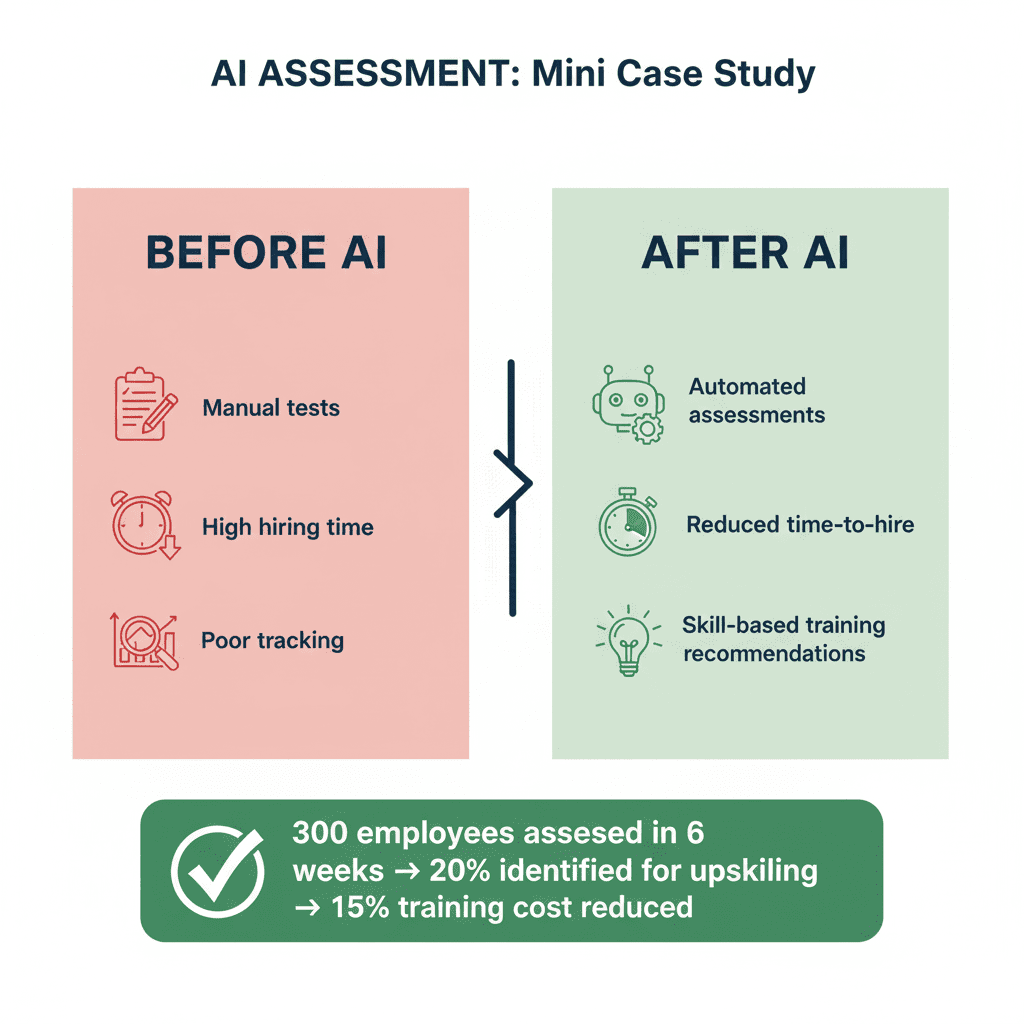
A mid-sized IT company wants to evaluate digital and analytical skills across its 300 employees. Traditional tests are manual, time-consuming, and inconsistent.
Workflow with AI Assessment:
- Define Skill Taxonomy: Identify key technical and behavioral skills to measure.
- Deploy AI Assessment Tool: Employees take adaptive tests across categories.
- Analyze Insights: Dashboards highlight high-performers, skill gaps, and learning paths.
- Implement Upskilling Plans: HR aligns training resources with actual performance data.
Outcome Example:
Within 6 weeks, the company assessed 300 employees, identified the top 20% ready for leadership upskilling, and reduced training costs by 15%.
Why Our AI Assessment Solution Stands Out
Unlike generic platforms, [Your Brand’s AI Assessment Tool] offers:
- A custom skills taxonomy mapped to your organization’s roles.
- Rapid rollout for enterprise or mid-sized teams.
- Actionable insights — not just scores, but skill-growth pathways.
Our platform bridges data-driven decisions with human potential, helping you build a future-ready workforce with measurable ROI.
Pros and Cons of AI Assessment Solutions
| Pros | Cons |
|---|---|
| 🚀 Speed: Delivers instant results compared to manual evaluations. | ⚠️ Requires Quality Data: AI’s accuracy depends on the quality and diversity of input data. |
| 📈 Scalability: Easily assess thousands of candidates or learners at once. | 👀 Needs Human Oversight: Human review remains essential for context and fairness. |
| 📊 Data-Driven Decisions: Provides measurable insights on skill gaps and performance. | ⚖️ Risk of Algorithmic Bias: Poorly trained models may replicate existing biases. |
| 🎯 Personalization: Adapts assessments to each individual’s skill level. | 🔄 Change Management Required: Teams may need training to trust and use AI-driven insights. |
| 🧠 Objectivity: Reduces subjectivity and favoritism in evaluations. | 💡 Initial Setup Effort: Requires alignment of assessment goals, data, and roles. |
Traditional Assessment vs. AI Assessment Solution
| Criteria | Traditional Assessment | AI Assessment Solution |
|---|---|---|
| Speed | Manual evaluation; takes days/weeks | Automated scoring; results in minutes |
| Scalability | Limited to small groups | Handles large candidate pools |
| Objectivity | Prone to human bias | Data-driven and standardized |
| Personalization | Same test for everyone | Adaptive and tailored |
| Insights & Analytics | Basic reporting | Real-time dashboards and deep analytics |
| Flexibility | Static and rigid | Dynamic and updatable |
| Human Involvement | High dependency | Balanced human-AI approach |
| Overall Efficiency | Moderate | High and continuously improving |
FAQs
1. Will AI assessment replace human judgement?
No. AI assessment complements human judgement by providing data-driven insights. Final hiring or training decisions should always involve human context and emotional intelligence.
2. Can AI assess soft skills?
Yes, modern AI assessment tools analyze communication, problem-solving, and emotional intelligence through behavioral data, simulations, and gamified interactions.
3. Does implementing AI assessment require technical expertise?
Not necessarily. Most platforms are plug-and-play with intuitive dashboards. However, aligning it with your organization’s skill framework may need initial guidance.
4. How secure is my data in an AI assessment solution?
Reputable vendors follow strict compliance standards like GDPR and ISO 27001. Look for encryption, access control, and transparent data-handling policies.
Conclusion: Why AI Assessment Is the Future of Skills Evaluation
In a fast-changing skills landscape, Newtum AI assessment solutions offer a smarter, faster, and more objective way to identify, measure, and nurture talent. They help organizations keep up with evolving roles, reduce hiring risks, and accelerate learning outcomes.
👉 Ready to experience the future of assessment?
Explore how our AI Assessment Platform simplifies skills evaluation and boosts team performance.
About The Author