
Understanding ‘Behavioral Patterns in Java’ is crucial for writing flexible and efficient code. These patterns help tackle complex issues like communication between objects, managing algorithms, and handling responsibilities. By mastering them, you’ll enhance your coding skills significantly. Curious to learn more? Keep reading to dive deeper into these vital concepts.
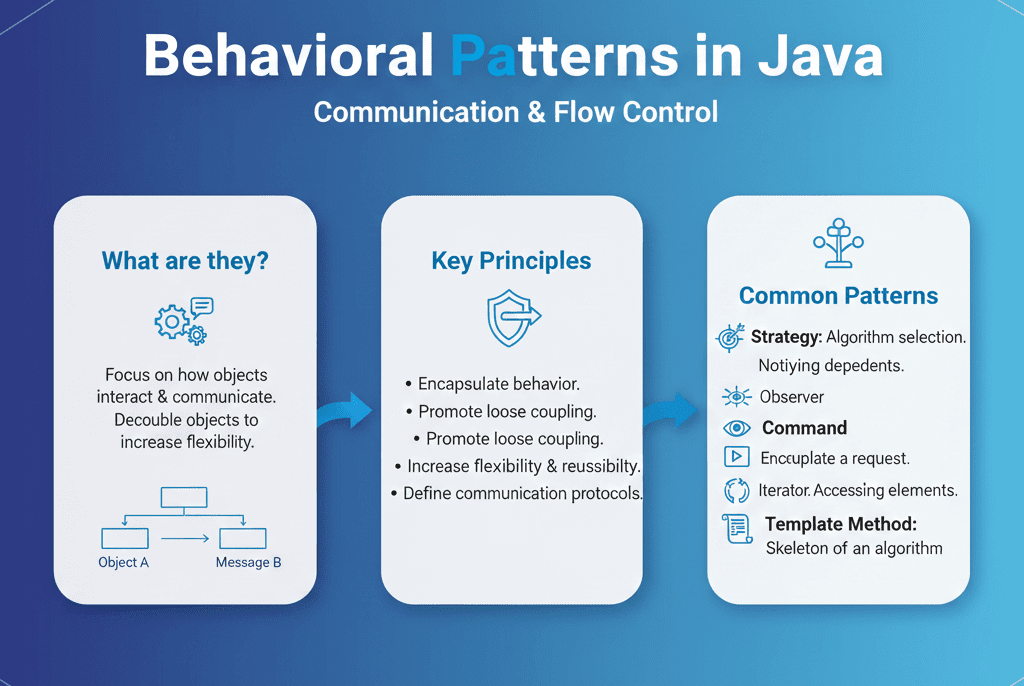
What is ‘Behavioral Patterns in Java’?
Have you ever wondered how objects in your Java code communicate with each other? That’s where ‘Behavioral Patterns in Java’ come into play. These patterns focus on the interaction and communication between objects, making your code more flexible and enhancing its responsibility distribution. Think of them as the bridge that ensures each part of your program can exchange information efficiently. There are several key behavioral patterns, like Observer, Strategy, and Command, each serving different purposes, such as notifying changes, switching algorithms, or issuing commands. They’re foundational in crafting code that’s not only well-organised but also easy to maintain and extend.
java
interface Strategy {
    void execute();
}

class ConcreteStrategyA implements Strategy {
    public void execute() {
        System.out.println("Executing Strategy A");
    }
}

class Context {
    private Strategy strategy;

    public void setStrategy(Strategy strategy) {
        this.strategy = strategy;
    }

    public void executeStrategy() {
        strategy.execute();
    }
}
Behavioral Patterns in Java Coding
java
import java.util.ArrayList;
import java.util.List;

// Observer Pattern Example
interface Observer {
    void update(String message);
}

class ConcreteObserver implements Observer {
    private String name;

    public ConcreteObserver(String name) {
        this.name = name;
    }

    @Override
    public void update(String message) {
        System.out.println(name + " received message: " + message);
    }
}

class Subject {
    private List observers = new ArrayList<>();

    public void addObserver(Observer observer) {
        observers.add(observer);
    }

    public void removeObserver(Observer observer) {
        observers.remove(observer);
    }

    public void notifyObservers(String message) {
        for (Observer observer : observers) {
            observer.update(message);
        }
    }
}

// Strategy Pattern Example
interface Strategy {
    int execute(int a, int b);
}

class AdditionStrategy implements Strategy {
    @Override
    public int execute(int a, int b) {
        return a + b;
    }
}

class SubtractionStrategy implements Strategy {
    @Override
    public int execute(int a, int b) {
        return a - b;
    }
}

class Context {
    private Strategy strategy;

    public Context(Strategy strategy) {
        this.strategy = strategy;
    }

    public void setStrategy(Strategy strategy) {
        this.strategy = strategy;
    }

    public int executeStrategy(int a, int b) {
        return strategy.execute(a, b);
    }
}

// Template Method Pattern Example
abstract class AbstractClass {
    public void templateMethod() {
        primitiveOperation1();
        concreteOperation();
        primitiveOperation2();
    }

    protected abstract void primitiveOperation1();

    protected abstract void primitiveOperation2();

    private void concreteOperation() {
        System.out.println("Concrete operation in AbstractClass");
    }
}

class ConcreteClass extends AbstractClass {
    @Override
    protected void primitiveOperation1() {
        System.out.println("Primitive Operation 1 implemented by ConcreteClass");
    }

    @Override
    protected void primitiveOperation2() {
        System.out.println("Primitive Operation 2 implemented by ConcreteClass");
    }
}

// Main method to demonstrate the patterns
public class BehavioralPatternsDemo {
    public static void main(String[] args) {
        // Observer Pattern
        Subject subject = new Subject();
        Observer observer1 = new ConcreteObserver("Observer 1");
        Observer observer2 = new ConcreteObserver("Observer 2");

        subject.addObserver(observer1);
        subject.addObserver(observer2);

        subject.notifyObservers("Hello, Observers!");

        // Strategy Pattern
        Context context = new Context(new AdditionStrategy());
        System.out.println("Addition: " + context.executeStrategy(3, 4));

        context.setStrategy(new SubtractionStrategy());
        System.out.println("Subtraction: " + context.executeStrategy(9, 2));

        // Template Method Pattern
        AbstractClass abstractClass = new ConcreteClass();
        abstractClass.templateMethod();
    }
}
Explanation of the Code
The code given demonstrates three behavioural design patterns in Java: Observer, Strategy, and Template Method. Let’s break them down for clarity:
- Observer Pattern: The `Observer` interface listens to updates. `ConcreteObserver` implements this interface, reacting to messages. A `Subject` holds observers and can notify them when needed. It’s like a newsletter where subscribers (observers) get notifications when there’s new content.
- Strategy Pattern: This involves the `Strategy` interface, where `AdditionStrategy` and `SubtractionStrategy` provide different implementations of calculations. The `Context` class utilizes these strategies, allowing dynamic swapping, akin to changing tools in a toolbox for different tasks.
- Template Method Pattern: `AbstractClass` outlines a common sequence of steps but defers some to subclasses (`ConcreteClass`). This is like a cooking recipe template where specific ingredients or steps can vary.
The main method showcases these patterns, making them applicable in different scenarios. These patterns help organise code for better maintainability and flexibility.
Output
Observer 1 received message: Hello, Observers!
Observer 2 received message: Hello, Observers!
Addition: 7
Subtraction: 7
Concrete operation in AbstractClass
Primitive Operation 1 implemented by ConcreteClass
Primitive Operation 2 implemented by ConcreteClass
Learn How Do Structural Design Patterns in Java Work?
Harnessing Behavioral Patterns in Java for Practical Applications
- Netflix & Recommendation System:
Netflix uses behavioral patterns to personalize the user experience, enhancing its recommendation system by predicting what shows a user might enjoy watching next.
Outputs: Increased user engagement by curating personalized content.interface RecommendationStrategy { List recommend(User user); } class CollaborativeFiltering implements RecommendationStrategy { public List recommend(User user) { // Logic for recommending based on similar users' choices } } class ContentBasedFiltering implements RecommendationStrategy { public List recommend(User user) { // Logic for recommending based on previously watched content } } class RecommendationContext { private RecommendationStrategy strategy; public void setStrategy(RecommendationStrategy strategy) { this.strategy = strategy; } public List executeStrategy(User user) { return strategy.recommend(user); } } RecommendationContext context = new RecommendationContext(); context.setStrategy(new CollaborativeFiltering()); List recommendations = context.executeStrategy(currentUser); - Amazon & Shopping Cart Updates:
Behavioral patterns help manage the state of a shopping cart as users add or remove items, providing a seamless shopping experience.
Outputs: Real-time updates reflecting on user’s cart, enhancing user satisfaction.interface CartState { void updateCart(CartContext context, Item item); } class ItemAddedState implements CartState { public void updateCart(CartContext context, Item item) { // Logic for adding item to cart } } class ItemRemovedState implements CartState { public void updateCart(CartContext context, Item item) { // Logic for removing item from cart } } class CartContext { private CartState state; public void setState(CartState state) { this.state = state; } public void executeUpdate(Item item) { state.updateCart(this, item); } } CartContext context = new CartContext(); context.setState(new ItemAddedState()); context.executeUpdate(new Item("Laptop")); - Spotify & Playlists:
Spotify employs behavioral patterns to sort and organize playlists dynamically, tailoring them to user preferences.
Outputs: Enhanced user experience by providing dynamic and relevant song orders.interface SortStrategy { void sort(List playlist); } class SortByPopularity implements SortStrategy { public void sort(List playlist) { // Logic for sorting by popularity } } class SortByReleaseDate implements SortStrategy { public void sort(List playlist) { // Logic for sorting by the date of release } } class PlaylistContext { private SortStrategy strategy; public void setStrategy(SortStrategy strategy) { this.strategy = strategy; } public void executeSort(List playlist) { strategy.sort(playlist); } } PlaylistContext context = new PlaylistContext(); context.setStrategy(new SortByPopularity()); context.executeSort(myPlaylist);
Behavioral Patterns in Java Interview Questions
- What’s the simplest way to understand the Observer Pattern?
Picture a game streaming platform. The player (subject) broadcasts live, while subscribers (observers) get real-time notifications whenever there’s an update. Java’s built-in libraries, withjava.util.Observerandjava.util.Observable, make implementing this a breeze. - Can the Strategy Pattern improve my game development code?
Think of a game character with different attack strategies—say, melee and long-range. The Strategy Pattern allows you to easily switch or extend these strategies at runtime, adding flexibility to your game design process. - What is the difference between the Command Pattern and a simple function call?
The Command Pattern encapsulates a request as an object, allowing for parameterization, queuing, and logging, unlike direct function calls. It enables features like undoable operations and complex command sequences. - How does the Template Method Pattern simplify software development?
By defining the skeleton of an algorithm in a base class but deferring specific steps to subclasses, the Template Method Pattern promotes code reuse and tackles redundancy, simplifying maintenance and enhancing consistency across projects. - When should you use Visitor Pattern?
Use it when operations on object structures need to be performed without modifying the classes of the elements, enabling flexible operation implementations and scenarios where multiple disparate operations are required. - Why is the Iterator Pattern critical in Java?
It provides a uniform way to traverse collections without exposing the underlying collection’s specifics, hence boosting encapsulation and handling complex data structures efficiently. - Does the State Pattern have any real-world application?
Yes, ATM operations provide a real-world example, where each action depends on the ATM’s current state, like idle or transaction initiated, and transitions seamlessly between states using the State Pattern. - How can the Chain of Responsibility Pattern be beneficial in handling requests?
It passes requests along a chain of handlers until one handles it, akin to filtering processes in input systems, enhancing flexibility in request processing without the necessity of code alterations.
Experience the future of coding with our AI-powered Java online compiler. Instantly write, run, and test your code, harnessing the power of AI for real-time feedback and enhanced learning. Dive into seamless coding with minimal effort, letting technology streamline your programming journey and bring your Java projects to life.
Conclusion
Completing ‘Behavioral Patterns in Java’ provides a robust understanding of design patterns, which makes your code more efficient and maintainable. It’s a significant step toward mastering Java and other languages. Ready to expand your coding skills? Discover more at Newtum and take the next leap in your journey!
Edited and Compiled by
This article was compiled and edited by @rasikadeshpande, who has over 4 years of experience in writing. She’s passionate about helping beginners understand technical topics in a more interactive way.
About The Author