There is something quietly frustrating about following a learning path that was designed for someone else. You sit through explanations of concepts you already grasp. You rush past ideas that deserve more time. You receive feedback that feels generic and entirely disconnected from how your mind actually works. For decades, this has been the default experience of education — broad enough to serve the many, specific enough to serve almost no one.
That frustration is exactly what AI personalized learning assessment is built to eliminate.
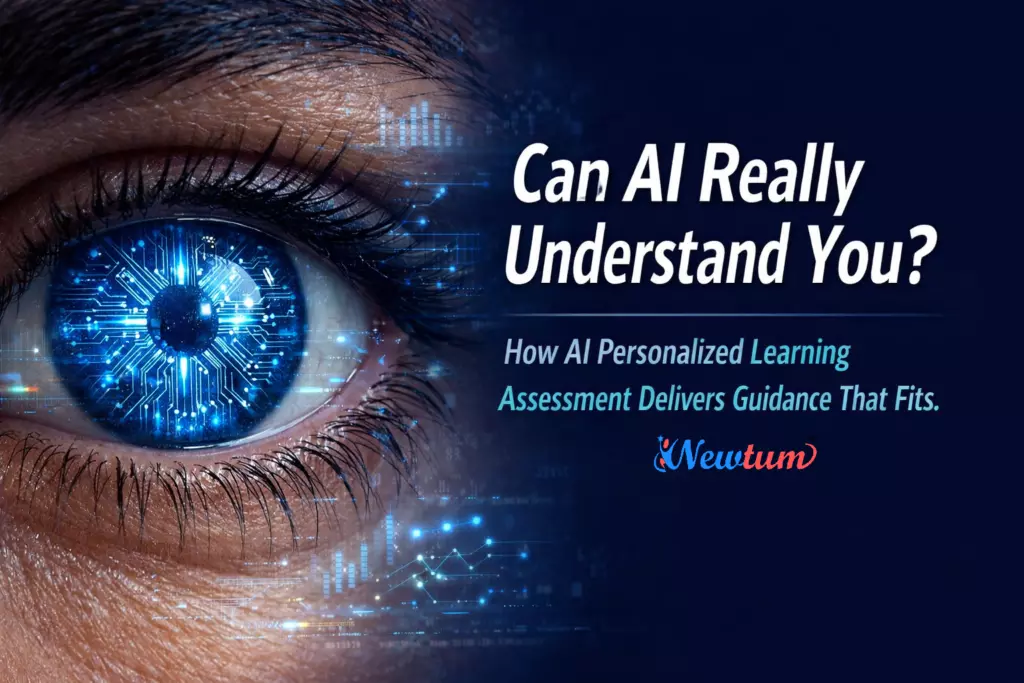
The question people are beginning to ask is not just whether AI can test what you know — but whether it can genuinely understand how you think, where you struggle, and what kind of guidance will actually move you forward. The answer, increasingly, is yes.
What Does It Mean for AI to “Understand” a Learner?
Understanding, in the human sense, involves attention, pattern recognition, and the ability to respond differently to different people. For a long time, technology could deliver content and score answers, but it could not adjust based on how a person was actually learning.
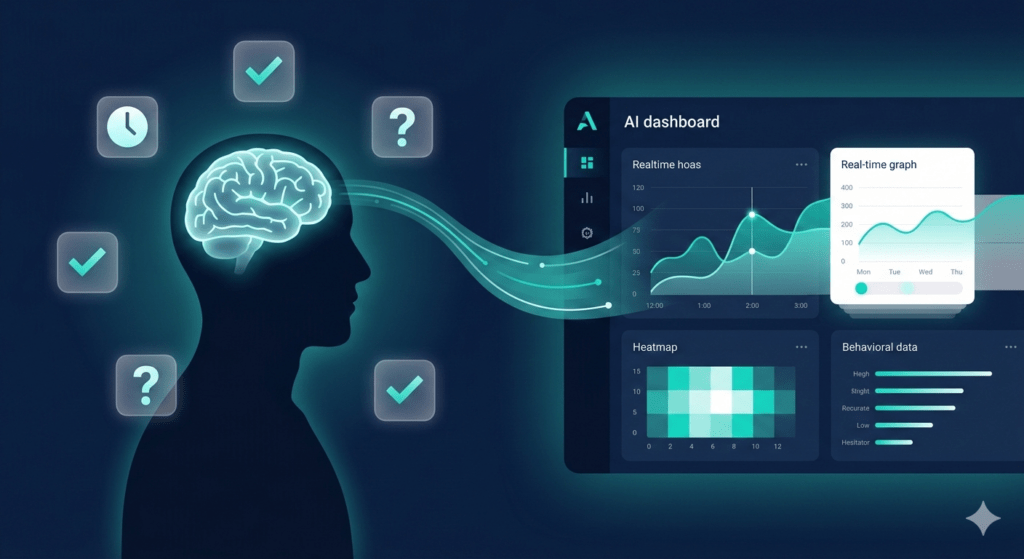
AI personalized learning assessment changes this by doing something fundamentally different from traditional testing. It does not just measure whether you got an answer right or wrong. It tracks how you got there — how long you paused before responding, which problem types you consistently approach from the wrong direction, where your accuracy drops under time pressure, and how your performance shifts across different formats.
This is not assessment as a snapshot. It is assessment as an ongoing conversation between the learner and the system — one that builds a progressively accurate picture of how a specific person processes and retains knowledge.
How AI Personalized Learning Assessment Reads Your Patterns
Every learner has a fingerprint — a genuine, measurable pattern of cognitive behavior that shows up consistently across how they engage with problems.
AI personalized learning assessment identifies this fingerprint by analyzing dozens of behavioral data points simultaneously. It notices when you answer quickly and correctly (genuine fluency) versus quickly and incorrectly (an overconfident gap). It detects whether you struggle more with conceptual versus procedural problems. It tracks whether your accuracy improves with repetition or plateaus, revealing whether a concept needs to be reinforced differently.
These are not observations a static quiz can make. They require adaptive technology — a system that changes what it presents based on what it observes, in real time. The result is a learning profile generated through actual performance, not self-reporting.
Adaptive Feedback: Guidance That Evolves With You
One of the most powerful elements of AI personalized learning assessment is not the assessment itself but what it enables: feedback that adapts as you do.
Traditional feedback loops are largely static. You complete an exercise, receive a score, and move on. The feedback does not know whether this is a recurring error pattern or an isolated slip. Adaptive feedback, powered by continuous assessment data, is entirely different. If the system detects that you have been making the same type of conceptual error across multiple exercises, it does not simply flag the mistake — it identifies the underlying gap and surfaces a targeted explanation designed to address the root cause.
This level of specificity matters enormously for motivation too. Learners who receive feedback that feels relevant to their actual situation trust the guidance more and are more likely to act on it.
Skill Gap Mapping — Precision Over Guesswork
Most learners have a vague sense of where they are weak, but an imprecise picture of the exact nature of that weakness. “I’m bad at Python” is a feeling, not a diagnosis. It could mean you struggle with syntax, with object-oriented thinking, or with debugging logic — and each requires a different intervention.
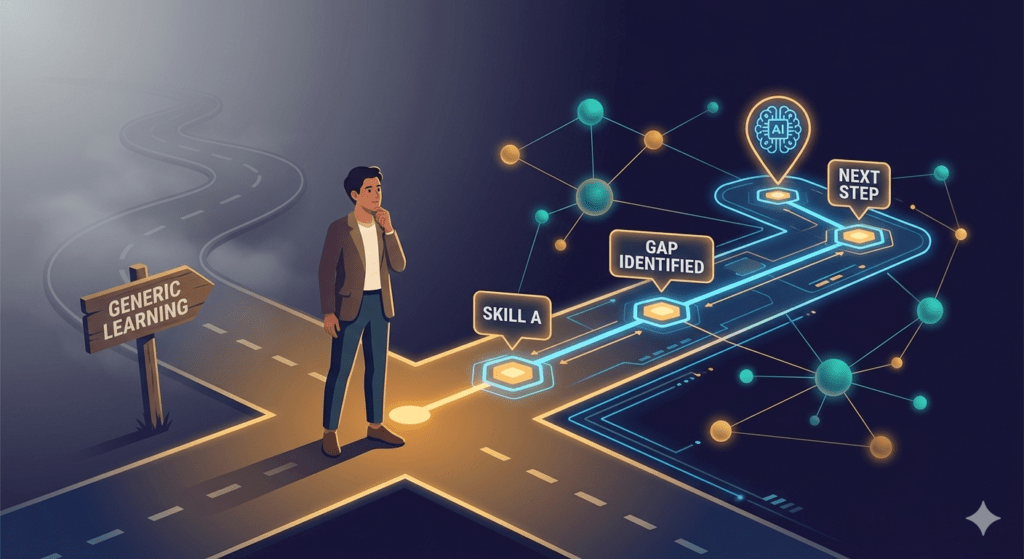
AI personalized learning assessment maps skill gaps with the granularity that transforms vague discomfort into actionable direction. Rather than identifying broad weaknesses, it isolates specific sub-skills and recommends targeted content calibrated to that exact gap. This is the difference between a general map and a navigation system. Both show you where you are. Only one tells you precisely how to get where you need to go.
Why One-Size-Fits-All Learning Is Failing Learners
Standardized learning environments are not failing because the content is poor. They fail because content alone is not enough. The pace, format, and sequence of instruction all interact with the individual in ways a fixed structure cannot accommodate.
A learner who grasps concepts quickly but forgets without spaced repetition needs something entirely different from one who absorbs slowly but retains well. When both receive identical instruction, one is bored and one is lost — and neither reaches their potential. AI personalized learning assessment treats personalization not as a feature but as a foundation, ensuring that the content, pace, and guidance remain continuously calibrated to the individual.
Real-World Impact: What Changes When Guidance Fits
Learners who receive guidance calibrated to their actual skill level and learning pattern reach competency faster. They spend less time reviewing mastered material and more time working at the productive edge of their capability — the zone where real learning happens.
For professionals upskilling in a fast-moving field, this efficiency is critical. The ability to compress a learning arc through AI personalized learning assessment means reaching job-readiness in weeks rather than months. For students, it means fewer moments of feeling lost and more moments of genuine understanding — the kind that builds lasting confidence.
What to Expect from Newtum’s Upcoming AI Assessment Tool
Not all tools that use the word “personalized” deliver genuine personalization. A truly effective AI personalized learning assessment adapts in real time based on performance, not just intake questionnaires. It tracks behavioral signals — timing, error patterns, performance variance — and produces specific, actionable output rather than broad category labels. Most importantly, it closes the loop between assessment and learning by translating results directly into targeted recommendations and progress checkpoints.
This is exactly the standard Newtum’s upcoming AI Assessment tool is being built to meet. Designed to go beyond testing and into genuine understanding of how each individual learns, it brings the precision of AI personalized learning assessment directly to learners and professionals who are ready to stop guessing and start growing with a system that truly knows them.
Conclusion — The Future of Learning Is Personal
The question of whether AI can really understand you is no longer hypothetical. AI personalized learning assessment does not replace the effort of learning — it ensures that effort is directed precisely where it will have the most impact. For anyone who has ever felt under-served by a learning experience that did not see them clearly, this shift is not just a convenience. It is a restoration of what great teachers have always offered: the experience of being understood well enough to be guided well.
Stay tuned to Newtum. A smarter, more personal way to learn is almost here.
About The Author