Code moves fast now. Too fast.
With AI tools shipping thousands of lines in a single afternoon, your review window has narrowed dramatically. A pull request that once took a week to write might now land on your desk in two hours, generated by Copilot, Cursor, or Claude, looking perfectly syntactically valid. But syntactically valid code is not functionally correct code.
That is the testing gap no one prepared for.
AI QA engineering is the discipline that fills this gap. It is not a separate role that only QA specialists handle. It is a skill set that every developer, junior or senior must actively build as AI accelerates delivery pipelines beyond what manual review can absorb.
This post covers what AI QA engineering actually is, why it matters right now, and exactly what you need to learn to stay ahead of the code your AI is writing faster than you can read.
What Is AI QA Engineering?
AI QA engineering refers to the practice of using artificial intelligence to design, generate, execute, and continuously improve quality assurance processes across the software development lifecycle.
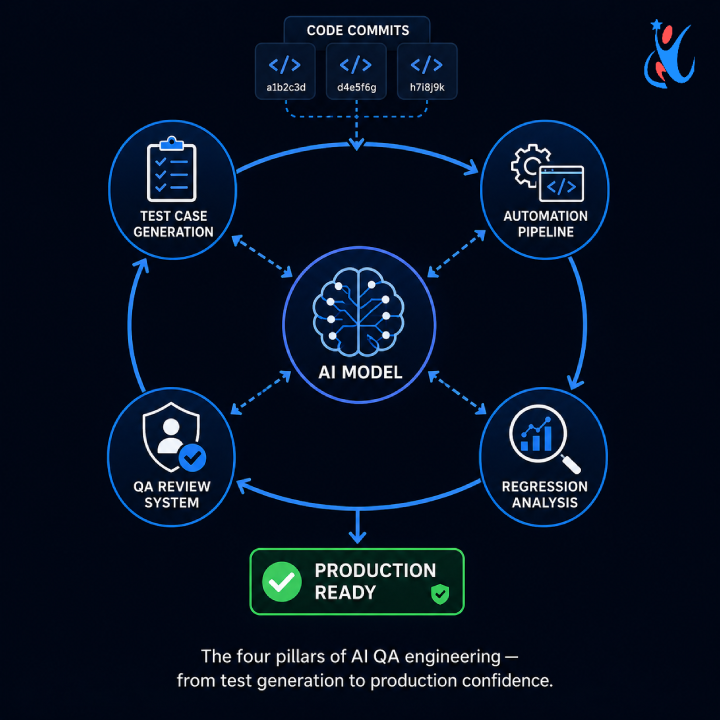
It covers four main domains:
- AI-generated test cases – using AI to produce unit tests, edge case coverage, and boundary value tests that reflect real-world risk patterns, not just the obvious happy paths.
- AI-powered automation pipelines – continuous testing systems that adapt to code changes without requiring manual test maintenance for every commit.
- AI-driven regression analysis – detecting when new code breaks existing behavior across a full system, not just at the unit level where traditional tests live.
- AI review systems – automated layers that evaluate code quality, correctness, and test coverage before a human ever opens the pull request.
Together, these four domains form the operational core of what AI QA engineering looks like in a modern development team. In 2026, teams that treat them as optional are quietly accumulating technical debt with every AI-generated commit they ship.
Why Developers Can No Longer Outsource QA Thinking
For a long time, the mental model was clean: developers write code, QA engineers test it. That division of labor worked when code moved at a human pace.
AI broke this model entirely.
When an AI assistant generates a service, a controller, and a data layer in twenty minutes, the QA team cannot keep up with the volume — even if they are also using AI. And even then, the developer is still the person closest to the intent of the code, which makes the developer the one best positioned to validate whether the output actually does what was asked.
AI QA engineering is now a developer responsibility, not a downstream handoff. Three forces are driving this shift:
- Output velocity – AI generates code faster than test suites can be written manually. The volume problem alone makes traditional QA handoffs untenable at modern delivery speeds.
- Hallucination risk – AI-generated code can appear syntactically correct while containing logical errors, phantom API calls, or undefined edge cases. Without systematic test coverage at the point of generation, these bugs reach production silently.
- Regression complexity – Every AI-generated commit can interact with existing modules in unpredictable ways, multiplying regression surface area with each push in ways that manual testing cannot scale to cover.
The developer who does not understand AI QA engineering is a developer whose AI-generated commits become a production liability. The developer who does understand it becomes the person on their team whose AI-generated code actually ships cleanly and stays clean.
AI-Generated Test Cases: How They Work and Where They Fall Short
The first practical skill in AI QA engineering is understanding how AI-generated test cases are structured — and precisely where they break down.
AI models like Copilot and GPT-4o can generate test suites rapidly when given function signatures, docstrings, or even just a brief description. Consider this example:
python
# Function
def calculate_discount(price: float, discount_percent: float) -> float:
    if discount_percent < 0 or discount_percent > 100:
        raise ValueError("Discount must be between 0 and 100")
    return price * (1 - discount_percent / 100)

# AI-generated tests (Pytest)
def test_standard_discount():
    assert calculate_discount(100.0, 10.0) == 90.0

def test_zero_discount():
    assert calculate_discount(100.0, 0.0) == 100.0

def test_full_discount():
    assert calculate_discount(100.0, 100.0) == 0.0

def test_invalid_negative():
    with pytest.raises(ValueError):
        calculate_discount(100.0, -5.0)
This provides solid surface-level coverage. But AI QA engineering at a professional level means pushing deeper. Notice what the AI likely missed:
- Floating point precision — What does
calculate_discount(199.99, 33.33)return? A long float? Does it match financial expectations at scale? - Integer input coercion — What happens when
priceis passed as an integer instead of a float? - Zero price edge case — Is
calculate_discount(0.0, 50.0)handled correctly, or does it silently return-0.0? - Extreme scale — Does the function behave correctly at values representing large financial transactions near float precision limits?
AI-generated test cases reliably cover the happy path and obvious error paths. They reliably miss the edge cases that cause production incidents. AI QA engineering skill means prompting AI more precisely — explicitly asking for boundary conditions, type coercion scenarios, floating point edge cases, and state-dependent failures.
Prompting pattern for stronger test generation:
Generate pytest tests for this function covering:
- Standard valid inputs
- Boundary conditions (min/max values for each parameter)
- Type coercion edge cases (int vs float, string input)
- Float precision scenarios at financial scale
- Invalid input combinations beyond obvious single-parameter failures
- State-dependent failures if applicable
The developer who uses this prompting pattern consistently is already practicing AI QA engineering — not just running whatever tests the AI first suggests and calling coverage done.
Building AI-Powered Automation Pipelines
A test that runs once is a snapshot. A test that runs on every commit is a safety net.
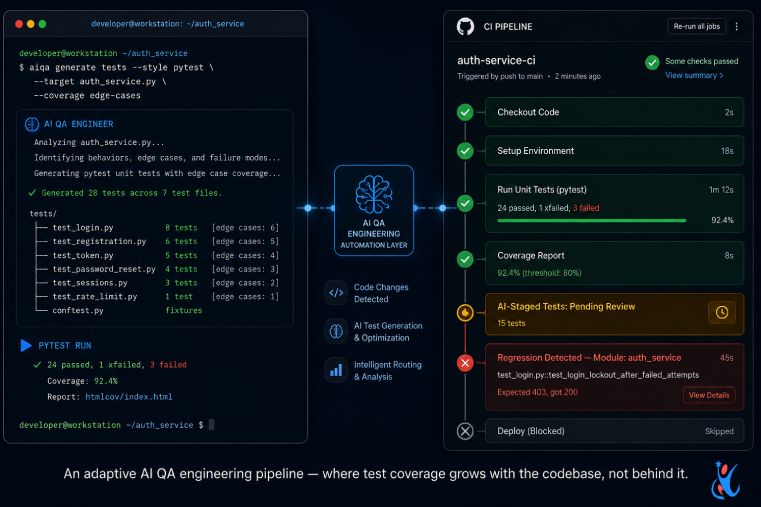
AI QA engineering includes designing automation pipelines that use AI to maintain, extend, and triage test suites as codebases evolve. The critical shift is from static CI/CD pipelines to adaptive ones.
Here is what a functional AI QA engineering automation pipeline looks like in practice:
- Step 1 — Commit hook triggers AI test audit:
When a developer pushes code, an AI model scans the diff and identifies which modules were changed. It checks whether existing test coverage maps to those modules. - Step 2 — Gap detection and targeted test generation:
If coverage gaps exist, the AI generates new tests for the changed functions. These land in a staging test suite — not the main suite — pending developer review before merge. - Step 3 — Parallel test execution:
Existing tests and new AI-generated tests run in parallel against the new build. Speed is maintained; coverage is extended incrementally. - Step 4 — Failure triage and prioritization:
Failing tests are sorted by the AI model — is this a pre-existing failure, a regression caused by this specific commit, or a false positive from an imperfect AI-generated test that needs refinement? - Step 5 — Developer review queue:
The developer receives a clean, actionable report — what passed, what failed, what is a suspected regression, and which AI-generated tests need human validation before the PR can merge.
Tools like Diffblue Cover, Testim, Mabl, and GitHub Actions with LLM API integrations support various stages of this pipeline today. Even if you cannot build the full pipeline immediately, starting with Step 1 — AI-powered diff analysis tied to coverage mapping — is within reach using GitHub Actions combined with a targeted LLM call.
📸 Image 2 — Place here (after “Building AI-Powered Automation Pipelines” section)
Regression Analysis in the AI Development Cycle
Regression is the test category that AI-accelerated development breaks most violently.
When a senior developer writes a new feature over two careful days, regression risk is containable. When an AI generates three interconnected services in an afternoon, regression surface area explodes — because the AI does not inherently know how its output interacts with your legacy code or existing module contracts.
AI QA engineering addresses this through smarter regression targeting. Instead of running the full regression suite on every commit — slow, expensive, and increasingly impractical as AI-generated code accumulates — an intelligent regression engine does the following:
- Dependency mapping – Before running tests, the AI analyzes the changed file’s import graph and identifies all downstream modules that depend on it, directly or transitively. Only tests touching the actual impact zone run first, dramatically reducing signal time.
- Risk-ranked execution – Tests related to the highest-risk dependency paths run first, giving the developer the fastest possible signal on whether the commit is safe to proceed before full suite execution begins.
- Historical failure pattern matching – The AI correlates the current change against historical failure data. If similar modifications in this module previously caused failures in specific test groups, those groups are flagged for priority execution regardless of direct dependency.
- Semantic diff analysis – Beyond line-level diffs, an intelligent AI QA engineering regression system evaluates whether the semantic intent of a function changed, even when the code looks superficially similar. A refactor that produces the same output in 95% of cases but breaks the remaining 5% is precisely the failure that traditional diff tools miss.
For senior developers, this is where AI QA engineering becomes a genuine architectural concern. Building regression pipelines that feed historical failure data back into the AI model is a systems design decision — one that pays compounding dividends as the codebase and team scale.
AI Review Systems for QA: The Layer Beyond Linting
Code review and QA review are converging in AI-assisted development environments. The final pillar of AI QA engineering is building or integrating review systems that evaluate code quality from a correctness lens — not just style or syntax.
Traditional linters catch syntax issues. Traditional code review catches logic issues. AI QA engineering review systems catch functional correctness issues before they reach production.
- Test coverage enforcement — The AI review system flags pull requests where new code has no corresponding test coverage, blocking the merge until coverage is added or explicitly overridden with documented justification.
- Behavioral spec comparison — The review system compares the AI-generated code’s observable behavior against the specification in the linked ticket or PR description, flagging semantic mismatches even when the code is syntactically clean.
- Security test injection — For security-sensitive functions — authentication, payment processing, file access — the AI review system automatically adds adversarial test cases to the staging suite before approval. Invalid tokens, oversized inputs, SQL injection patterns, and authorization boundary tests must pass before the PR can proceed.
- Test quality scoring — Not all tests are equal. An AI QA engineering review layer can evaluate test quality — Are assertions meaningful or just checking that a function returns something? Are edge cases covered? Is there test isolation? — and surface a quality score alongside traditional code review.
Integrating this layer is where AI QA engineering moves from individual skill to team-level system — and where development organizations that invest in it begin to clearly separate from those that don’t.
What Junior Developers Should Learn First
If you are early in your career, AI QA engineering might feel like a senior-level concern. It is not. These skills compound fastest when you start building them early, before bad testing habits calcify.
- Learn to read and critique AI-generated tests before you try to generate better ones.
Take any AI-generated test suite and ask: What is not tested here? Run the function against inputs the tests do not cover. This critical thinking is the foundation everything else in AI QA engineering builds on — and it costs nothing to start practicing today. - Reach working fluency in pytest or Jest.
You do not need to master these frameworks, but you need enough command to modify AI-generated tests, add meaningful assertions, and understand precisely what a test failure is telling you about the code under test. - Practice QA-specific prompt engineering.
As demonstrated in the test case section above, the quality of AI-generated tests directly reflects how specifically you instruct the model. Make a habit of including edge case, boundary condition, and type coercion instructions in every test generation prompt — this one habit will separate your test quality from the average AI-generated default. - Understand what a CI/CD pipeline does at a conceptual level.
You do not need to build one from scratch immediately, but understanding the flow — code commit, automated tests, pass/fail signal, deployment gate — is what makes AI QA engineering automation meaningful rather than abstract. This context transforms you from someone who runs tests to someone who reasons about testing systems.
What Senior Developers Need to Rethink
If you are a senior developer, the question is not whether to engage with AI QA engineering — it is whether your current testing infrastructure is built to scale with AI-generated code volumes.
- Audit your existing test coverage with fresh eyes.
Most legacy codebases have coverage written for code that moved at human pace. AI-generated additions silently reduce effective coverage by introducing new code paths that existing tests never reach. Run a coverage report against your last ten AI-assisted PRs and see where the gaps actually are — not where you assume they are. - Build regression intelligence into your pipeline before it becomes a crisis.
Static regression suites become expensive and slow as AI-generated code accumulates. Investing in dependency-based regression targeting — even a lightweight version using coverage.py or Istanbul’s coverage map output — will pay back in reduced CI time and faster failure signals. This is AI QA engineering at the infrastructure layer. - Make QA review a formal part of your PR standards.
If your team uses AI to generate code, your PR review checklist needs an explicit QA column: Are there tests? Are they non-trivial? Do they cover edge cases, or just the happy path the AI defaulted to? AI QA engineering at team scale is a culture decision before it is ever a tooling decision. - Evaluate dedicated AI QA tooling on a regular cadence.
Diffblue Cover, Testim, Mabl, Applitools, and GitHub Copilot for PRs all have QA-relevant capabilities worth evaluating against your current stack. The AI QA engineering tooling landscape moves quickly — a quarterly evaluation cycle is not overkill for any team shipping AI-assisted code at volume.
Tools in the AI QA Engineering Stack
| Tool | Core Capability | Best Fit |
|---|---|---|
| Diffblue Cover | Auto-generates unit tests for Java codebases | Java/Spring backend teams |
| Testim | AI test creation and self-healing maintenance | Web app QA automation |
| Mabl | Low-code AI test automation for web apps | Teams without dedicated QA headcount |
| Applitools | AI visual testing and regression detection | UI-heavy front-end applications |
| GitHub Copilot for PRs | AI-generated PR descriptions and inline test suggestions | Any GitHub-hosted project |
| Pytest + GPT-4o | Prompt-driven test generation with structured instructions | Python projects of any scale |
| Jest + Copilot | AI-assisted JavaScript and React unit testing | Frontend and Node.js teams |
Specific tools matter less than the workflow they serve. Every option in this table delivers its value only when embedded in a pipeline with clear ownership, human review gates, and defined escalation paths for failed tests. The tool is the mechanism; AI QA engineering discipline is the system.
The Future of AI QA Engineering in Development Teams
The trajectory is clear: as AI generates more code, quality assurance becomes the professional differentiator — not code generation speed.
Generating a feature from a prompt is already becoming table stakes across the industry. The developers who earn trust, advance to technical leadership, and build enduring credibility will be the ones whose AI-assisted features arrive with complete test coverage, clean regression signals, and maintainable automation pipelines. That is AI QA engineering as a long-term career asset — not a peripheral nice-to-have, but the differentiator between reliable output and merely fast output.
For development teams, the organizations that invest in AI QA engineering infrastructure now will ship faster with lower defect rates as AI code volumes grow. Teams that treat QA as a downstream handoff — even while AI accelerates their output — will find their pipelines growing increasingly brittle as codebase complexity accumulates faster than their test suites can follow
Conclusion
Testing has never been the boring part of software development. In an AI-accelerated world, it has become the most strategically important part.
AI QA engineering is the skill set that separates developers who ship reliably from developers who merely ship fast. It spans AI-generated test case generation, adaptive automation pipelines, intelligent regression analysis, and review systems that enforce quality before code reaches production.
Whether you are writing your first test suite or redesigning your team’s entire CI/CD infrastructure, the principles of AI QA engineering apply at every level. The entry point is simple: look at the next pull request you review and ask whether the tests are there, whether they are meaningful, and whether they cover the edge cases the AI did not think to write.
That question is the beginning of the discipline and in 2026, it might be the most important technical habit you build all year. Learn to adapt AI with Newtum for a better Career.
About The Author