AI resistant developer skills are quickly becoming the most important investment a developer can make. Every developer feed is saturated with the same anxious headline: AI is coming for your job. That noise is loud, it is repetitive, and it is mostly useless. It gives you nothing to do on Monday morning. What developers actually need is a strategic answer to a practical question: which capabilities compound in value as AI tools get better, and which ones quietly erode? That question is the entire subject of this guide: how to build AI-resistant developer skills that make you more valuable, not less, as AI absorbs more of the routine work.
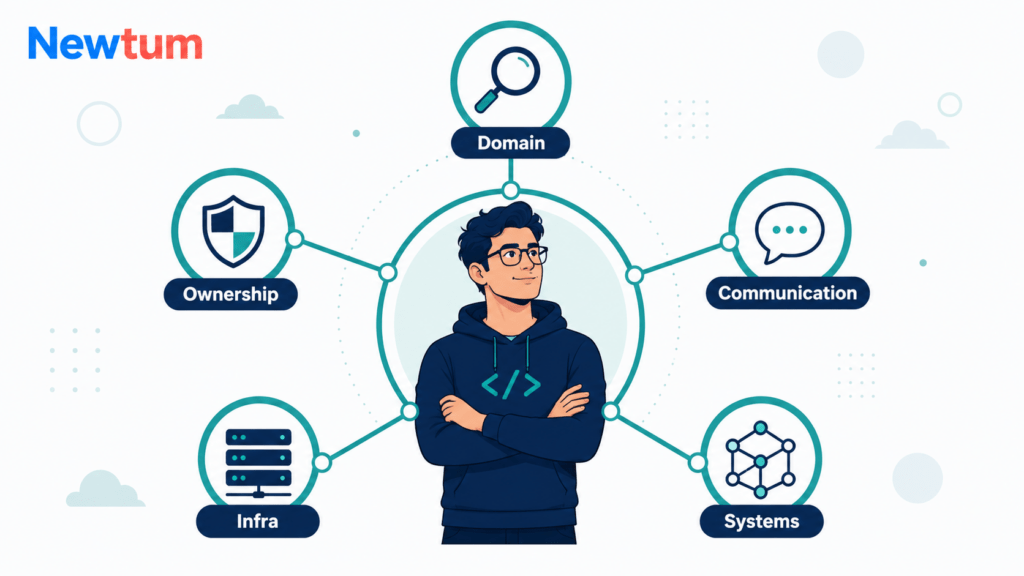
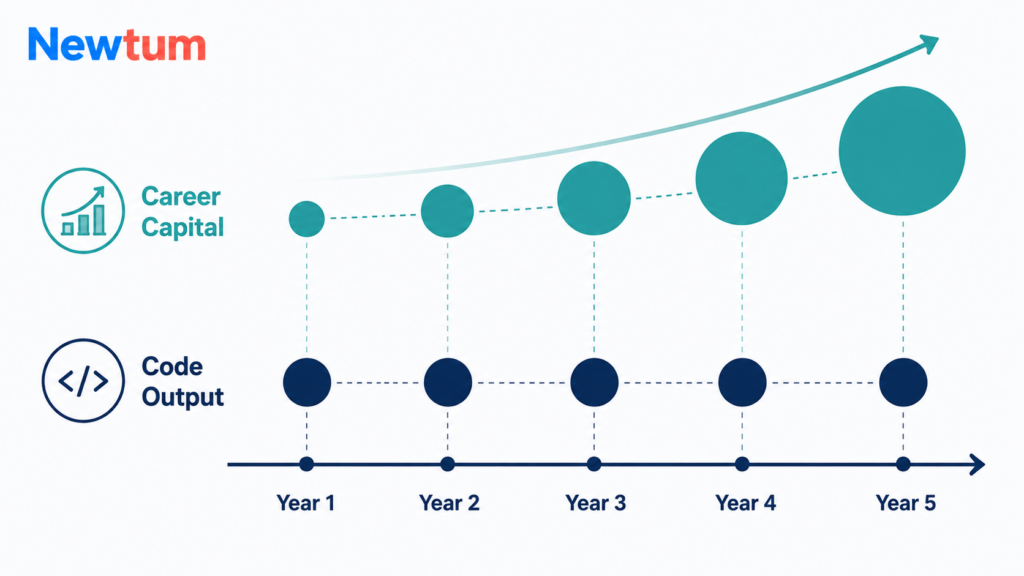
Career capital is not a metaphor here. It is the literal accumulation of judgment, relationships, context, and accountability that makes an organization dependent on you specifically, not on “a developer.” AI models can write a function. They cannot own a production incident at 2 a.m., negotiate scope with a stakeholder who trusts your judgment, or explain why a schema decision from eighteen months ago still matters today. This article breaks down five compounding assets domain expertise, ownership, communication, infrastructure knowledge, and systems thinking using a single framework you can start applying this week.
Introducing the CAPITAL Framework
To make these five assets easy to apply and easy to remember, this guide organizes them into the CAPITAL framework: Context mastery, Accountability, Persuasive communication, Infrastructure fluency, Team leverage, Architecture-level thinking, and Longevity habits. Each pillar below is one of the durable, AI-resistant developer skills that compounds over a career instead of decaying with the next model release.
Pillar 1: Domain Expertise – The Moat AI Cannot Copy
A language model can generate syntactically correct code for almost any domain on request. What it cannot do is know that your insurance client’s claims engine has an undocumented rule from a 2019 regulatory settlement, or that your fintech partner’s settlement window closes ninety minutes earlier on the last business day of the quarter. That kind of knowledge lives in people, not in training data, and it is one of the clearest examples of AI resistant developer skills in practice.
Domain expertise compounds because it is cumulative and specific. Every incident you debug, every stakeholder conversation you sit in on, and every edge case you patch adds a detail that AI has no way of inferring from a generic prompt. Developers who treat their domain as a specialization — healthcare compliance, payments infrastructure, logistics routing, whatever it is — become the person a team turns to before it turns to a model.
- Read the business documentation, not just the technical docs — compliance memos, postmortems, and client escalation threads carry context that never makes it into code comments.
- Sit in on requirements and stakeholder calls even when you are not required to. Domain fluency is built through exposure, not through tickets alone.
- Keep a personal log of tribal knowledge – undocumented business rules, historical decisions, and known workarounds — and treat it as an asset you own.
Pillar 2: Ownership – From Task Completion to Outcome Accountability
The developers who feel the least AI anxiety today are rarely the strongest coders. They are the ones who own outcomes end to end: they notice when a sprint is drifting, they make the call on renegotiating scope, and they are the first name mentioned when something breaks in production. Ownership is one of the AI resistant developer skills that scales with seniority instead of being displaced by it, because ownership requires being accountable to other humans, which is a role AI cannot occupy.
For junior developers, ownership starts small: owning a feature from ticket to production, not just the code that ships. For senior developers, it extends to owning delivery outcomes across a team, including the judgment calls about what AI-generated work is safe to merge and what needs a second pass. Either way, the underlying signal is the same — organizations pay for people who can be trusted with a decision, not just an implementation.
| Try This This Week Pick one task on your plate and reframe it from “complete the ticket” to “own the outcome.” Follow it through deployment, monitor it after release, and report back on what actually happened, not just that the PR merged. |
Pillar 3: Communication – Translating Technical Reality Into Business Decisions
AI can draft a technical document in seconds. It cannot walk into a room, read that a stakeholder is quietly frustrated, and adjust the explanation in real time. It cannot notice that a product manager’s confident nod means they did not actually follow the tradeoff you just described. Communication of this kind – reading a room, translating architecture into business risk, negotiating a deadline with evidence instead of opinion remains squarely human, which is exactly why it belongs on any serious list of AI-resistant developer skills.
This matters for junior developers too. The habit of explaining what you built, why you built it that way, and what tradeoff you accepted is a communication muscle that compounds into influence over time. Developers who can defend a technical decision to a non-technical stakeholder get trusted with bigger decisions faster than developers who write great code but explain nothing.
- Practice writing a two-paragraph summary of every non-trivial change: what changed, why, and what risk was accepted.
- When disagreeing with a stakeholder, lead with the business impact of the tradeoff, not the technical mechanism.
- Volunteer to present in cross-functional meetings – repetition is what turns communication into a career asset.
Pillar 4: Infrastructure Knowledge – Understanding What Happens After Deploy
AI-generated code tends to assume a clean, idealized environment. Production infrastructure is never clean. It has legacy load balancers, half-migrated services, rate limits nobody documented, and failure modes that only show up under real traffic. Developers who understand deployment pipelines, observability, networking basics, and how a system actually behaves under load hold one of the more underrated AI-resistant developer skills, because this knowledge is earned through incidents, not generated from a prompt.
You do not need to become a dedicated infrastructure engineer to benefit from this. Understanding how your service is deployed, what your monitoring dashboards actually show, and how to read a postmortem critically will make you dramatically more effective at reviewing AI-generated code, because you will recognize when a suggestion ignores a real-world constraint the model was never told about.
Pillar 5: Systems Thinking – Seeing the Architecture, Not Just the Function
The final pillar ties the other four together. Systems thinking is the ability to reason about how services interact, where a change will ripple, and what happens at scale not just whether one function passes its tests. It is the difference between generating a correct snippet and designing something that survives contact with production traffic, three years of feature growth, and a team that will inherit the code after you move on.
Of all five pillars, systems thinking is the one most junior developers underinvest in early, assuming it is a senior-only concern. That assumption is outdated. In an AI-accelerated workflow where implementation is faster than ever, the bottleneck has shifted upstream to design decisions – which makes systems thinking one of the highest-leverage AI-resistant developer skills a junior developer can start building on day one.
How the Five Pillars Compound Into Career Capital
None of these pillars work in isolation, and that is the point. Domain expertise without communication stays locked in one person’s head. Ownership without systems thinking leads to heroics instead of durable fixes. Infrastructure knowledge without communication cannot be escalated when it matters. Career capital is built at the intersection of all five, and that intersection is precisely what AI cannot replicate, because it requires accumulated judgment across a specific team, a specific domain, and a specific set of relationships over time.
The developers who will feel most secure over the next five years are not the ones racing to out-code AI. They are the ones deliberately compounding these five assets while using AI to handle the parts of the job that were always mechanical. That is the strategic reframe this guide is built around: AI-resistant developer skills are not a defensive posture. They are simply good career strategy, model release cycle or not.
A 90-Day Starting Plan
- Weeks 1–4: Pick one domain area and go deep — read every postmortem, business doc, and escalation thread you can find.
- Weeks 5–8: Take ownership of one outcome end to end, including post-release monitoring and stakeholder reporting.
- Weeks 9–12: Present one technical decision to a non-technical audience, and shadow one infrastructure or on-call rotation.
Conclusion
Fear content tells you AI is a threat and stops there. Strategy tells you exactly what to build instead. Domain expertise, ownership, communication, infrastructure knowledge, and systems thinking are not a hedge against AI — they are the actual substance of a senior engineering career, and they were always going to matter. Start with one pillar this week, and treat the accumulation of AI resistant developer skills as the career investment it is.
Learn how to adapt to AI with Newtum for a better Career.
Frequently Asked Questions
What are AI-resistant developer skills, exactly?
AI-resistant developer skills are the capabilities that grow in value as AI tools improve, rather than being displaced by them – domain expertise, ownership, communication, infrastructure knowledge, and systems thinking are the five with the clearest evidence behind them.
Are AI-resistant developer skills only relevant for senior developers?
No. Junior developers benefit the most from starting early, since these skills compound over years and are far easier to build as habits than to retrofit later in a career.
Does this mean I should avoid using AI tools?
No, the strategic move is the opposite. Use AI to accelerate the mechanical parts of the job, and reinvest the time saved into the five compounding pillars covered in this guide.
About The Author