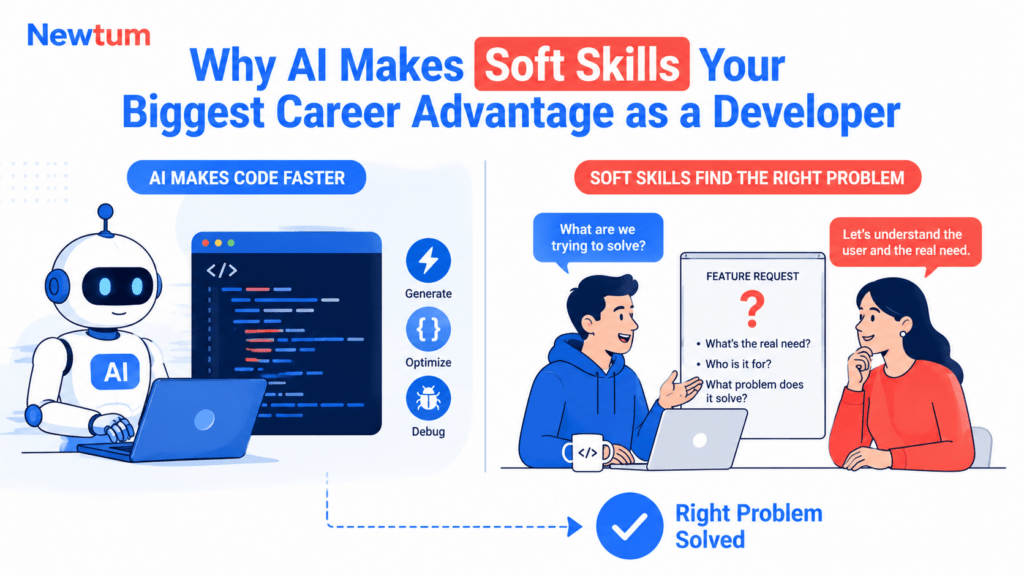
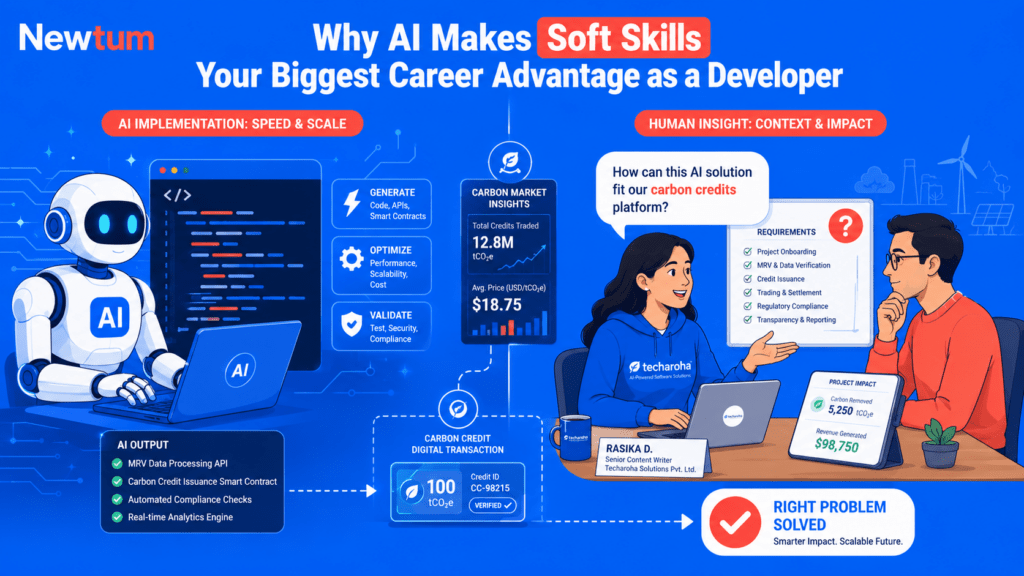
AI can write your function in ten seconds. It cannot sit in a stakeholder meeting, sense the gap between what the client is saying and what they actually need, and translate that into a spec your team can build against. That gap between generating code and understanding what to build in the first place is exactly where developer soft skills AI conversations are heading in 2026.
For years, “soft skills” sat at the bottom of the developer priority list, somewhere below “learn the new framework” and “get better at algorithms.” That ranking made sense when the bottleneck in software delivery was typing speed and syntax knowledge. AI has quietly removed that bottleneck. Once an assistant can scaffold an API, draft a migration script, or refactor a legacy module in minutes, the question stops being “who can write this fastest” and becomes “who can figure out what’s actually worth writing.” That second question is a communication problem, not a coding problem, and it’s why developer soft skills AI fluency is becoming a genuine competitive advantage rather than a resume filler line.
This post breaks down why that shift is happening, and gives both junior and senior developers a concrete way to build the four soft skills that matter most in an AI-assisted workflow: communication, requirement gathering, stakeholder alignment, and collaboration.
Why AI Raises the Value of Human Judgment, Not Lowers It
There’s a common assumption that as AI absorbs more technical work, developers become less important. The opposite is closer to the truth, and it’s worth being precise about why.
AI models are extraordinary pattern-matchers. Given a clear, well-specified prompt, they can produce working code faster than almost any human. But they cannot sit across the table from a product manager who says “make it faster” and figure out whether that means server response time, perceived UI latency, or the number of clicks to checkout. They cannot notice that a stakeholder’s body language shifted when a deadline was mentioned. They cannot build the trust that makes a client tell you the real constraint instead of the polite version of it.
Every one of those situations depends on soft skills. And every one of them determines whether the code that eventually gets written is AI-generated or not actually solves the right problem. This is the core argument behind developer soft skills AI thinking: the technical execution layer has been compressed, so the judgment layer above it now carries more of the project’s total risk and total value.
The Four Pillars Where Developer Soft Skills AI Fluency Pays Off
Rather than treating “soft skills” as a vague catch-all, it helps to break the discipline into four concrete, practiceable areas. These are the same four areas that show up repeatedly in engineering manager feedback when a project goes sideways — not because the code was bad, but because something upstream of the code was misunderstood.
1. Communication
Communication is the most visible developer soft skills AI application, and also the one most developers underrate. It shows up in three places: written documentation, verbal explanation to non-technical stakeholders, and the framing of technical trade-offs.
A developer who can explain why a database migration will take three days instead of one — in language a product owner actually understands — protects their team from unrealistic timelines. A developer who writes a clear pull request description saves every reviewer who touches that code for the next two years. Neither of those skills shows up in a leetcode score, but both compound across an entire career.
2. Requirement Gathering
AI tools are extremely good at generating code from a spec. They are extremely bad at generating the spec itself, because a spec requires asking the right follow-up questions of a human who often doesn’t fully know what they want yet.
Strong requirement gathering means asking “what happens when a user cancels mid-transaction” before you write a single line, not after a bug report three weeks post-launch. It means noticing when a stakeholder’s request contradicts something they said in an earlier meeting, and surfacing that contradiction early instead of building two conflicting features. This is one of the sharpest edges of developer soft skills AI value: the developer who gathers requirements well hands AI tools a prompt that’s actually correct, and gets usable output on the first pass instead of the fifth.
3. Stakeholder Alignment
Every non-trivial project has multiple people with different, sometimes competing definitions of success. A product manager wants speed to market. A security lead wants a slower, safer rollout. A designer wants a feature nobody scoped time for. None of them are wrong; they’re optimizing for different things, and someone has to reconcile that.
Developers who can sit in that tension, ask clarifying questions without sounding combative, and propose a path that respects the real constraints on all sides become the people organizations promote into technical leadership. This is not a “nice to have” people skill sitting next to engineering ability; it is engineering ability, applied at the level of the whole system instead of a single function.
4. Collaboration
AI pair programming has changed what daily collaboration looks like, but it has not removed the need for it. Code review, architecture discussions, and mentoring junior engineers still require the ability to disagree productively, give feedback that lands without damaging trust, and build shared context across a team.
A developer who treats every code review as an opportunity to teach rather than to score points builds a stronger team over multiple years than one who simply ships fast alone. That difference in team-building capacity is invisible in a single sprint and enormous over a career.
Read about –The Rise of AI QA Engineers: Testing Skills Developers Cannot Ignore
The ALIGN Framework: A Practical Model for Developer Soft Skills AI Growth
To make these four pillars easier to practice deliberately rather than absorb by accident, it helps to organize them into a repeatable framework. This is the ALIGN Framework, five habits that translate developer soft skills AI theory into something you can actually do in your next meeting.
- A – Active Listening.
Before proposing a solution, restate the problem back to the stakeholder in your own words. This single habit catches more misunderstandings before they become rework than any amount of technical skill. - L – Language Translation.
Practice explaining technical trade-offs (latency, tech debt, scalability limits) in terms of business outcomes: cost, risk, and time. If a non-technical stakeholder can repeat your explanation back accurately, you’ve translated well. - I – Iterative Clarification.
Treat requirement gathering as a loop, not a single meeting. Send a short written summary after every requirements conversation and ask the stakeholder to confirm or correct it. This creates a paper trail and catches drift early. - G – Grounding in Written Record.
Document decisions, not just tasks. A short written note explaining why a particular approach was chosen saves hours of re-litigation months later, and gives future AI tools better context to work from too. - N – Negotiating Trade-offs.
When stakeholders disagree, don’t default to whoever spoke last or loudest. Lay out the trade-offs explicitly — “faster ships in two weeks but skips the audit trail” and let the group choose with full information.
Developers who run new projects through this framework consistently report fewer requirement changes late in a sprint, because most of that churn traces back to a skipped step in ALIGN, not a technical miscalculation.
Junior vs. Senior: Where Developer Soft Skills AI Priorities Differ
For junior developers, the fastest-growing skill gap is requirement gathering and written communication. Early-career engineers are often handed a ticket and expected to execute it literally, without questioning ambiguity. That habit works against you in an AI-assisted environment, because AI will happily generate confident, well-formatted code for an ambiguous or incorrect requirement. Learning to ask “what should happen in this edge case” before prompting anything is the single highest-leverage soft skill a junior developer can build right now.
For senior developers and tech leads, the priority shifts toward stakeholder alignment and cross-functional negotiation. Senior engineers are increasingly the ones translating between product, design, security, and leadership, and AI tools have made it easier for a senior developer’s time to be spent on that translation work instead of on writing every function personally. The developers moving into technical leadership roles are the ones who treat that shift as an opportunity, not a distraction from “real” engineering.
How to Build These Skills Deliberately
Soft skills are trainable in the same disciplined way technical skills are — they just require different practice reps.
- Rewrite one requirement per week in plain, unambiguous language before touching any code, even for small tickets.
- Ask one clarifying question in every stakeholder meeting, even when you think you understand the ask. It signals engagement and often surfaces a hidden assumption.
- Send a written recap after every scoping conversation. This single habit builds both communication and requirement-gathering muscle simultaneously.
- Volunteer for one cross-functional meeting per month outside your immediate team: design reviews, security syncs, or leadership updates to build stakeholder alignment reps.
- Give feedback in code review that explains the “why,” not just the “what.” This is collaboration practice disguised as a routine task.
None of these require a course or a certification. They require repetition, and repetition is exactly what most developers skip because it feels less productive than shipping code.
The Bottom Line
AI has not made technical skill irrelevant; it has raised the floor on what’s expected and moved the ceiling somewhere else entirely. The developers who thrive over the next decade will be the ones who pair strong technical judgment with the communication, requirement-gathering, stakeholder alignment, and collaboration skills that AI cannot replicate. That combination is what developer soft skills AI readiness actually means in practice: not a checkbox next to “communication” on a resume, but a deliberate, practiced capability that determines whether the code your team ships solves the problem it was supposed to solve.
The technical bar was never really the ceiling. It was always the entry fee. Learn how to adapt AI with Newtum for a better Career.
About The Author