Something fundamental has shifted in software engineering. Two years ago, code review meant checking that your colleague’s pull request followed clean code principles, caught off-by-one errors, and didn’t introduce obvious security gaps. Today, a growing proportion of code in pull requests was not written by your colleague at all. It was generated by an AI assistant — and your colleague may have accepted it without reading it carefully.
This is the new reality of 2026. AI tools now write first drafts of functions, suggest entire modules, scaffold APIs, and refactor legacy code at speed no human developer can match. The productivity gains are real. But so is the risk. Because AI-generated code can be syntactically perfect, stylistically consistent, and completely wrong — wrong in ways that are invisible until production.
The developers who thrive in this environment are not the ones who write the most code. They are the ones who have developed strong AI code review skills: the ability to critically evaluate AI-generated output, detect its characteristic failure modes, and validate it to a standard that matches human-written code — or higher.
This blog breaks down the five core AI code review skills every developer needs in 2026, why they matter differently for junior and senior engineers, and how to build a repeatable review process that makes your AI-assisted workflow actually trustworthy.
Why AI Code Review Skills Are Now a Core Developer Competency
A few years ago, the conversation in most engineering teams was about whether to adopt AI coding tools. That conversation is over. GitHub’s 2025 developer survey found that over 78% of professional developers now use AI assistants in their daily workflow. Enterprise companies are not just allowing AI-generated code — they are expecting developers to produce more output using these tools.
But expectation and responsibility do not cancel each other out. They compound. Shipping more code faster means more surface area for bugs, vulnerabilities, and architectural mistakes. And when those mistakes are introduced by a probabilistic language model that has no understanding of your business domain, your compliance requirements, or your production infrastructure, the review burden on developers increases — it does not decrease.
This is why AI code review skills have evolved from “nice to have” into a hiring signal. Technical interviews in 2026 increasingly include tasks where candidates are handed AI-generated code and asked to evaluate it. Engineering managers are adding “AI output validation” to performance rubrics. The skill set is no longer optional.
The five critical AI code review skills are: hallucination detection, logic validation, security review, architecture review, and AI output auditing. Each targets a different category of failure mode, and each requires a different kind of developer attention.
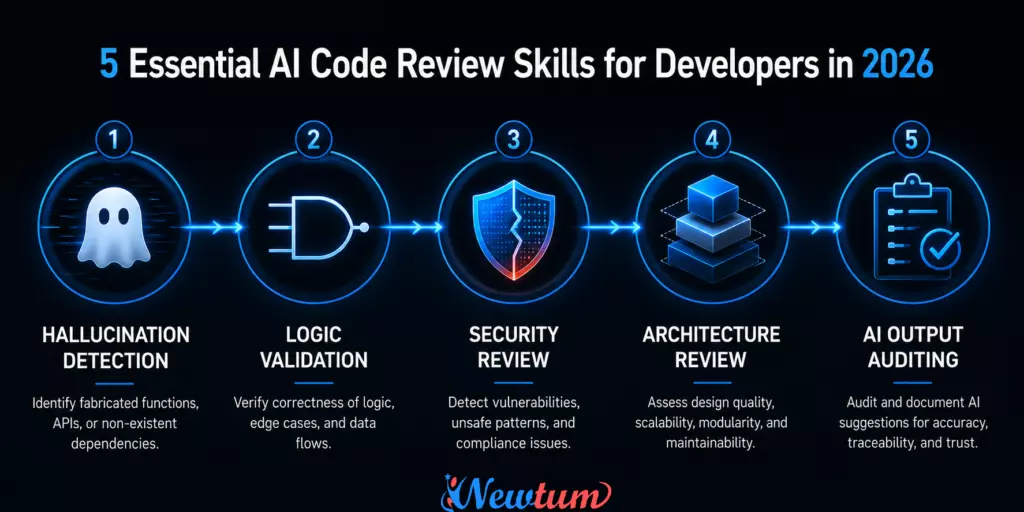
Skill 1 – Hallucination Detection: Spotting What Never Existed
The term “hallucination” in AI refers to a model generating confident, plausible-sounding output that is factually false. In the context of code generation, hallucinations appear as:
- Invented library functions — the AI calls a method that does not exist in the library’s actual API
- Fabricated dependencies —
importstatements referencing packages that were never published - Misremembered method signatures — real functions called with incorrect parameter names or the wrong number of arguments
- Outdated API usage — code that was valid two major versions ago but has since been deprecated or removed
Hallucinated code is particularly dangerous because it often passes a quick visual scan. The function name sounds right. The logic looks reasonable. It only fails at runtime — sometimes deep inside a conditional branch that isn’t triggered in normal test scenarios.
How to detect hallucinations in AI-generated code:
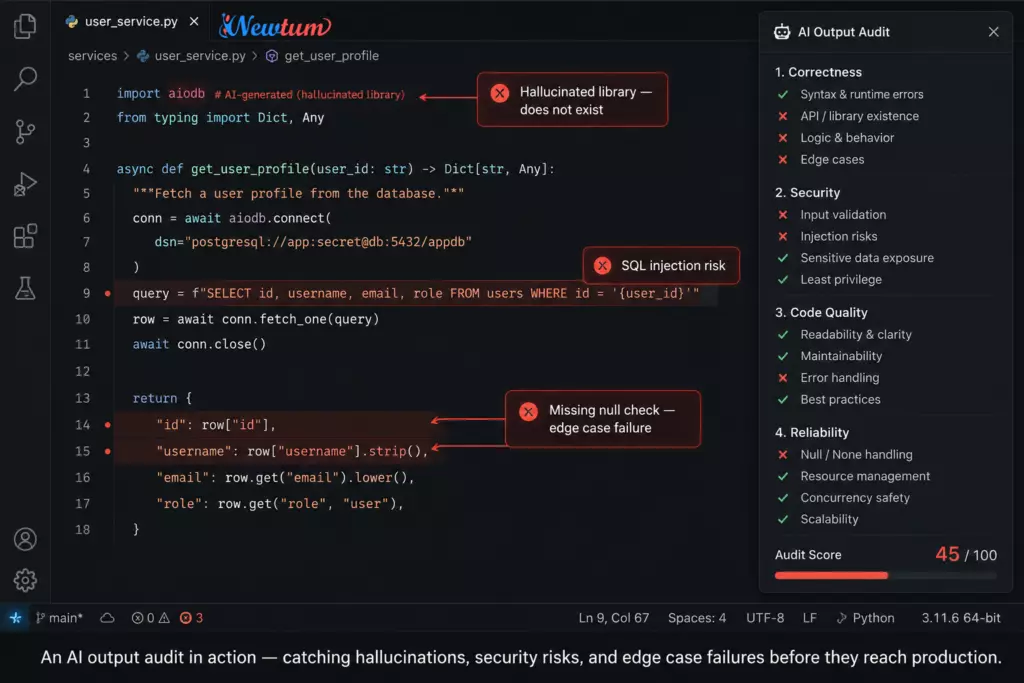
The first line of defense is dependency verification. Every import, every library call, and every external method reference should be checked against the official documentation or package registry. Do not assume a function exists because the AI wrote it with confidence. Confidence is a hallucination risk factor, not a quality signal — AI models are statistically trained to sound certain.
The second technique is version pinning. When AI generates code using a third-party library, verify which version is being referenced. A function that exists in v3.2 of a library may not exist in v2.8, which your project actually depends on.
The third — and most powerful — technique is direct sandbox testing. Copy the AI-generated snippet into an isolated environment with your actual dependencies installed, and run it against a representative input. If it throws an AttributeError, ImportError, or MethodNotFoundError, you have found a hallucination.
Building strong hallucination detection into your AI code review skills takes practice, but the mental model is simple: trust the logic, verify every reference.
Skill 2 — Logic Validation: Proving the Code Does What It Claims
AI models are exceptional at generating code that looks correct. Logic errors are the hardest category of AI failure to catch, precisely because the code compiles, the tests may pass, and the output seems right — until an edge case or unexpected input exposes the flaw.
Common logic failures in AI-generated code include:
- Off-by-one errors — loop boundaries that include or exclude one extra element
- Incorrect conditional logic —
>=where>was needed,orwhereandwas required - Missing edge case handling — no guard for empty inputs, null values, or zero denominators
- Incorrect order of operations — mathematical or string operations applied in the wrong sequence
- Faulty assumptions about data — assuming a sorted list when the input may not be sorted, or assuming a dictionary key exists when it may be absent
The most effective AI code review skill for logic validation is trace testing: mentally (or actually) running the code against three categories of input simultaneously — a typical valid input, a boundary input (the smallest or largest value the function should handle), and an invalid or unexpected input. AI models optimize for the “happy path” — the common, well-formed case. Boundary and invalid inputs are where their logic most frequently breaks.
A second powerful technique is specification-first review. Before reading the AI’s implementation, write down in plain language what the function should do: its inputs, its outputs, its invariants, and its edge cases. Then read the code against that specification. This prevents you from being led by the AI’s implementation choices and instead evaluates whether the code satisfies the actual requirement.
Logic validation is the most intellectually demanding of all AI code review skills because it requires understanding both the intended behavior and the actual behavior of the generated code — and holding both in mind simultaneously.
Skill 3 — Security Review: Finding Vulnerabilities AI Cannot See
Security is where AI code generation introduces the most serious real-world risk. AI models are trained on vast amounts of public code — including code that contains vulnerabilities, uses deprecated security practices, and reflects patterns from an era before modern threat models existed. The model has no awareness that a particular pattern is unsafe in your specific context.
The most common security failures in AI-generated code are:
- Injection vulnerabilities. String concatenation in database queries is the classic example. AI will generate
"SELECT * FROM users WHERE id = " + user_idwithout hesitation, because it has seen this pattern millions of times. Parameterized queries are the correct approach, but AI does not always choose them unless explicitly prompted. - Missing authentication and authorization checks. AI generates endpoint handlers that perform the requested action without verifying that the requesting user has permission to perform it. The logic of the operation is implemented correctly; the access control is simply absent.
- Hardcoded credentials and secrets. AI frequently generates example code with placeholder secrets like
api_key = "sk-abc123"orpassword = "admin". These find their way into production repositories more often than security teams would like to admit. - Insecure cryptography. Older hashing algorithms (MD5, SHA-1) appear in AI-generated authentication code because they are well-represented in training data. Modern secure hashing standards require explicit prompting or review.
- Unsafe deserialization. AI-generated code may use Python’s
picklemodule or JavaScript’seval()on untrusted input — patterns that are catastrophically unsafe but syntactically valid.
Strong AI code review skills in the security domain require a threat modeling mindset: for every function that touches external input, database access, authentication, file operations, or network communication, ask “what happens if a malicious actor controls this input?” If the answer is “nothing good,” the code needs revision before it ships.
Security-focused AI code review skills also benefit from automated support. Tools like Semgrep, Bandit (Python), and ESLint security plugins can catch many of these patterns mechanically, freeing your manual review for more nuanced judgment calls.
Skill 4 — Architecture Review: Evaluating System-Level Decisions
Architecture review is the AI code review skill that most junior developers underestimate and most senior developers consider the most important. When AI tools operate in Composer or Agent mode — writing multiple files, creating new modules, suggesting design patterns — their output can be structurally sound at the code level while being architecturally wrong for your system.
AI does not know:
- Your team’s technical debt and the constraints it imposes
- Your deployment environment (serverless, containerized, on-premise)
- Your scalability requirements and the traffic patterns your system must handle
- Your organization’s existing standards and the patterns your other services follow
- Your future roadmap and the extensibility your codebase needs
When AI suggests a design pattern or proposes a module structure, it is drawing on textbook examples and common patterns from open-source repositories. These suggestions are not wrong in the abstract — but they may be wrong for your specific context.
Architecture review as part of your AI code review skills requires asking a distinct set of questions:
- Does this solution fit within our existing service boundaries, or does it create new coupling?
- Does this approach scale to our expected load, or does it work only for the volume in the AI’s example?
- Are there existing utilities, abstractions, or shared services in our codebase that should be used here instead of the new ones the AI created?
- Does this design make the system harder or easier to test, monitor, and extend?
- Does the proposed structure align with our team’s conventions, or will it become an isolated island that only one person understands?
Architecture review is inherently a conversation with context, which is exactly what AI lacks. This is why it remains one of the most uniquely human of all AI code review skills — and the one that companies increasingly value in senior engineers.
Skill 5 — AI Output Auditing: Building a Repeatable Review Process
The four skills above describe what to look for. This fifth skill describes how to look for it systematically. AI output auditing is the practice of applying a consistent, documented review process to AI-generated code — rather than relying on ad hoc inspection that varies with reviewer energy and attention.
A mature AI code review skill set culminates in a personal or team-level audit checklist that gets applied every time AI-generated code enters a pull request. A strong AI output audit covers:
Pre-merge verification steps:
- All imports and external references verified against current official documentation
- Function traced against typical input, boundary input, and invalid input
- All external inputs checked for injection, sanitization, and validation
- All access-controlled operations confirmed to include authorization checks
- No hardcoded credentials, secrets, or environment-specific values
- Cryptographic operations use current recommended standards
- Module structure consistent with existing codebase conventions
- Design pattern appropriate for team’s deployment and scaling context
- Test coverage includes at least one boundary and one invalid-input case
- AI-generated comments or documentation verified for accuracy against the actual implementation
The discipline of auditing goes beyond individual review. Teams with mature AI code review skills integrate auditing into their CI/CD pipeline: automated static analysis catches categories 1, 3, 4, 5, and 6 mechanically, while human review focuses its energy on categories 2, 7, 8, and 10 — the ones that require judgment.
AI output auditing also creates organizational learning. When a reviewer catches a particular type of failure in AI-generated code, that finding should update the checklist. Over time, a team’s audit process becomes a knowledge base of the specific failure modes most relevant to their stack, their AI tooling, and their domain.
How Junior Developers Can Build These AI Code Review Skills Fast
For junior developers, building AI code review skills is both an immediate productivity challenge and a long-term career investment. The immediate challenge: you may not yet have the domain knowledge to recognize when AI output is subtly wrong. The investment: developers who build these skills early will be far more valuable than peers who simply accept AI output.
Three practices accelerate the development of AI code review skills for junior engineers:
- Read the documentation obsessively. Hallucination detection is only possible if you know what functions actually exist. Every library you use — invest time in reading its official docs, not just the AI’s explanations of it. The mismatch between what the AI says a function does and what it actually does becomes immediately obvious when you know the source.
- Write tests before reviewing code. When you receive AI-generated code, write the tests you think should pass before you look at the implementation in detail. This forces you to think about the specification independently of the AI’s choices, which dramatically improves your ability to spot logic gaps.
- Review AI output with another developer. Pair review of AI-generated code builds AI code review skills faster than solo review. Explaining why you’re flagging a particular line forces you to articulate the failure mode — and that articulation accelerates learning.
How Senior Developers Should Level Up Their Review Standards
Senior developers face a different challenge: they have the knowledge to catch AI errors, but they may not have updated their review process to treat AI-generated code with appropriate skepticism.
The most important mental shift for senior developers is resisting the efficiency trap. AI-generated code looks finished. It compiles. It often passes lint. The temptation to approve it quickly — because it seems complete — is the primary source of AI-related production incidents.
Senior developers building advanced AI code review skills should focus on two areas: architectural review depth and cross-team review standards. Architectural review depth means not just evaluating whether the AI’s code works, but whether it fits — into the team’s standards, the system’s design, and the organization’s future direction. Cross-team review standards means advocating for documented AI review checklists, shared tooling, and consistent expectations that apply to all AI-generated code in the codebase.
Senior engineers who treat AI code review skills as a craft — and invest in building shared review culture around AI output — create compounding value for their entire team.
AI Code Review Skills Checklist (Quick Reference)
| Review Area | Key Check | Priority |
|---|---|---|
| Hallucination Detection | Verify all imports and library calls against official docs | High |
| Hallucination Detection | Test in isolated sandbox with actual dependencies | High |
| Logic Validation | Trace against boundary and invalid inputs | High |
| Logic Validation | Compare implementation against written specification | Medium |
| Security Review | Check all external inputs for injection risk | Critical |
| Security Review | Verify authentication and authorization on every endpoint | Critical |
| Security Review | Scan for hardcoded credentials and deprecated crypto | Critical |
| Architecture Review | Check module structure against codebase conventions | Medium |
| Architecture Review | Evaluate design pattern fit for scale and deployment context | High |
| AI Output Auditing | Apply team checklist consistently on every PR | High |
| AI Output Auditing | Update checklist when new failure patterns are discovered | Medium |
Frequently Asked Questions (FAQs)
What are AI code review skills and why do they matter in 2026? AI code review skills are the competencies developers need to evaluate, validate, and audit code generated by AI tools before it enters production. They matter in 2026 because AI-generated code now represents a significant share of code in professional engineering workflows, and its failure modes — hallucinations, logic gaps, security vulnerabilities — are distinct from those of human-written code.
How is reviewing AI-generated code different from reviewing human-written code? Human code review assumes the author had design intent and domain knowledge. AI code review cannot make that assumption. Developers must verify every external reference for existence, trace logic against edge cases the AI may have ignored, and evaluate whether the AI’s choices fit the actual system context — not just a generic textbook scenario.
Can automated tools replace manual AI code review skills? Automated tools — linters, SAST scanners, type checkers — handle a meaningful portion of AI code review mechanically. But logic validation, architecture review, and context-sensitive judgment cannot be automated. Human AI code review skills remain essential for the categories of failure that require understanding business domain, system context, and organizational constraints.
Which AI code review skill is most important for junior developers to learn first? Hallucination detection, because it is the most immediately learnable and the most frequently encountered. Verifying library calls against official documentation is a concrete, actionable practice that junior developers can apply immediately and that builds domain knowledge as a side effect.
How should teams standardize AI code review skills across engineering groups? Teams should document a shared AI output audit checklist, integrate automated security and linting checks into CI/CD pipelines, and include AI code review criteria in pull request templates. Periodic review of the checklist — updated when new failure modes are discovered — keeps the process current as AI tooling evolves.
Do these AI code review skills apply to all AI coding tools equally? The core skills apply universally because they target categories of failure inherent to large language models, not specific tools. However, different tools (GitHub Copilot, Cursor, ChatGPT, Gemini Code) have different strengths and characteristic failure patterns. Teams should maintain tool-specific notes within their audit process as they discover patterns unique to the tools they use.
Conclusion
The job of a developer in 2026 is not to compete with AI. It is to be the quality gate that AI cannot be for itself. AI tools will write more code, faster, with each passing year. But they will not develop judgment. They will not understand your business domain. They will not know when a pattern that works in theory will fail in your production environment at 3 AM on a Tuesday.
That judgment — expressed through strong AI code review skills — is what separates developers who add genuine value from those who are simply faster at shipping AI output. Hallucination detection, logic validation, security review, architecture review, and AI output auditing are not bureaucratic checkboxes. They are the craft skills of the next generation of software engineering.
Build them deliberately. Apply them consistently. Teach them to your team. The developers who invest in serious AI code review skills today are the ones who will be trusted with the most consequential systems tomorrow — because they are the ones who can actually guarantee the quality of what ships. Newtum helps to adapt AI with the changing times.
About The Author