AI ready developer portfolio is no longer just a competitive advantage- it has become an essential differentiator in 2026. Today, employers assume every candidate can ship a to-do app, a weather app, or a clone of a popular SaaS product with an AI assistant doing half the typing. That assumption has quietly rewritten what “impressive” means, making an AI-ready portfolio far more valuable than simply showcasing completed projects.
This guide is written specifically for junior developers who feel the ground shifting under them. You are not being asked to know more computer science than the generation before you. You are being asked to prove something new: that you can direct AI tools with judgment, defend your architecture choices, and show the business outcome of your work, not just the code behind it. An AI-ready developer portfolio does exactly that.
Why Traditional Portfolios No Longer Differentiate Candidates
A traditional portfolio is a list. Project name, tech stack, a live link, a GitHub repo. It answers one question: can you build something that runs? In 2026, that question is not interesting anymore, because AI coding assistants have made “something that runs” trivially cheap to produce. A hiring manager scrolling through forty portfolios in an afternoon cannot tell your weather app from the next candidate’s weather app, because both were probably scaffolded by the same AI model in twenty minutes.
What recruiters are actually screening for now is upstream of the code: how did you scope the problem, what did you ask the AI to do, and what did you check yourself, why did you choose this architecture over three other options, and what changed in the real world because you built this. None of that fits into a bullet-pointed project list. It needs a different container. That container is what we are calling an AI-ready developer portfolio, and it is built around four things: context, workflow, architecture, and evidence.
What Makes a Portfolio Genuinely AI Ready
An AI-ready developer portfolio is not a portfolio with an “I used ChatGPT” badge stuck on it. It is a portfolio where every project is documented as a decision trail, not a finished artifact. The difference sounds small until you sit across from a technical interviewer who asks “walk me through why you built it this way,” and you realize a traditional portfolio gives you nothing to say beyond “it just worked.”
Four qualities separate a genuinely AI-ready developer portfolio from a cosmetic one:
- It documents reasoning, not just results — every project includes the “why” behind key decisions, not only the “what” that got shipped.
- It shows AI collaboration explicitly — prompts, validation steps, and corrections are visible, not hidden behind a polished README.
- It presents architecture as a choice — alternatives that were considered and rejected are named, along with the tradeoff that decided it.
- It quantifies impact — load times, error rates, user numbers, or time saved are stated as numbers, not adjectives like “significantly improved.”
Learn Stop Being the Best Coder in the Room: How to Think Like a Tech Lead in the AI Era
The CASE Framework for Presenting Portfolio Projects
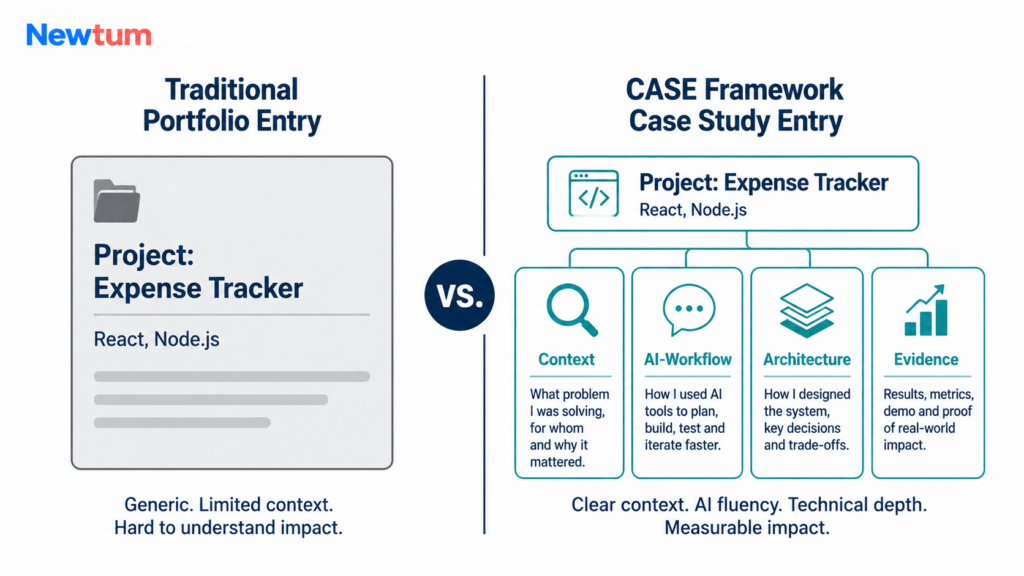
To make this repeatable rather than a vague aspiration, use a simple structure for every project you add to your portfolio going forward. We call it the CASE Framework: Context, AI-Workflow, System Architecture, Evidence.
| The CASE Framework Context — what problem existed, who it affected, why existing solutions fell short. AI-Workflow — which tool, what you prompted, what you validated or overrode. System Architecture — the structural decision made, the alternative rejected, and why. Evidence — the measurable before/after number that proves the outcome. |
- Context: what problem existed, who it affected, and why the existing solutions were insufficient. Two or three sentences, written like you are briefing a product manager, not a professor.
- AI-Workflow: exactly how AI tools were used in the build, which model or assistant, what you prompted it to do, what you personally reviewed or rejected, and where you overrode its output. This is the section most junior portfolios skip entirely, and it is the section that gives a hiring manager the clearest signal of how you think.
- System Architecture: the structural decisions behind the project why a relational database over a document store, why a monolith over microservices at this scale, why server-side rendering over a client-heavy build. State the alternative you didn’t choose and the one reason that ruled it out.
- Evidence: the measurable outcome response time before and after a change, test coverage percentage, number of users if it’s live, or hours saved on a manual process it replaced.
Every project documented through this structure becomes a self-contained case study instead of a screenshot with a caption. That is the core mechanism behind any credible AI ready developer portfolio, and it scales to as few as two or three projects done properly, rather than ten done superficially.
Writing the Case Study: A Worked Example
Take a simple project – an expense tracker with automated categorization. A traditional entry says: “Built an expense tracker with React and Node.js that categorizes transactions automatically.”
Run the same project through the CASE Framework and it reads differently:
- Context: manually categorizing bank transactions was taking a freelance user roughly twenty minutes a week, and existing budgeting apps required a paid subscription for automatic categorization.
- AI-Workflow: an LLM was prompted to classify transaction descriptions into eight spending categories; outputs were logged, and misclassifications above a five percent error rate on a hundred-transaction test set were caught and used to refine the prompt with clearer category definitions and few-shot examples.
- System Architecture: a rules-based fallback was built alongside the AI classifier, because a pure model call for every transaction was too slow and too costly at scale; the rules layer now handles seventy percent of transactions instantly, with the model reserved for ambiguous cases.
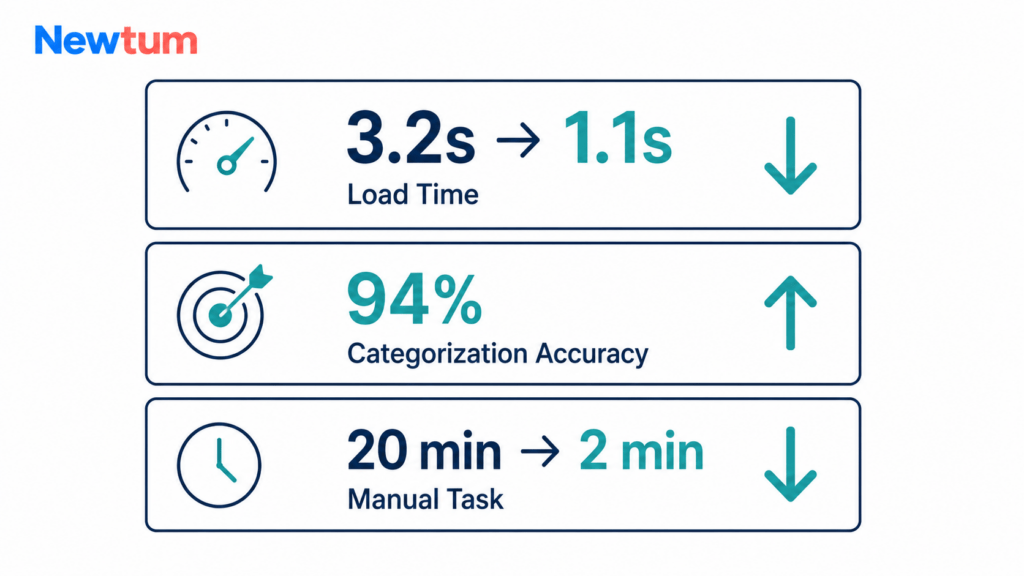
- Evidence: categorization accuracy reached ninety-four percent on the test set, and the manual weekly categorization task dropped from twenty minutes to under two.
Notice what changed. The stack is the same. The difference is entirely in what is documented around it. This is the single highest-leverage habit for any junior developer trying to build an AI ready developer portfolio without starting ten new projects from scratch — you are re-presenting work you have already done, with the reasoning made visible.
Documenting Your AI Workflow Without Oversharing
A common mistake is pasting an entire prompt history into a portfolio page, which reads as noise rather than signal. Keep the AI-Workflow section to three elements: the tool used, one representative prompt and how it evolved after a bad output, and the validation method – tests written, manual review, or a benchmark comparison against ground truth. A recruiter does not need your full chat log. They need proof that you treat AI output as a first draft that requires your judgment, not a finished answer you shipped unread.
This single habit showing validation, not just usage, is often the deciding factor between a portfolio that reads as “used AI to skip learning” and one that reads as “used AI as a tool the way a senior engineer would.” Every AI-ready developer portfolio should make this distinction unmistakable within the first few lines of each project.
Presenting Architecture Decisions Like an Engineer, Not a Student
Architecture decisions are usually invisible in junior portfolios because nobody taught the format. Borrow a lightweight version of the Architecture Decision Record used on real engineering teams: state the decision, the context that forced it, the alternatives considered, and the consequence of the choice, in four short lines per decision. You do not need five of these per project; one well-reasoned architectural call, clearly written, does more work than a paragraph of buzzwords like “scalable” and “robust” with nothing under them.
Presenting Measurable Impact Without Inflating It
Numbers are only credible if they are specific and honestly sourced. “Improved performance” is filler. “Reduced average page load from 3.2 seconds to 1.1 seconds, measured with Lighthouse across ten runs” is evidence. If a project has no users and no real traffic, measure something anyway: test coverage percentage, lines of manual work automated, or benchmark results against a documented baseline. An AI-ready developer portfolio does not require production traffic to include real numbers — it requires you to have measured something and to say exactly how.
A Quick Self-Audit Before You Rewrite Anything
Before touching a single project page, run this five-minute audit on what you already have. Open your three strongest projects and check each one against four questions: Does the write-up explain why you built it, not just what it does? Is there any mention of an AI tool, and if so, is there proof you reviewed its output? Is there a stated architectural tradeoff anywhere on the page? Is there a single number describing the outcome? Most junior portfolios score zero out of four on this audit, not because the underlying work is weak, but because none of it was ever written down. That gap between judgment that existed and judgment that is visible is precisely what separates a generic project list from a stronger portfolio, and closing it is usually a documentation exercise, not a coding one.
How Much Time This Actually Takes
A realistic estimate for converting one existing project into a fully documented case study using the CASE Framework is two to three hours: thirty minutes to reconstruct the context and the decision you made, an hour to write the AI-Workflow section honestly (including the parts where the model got it wrong), thirty minutes on the architecture tradeoff, and thirty minutes running whatever benchmark or test gives you the evidence line. Three projects at that pace is a single weekend, a modest time investment for the specific advantage of walking into a screening round with a portfolio built for the questions recruiters are actually asking in 2026.
Common Mistakes That Undermine an Otherwise Strong Portfolio
- Listing AI tools as a skills badge without ever showing how you used them — reads as unverified, and can work against you.
- Writing case studies as marketing copy instead of engineering reasoning — loses the exact signal a technical interviewer is looking for.
- Including ten shallow projects instead of three deep ones — dilutes attention across everything and depth in nothing.
- Skipping the “what I would do differently” line at the end — removes the clearest evidence of judgment a junior candidate can offer for free.
Frequently Asked Questions
Do I need to rebuild all my old projects to make my portfolio AI ready?
No. Most junior developers already have two or three projects worth re-documenting through the CASE Framework rather than rebuilding. The reasoning trail is usually more valuable to add than new code.
How many projects should an AI ready developer portfolio actually include?
Two to four fully documented case studies outperform eight to ten shallow entries. Depth of reasoning is the differentiator, not project count.
Is it risky to admit I used AI tools heavily during development?
It is only risky if you cannot show validation. Hiring managers in 2026 expect AI use; what they are evaluating is whether you reviewed, tested, and understood the output rather than shipping it unread.
What if my project never went live and has no real users?
Measure something else with equal rigor: test coverage, benchmark comparisons, or time saved on a manual process the project replaces. Evidence does not require production traffic.
Conclusion
Building an AI-ready developer portfolio is not about adding an “AI-powered” label to your existing work. It’s about changing what you document: the reasoning behind your prompts, the architecture behind your stack, and the number behind your impact. Pick two projects you already have, run them through the CASE Framework this week, and you will have a portfolio that survives the exact question every 2026 interview is built around: not “what did you build,” but “how did you think.”
Learn to Adapt AI with Newtum for a better career.
About The Author