Software development has always involved far more than writing code. Modern engineering teams spend significant amounts of time managing tickets, reviewing logs, investigating failures, maintaining tests, and handling deployment pipelines. While these activities are necessary, they often consume valuable engineering hours that could otherwise be spent solving complex business problems.
This is where AI agents for developers are changing the way engineering teams operate. Unlike traditional AI assistants that only respond to prompts, AI agents can observe workflows, make decisions, execute actions, and continuously improve processes with minimal supervision.
As organizations move toward agentic software development, AI agents for developers are becoming an essential part of modern engineering teams. From testing and monitoring to CI/CD and incident management, these intelligent systems are helping developers automate repetitive tasks while improving productivity and software quality.
What Are AI Agents?
Before exploring use cases, it is important to understand what makes AI agents different from conventional AI tools.
Traditional AI assistants wait for user instructions. In contrast, AI agents for developers can perform multi-step tasks autonomously. They can gather information, analyze context, execute actions, evaluate outcomes, and decide on the next step.
For example, rather than simply suggesting a fix for a failed deployment, an AI agent can:
- Analyze build logs
- Identify the root cause
- Generate a potential fix
- Run validation tests
- Submit recommendations to the engineering team
This capability makes AI agents for developers particularly valuable for repetitive engineering work.
Why Repetitive Engineering Tasks Are Ideal for AI Agents
Many engineering activities follow structured and repeatable patterns. Developers often spend hours on tasks that require consistency rather than creativity.
Examples include:
- Reviewing test failures
- Sorting tickets
- Monitoring infrastructure alerts
- Validating deployments
- Updating documentation
- Reviewing pull requests
Because these workflows involve defined processes and predictable decision trees, AI agents for developers can automate them effectively.
The result is increased developer focus on architecture, innovation, and problem-solving rather than routine operational work.
AI Agents for Developers in Software Testing
Testing is one of the most promising areas for automation.
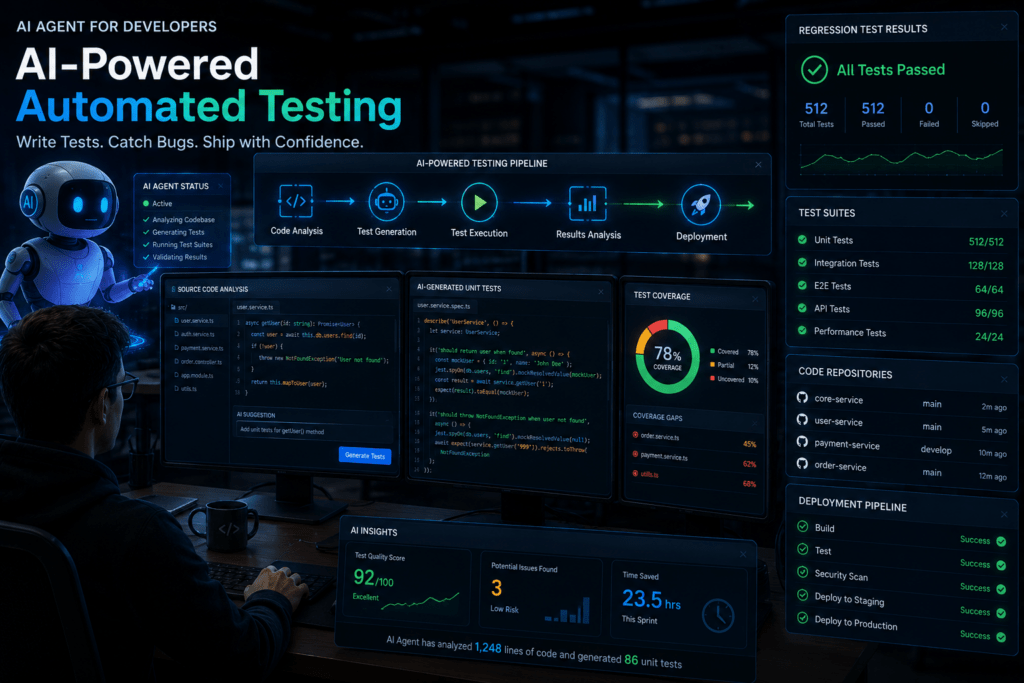
- Automated Test Generation
Developers frequently spend time writing unit tests and integration tests. Modern AI agents for developers can analyze code changes and automatically generate test cases that cover critical paths. This reduces manual effort while improving code coverage. - Regression Testing
Regression suites often grow large and difficult to maintain. AI agents for developers can identify impacted components and execute only the most relevant tests, reducing execution time and infrastructure costs. - Test Maintenance
When APIs or business logic change, tests often break. Instead of requiring engineers to manually update test scripts, AI agents for developers can identify outdated tests and suggest modifications automatically. - Bug Reproduction
Reproducing bugs is often a time-consuming process. AI agents can analyze logs, user actions, and error reports to recreate failure conditions, helping developers resolve issues faster.
AI Agents for Developers in Ticket Management
Engineering teams often struggle with growing backlogs and administrative overhead.
- Ticket Classification
Many organizations receive hundreds of tickets every week. AI agents for developers can categorize issues, assign labels, and route requests to the appropriate teams. - Priority Assignment
Not every issue deserves the same level of urgency. By analyzing business impact, customer reports, and system dependencies, AI agents for developers can recommend ticket priorities. - Requirement Summarization
Large feature requests often contain extensive discussions and documentation. AI agents can summarize requirements into concise engineering tasks. - Sprint Planning Support
During sprint planning, AI agents for developers can estimate effort, identify dependencies, and organize work items, helping teams make better planning decisions.
AI Agents for Developers in Monitoring and Incident Response
Operations teams generate massive amounts of monitoring data every day.
- Intelligent Log Analysis
Reviewing logs manually is inefficient. AI agents for developers can continuously analyze logs and identify unusual patterns before they become critical incidents. - Alert Correlation
Monitoring tools frequently generate alert storms. Instead of reviewing each alert individually, AI agents for developers can group related alerts and identify a common root cause. - Root Cause Investigation
When incidents occur, engineers often spend hours gathering evidence. AI agents can analyze infrastructure metrics, deployment history, application logs, and dependency changes to accelerate investigations. - Automated Postmortems
Creating incident reports can be tedious. AI agents for developers can generate timelines, summarize findings, and draft postmortem documents automatically.
AI Agents for Developers in CI/CD Automation
Continuous integration and continuous deployment pipelines involve numerous repetitive checks and validations.
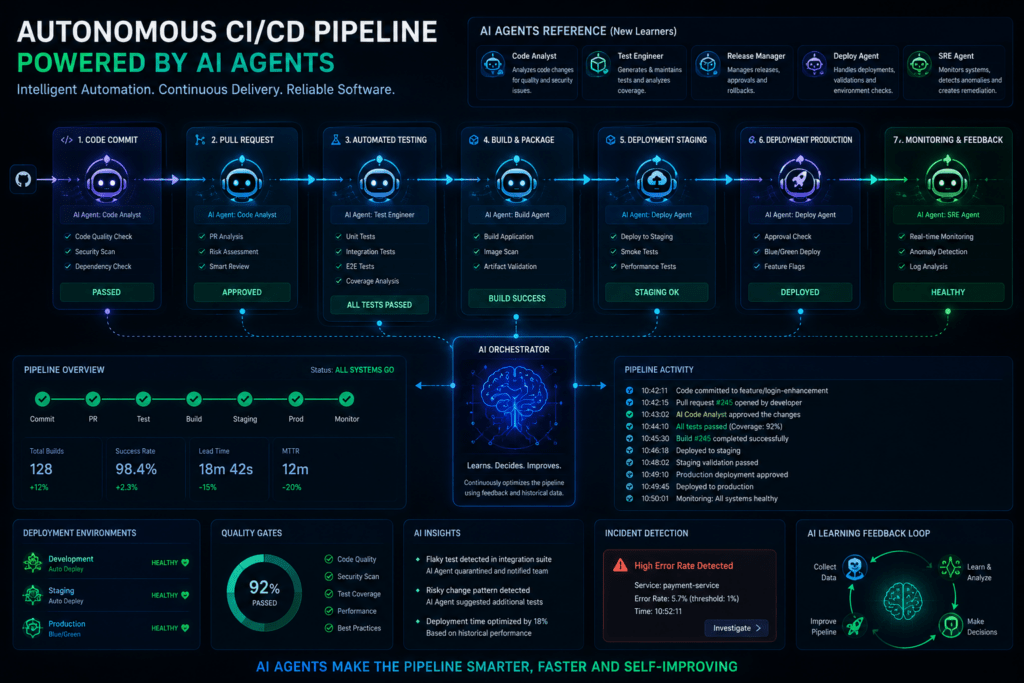
- Build Failure Diagnosis
When builds fail, developers often search through logs manually. AI agents for developers can identify likely causes and recommend fixes within minutes. - Pull Request Reviews
Code reviews are critical but time-consuming. AI agents can analyze pull requests, detect potential issues, identify security risks, and suggest improvements. - Deployment Validation
After releases, teams must verify system health. AI agents for developers can automatically validate deployments against predefined success criteria. - Release Documentation
Release notes frequently require manual compilation. AI agents can generate summaries based on commits, tickets, and pull requests.
Real-World Agentic Workflow Example
Imagine a bug report enters the system.
An engineering workflow powered by AI agents for developers might look like this:
- The ticket is automatically classified.
- Relevant logs are collected.
- Root cause hypotheses are generated.
- A code fix is suggested.
- Automated tests are created.
- CI/CD validation is executed.
- Deployment readiness is verified.
- Release notes are drafted.
Instead of requiring manual coordination across multiple tools, the entire workflow becomes streamlined through agentic automation.
Challenges and Best Practices
Despite their advantages, organizations should implement AI agents for developers carefully.
- Maintain Human Oversight
Critical engineering decisions should remain under human control. AI agents should augment engineers rather than replace them. - Establish Security Controls
AI agents often interact with repositories, infrastructure, and deployment systems. Access permissions must be managed carefully. - Monitor Agent Performance
Organizations should continuously evaluate accuracy, reliability, and operational impact. - Start Small
Teams should begin with low-risk automation opportunities before expanding to more complex workflows.
The Future of AI Agents Inside Engineering Teams
The next evolution of software engineering will likely involve multiple specialized agents collaborating together.
One agent may focus on testing, another on monitoring, and another on deployment management. Together, these systems will create highly automated engineering environments where repetitive work is handled autonomously.
As adoption increases, AI agents for developers will become as common as version control systems, CI/CD platforms, and cloud infrastructure tools. Teams that embrace agentic workflows today will be better positioned to deliver software faster, improve quality, and scale engineering operations efficiently.
Conclusion
Engineering teams face constant pressure to deliver software faster while maintaining quality and reliability. Much of the challenge comes from repetitive operational tasks that consume valuable developer time.
By automating testing, ticket management, monitoring, and deployment workflows, AI agents for developers enable teams to focus on higher-value engineering work. As agentic workflows become standard across the industry, organizations that successfully integrate AI agents for developers into their processes will gain significant advantages in productivity, scalability, and software delivery speed. Learn how to adapt AI with Newtum for a better career.
About The Author