There is a specific moment in many senior developers’ careers when they realize that writing excellent code is no longer the ceiling. The ceiling has moved. It is now somewhere above architecture reviews, mentoring conversations, delivery accountability, and team-wide technical judgment. Most senior engineers are not told when this shift happens. They feel it gradually — in the weight of decisions they are expected to own, in the trust stakeholders place in their recommendations, in the way junior developers start looking to them not just for code answers but for direction.
The arrival of AI development tools has accelerated this moment dramatically. In 2026, when AI can scaffold a service, generate boilerplate, and draft a first-pass architecture diagram in minutes, the defining question for senior engineers is not what can you build. It is how do you lead.
This post is about that shift. Specifically, it is about the tech lead skills AI era demands from senior developers — and the concrete thinking patterns, decision-making instincts, and team leadership behaviors that separate engineers who grow into tech leads from those who stay technically excellent but organizationally stagnant.
Why the Old Definition of “Senior” No Longer Holds
The classic definition of a senior developer was someone who could be handed a difficult problem and come back with a working solution. That definition rewarded depth of individual implementation skill.
The tech lead skills AI era now prizes are not about what you implement. They are about what you decide, what you review, what you prevent, and what you build in the people around you.
AI handles more of the implementation surface every sprint. GitHub Copilot autocompletes functions. Code agents generate test suites. LLMs draft API contracts and database schemas. If a senior developer’s primary value proposition is still “I write the hardest code,” they are operating in a shrinking lane.
The engineers who advance into tech lead roles today are those who understand that their leverage has shifted upstream — to the decisions that happen before anyone writes a line of code, and to the judgment that prevents bad AI-generated code from reaching production.
The LEAD Framework: Four Thinking Modes of an AI-Era Tech Lead
The behaviors that differentiate senior developers transitioning into tech lead roles cluster into four distinct modes. Together they form the LEAD Framework — a practical operating model for building the tech lead skills AI era environments demand:
- L — Listen to the system, not just the sprint
- E — Evaluate AI-generated architecture with structured skepticism
- A — Architect decisions explicitly, before implementation begins
- D — Deliver through teams, not through personal output
L: Listen to the System, Not Just the Sprint
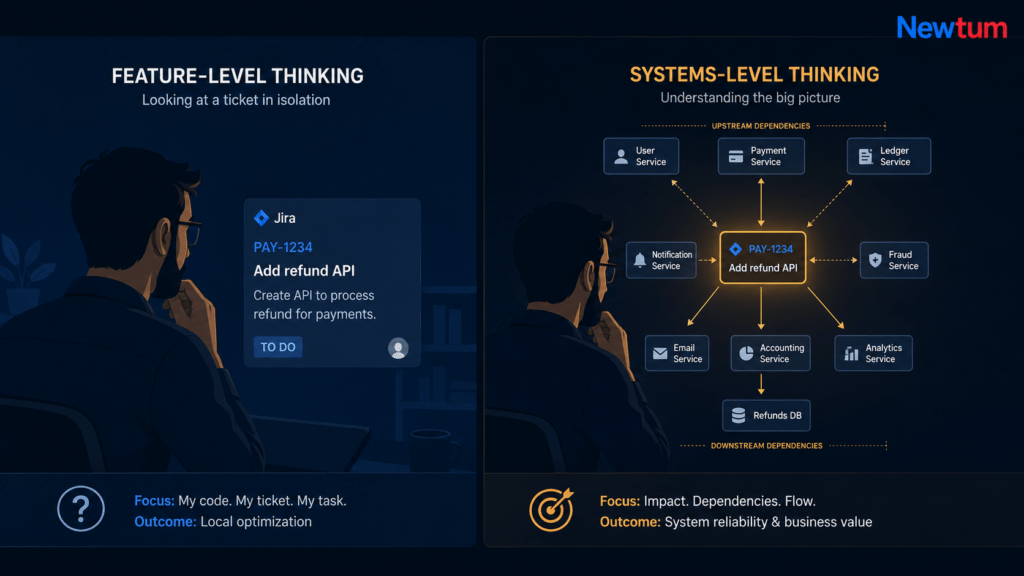
Most senior developers are good at listening within a sprint — they understand the ticket, they know the acceptance criteria, they can spot when a requirement conflicts with existing behavior.
Tech leads listen at a different resolution. They hear a product requirement and immediately ask: What does this do to the data model? What downstream systems does this touch? What assumption is this change making about how users behave?
This systems-level listening is harder when AI tools are in the room, because AI tools are very good at producing confident, plausible-sounding answers to narrow questions. An AI can tell you how to implement a feature. It cannot tell you whether that feature is architecturally coherent with the direction the system is heading in.
The tech lead’s first job is to hold that architectural direction in their head — and to translate every incoming request, whether from a product manager or from an AI tool, through that context before it becomes a task.
Practical habit: Before any major feature discussion, write a one-paragraph “architectural impact statement” — not in a ticket, just in a shared engineering channel — that explains how the proposed change fits or conflicts with the current system model. This surfaces conflicts early, before implementation begins, and trains the team to think in systems rather than features.
E: Evaluate AI-Generated Architecture with Structured Skepticism
This is arguably the most important of the tech lead skills AI era has made newly urgent. AI tools can now generate credible architecture diagrams, suggest service decompositions, and propose data models — quickly, and with surface-level coherence. They also get things wrong in ways that are not immediately visible.
AI-generated architecture tends to fail in three predictable patterns:
Pattern 1: Optimal in isolation, fragile in context. AI proposes a solution that is technically sound for the described problem but ignores how the system around it actually behaves. It does not know about the legacy service that will call this new endpoint, or the data pipeline that will break if the schema changes.
Pattern 2: Confident about the wrong tradeoff. AI will choose an architecture that optimizes for one dimension — say, latency — without flagging that this choice creates operational complexity that a small team cannot sustain.
Pattern 3: Missing constraints that are not in the prompt. AI does not know about the compliance requirement that rules out a cloud region, or the team skill gap that makes a certain framework a long-term maintenance liability.
The tech lead’s evaluation task is to review AI-generated architecture through the lens of what the AI cannot know: organizational context, team capability, political constraints, and long-term operational cost. The key review question is not “does this architecture work” — it is “does this architecture survive contact with our reality.”
Use the COST Review for every AI-generated architecture proposal:
| Dimension | The Question to Ask |
|---|---|
| Complexity | Is this more complex than the problem actually requires? |
| Operability | Can this team run this in production, including at 3am? |
| Survivability | What happens when one of these components fails? |
| Trade-off visibility | Does the design make its tradeoffs explicit or hide them? |
A: Architect Decisions Explicitly, Before Implementation Begins
One of the most underrated tech lead skills AI era development patterns expose is the discipline of making architectural decisions explicitly — before implementation begins.
Without AI tools, this discipline was enforced partly by the pace of development. It took time to build things, so there was a natural checkpoint between deciding and doing. AI tools compress that timeline dramatically. An engineer can go from “I think we should add a cache here” to a working implementation in thirty minutes.
That speed is a double-edged capability. When the underlying decision is sound, it is genuinely powerful. When the underlying decision is wrong, it creates a working-but-incorrect implementation that is significantly harder to reverse than a proposal on a whiteboard.
Tech leads in AI-accelerated teams establish a “decide before you generate” norm. This is not bureaucratic documentation. It means that for any change touching system boundaries — new services, external integrations, schema changes, significant refactors — the tech lead runs a brief decision checkpoint before AI-assisted implementation begins.
The three-question checkpoint:
- What are we actually deciding here, and why now?
- What is the reversibility cost if we get this wrong?
- Who needs to know about this decision and who is accountable for it?
These questions slow down the wrong things and accelerate the right things. They prevent teams from building quickly in the wrong direction — the specific failure mode AI-accelerated development enables most efficiently.
D: Deliver Through Teams, Not Through Personal Output
The fourth pillar of tech lead skills AI era practice is the one most senior developers resist longest: accepting that their primary delivery mechanism is now the team, not their own output.
This is uncomfortable because senior developers typically earned credibility through individual excellence. Transitioning to a model where success is measured by team outcomes — velocity, quality, knowledge distribution, psychological safety — feels less concrete and less controllable.
It is also more scalable by several orders of magnitude.
A senior developer who writes excellent code contributes one person’s output. A tech lead who improves a team of eight engineers by 20% has contributed the equivalent of 1.6 additional engineers — indefinitely, and compounding.
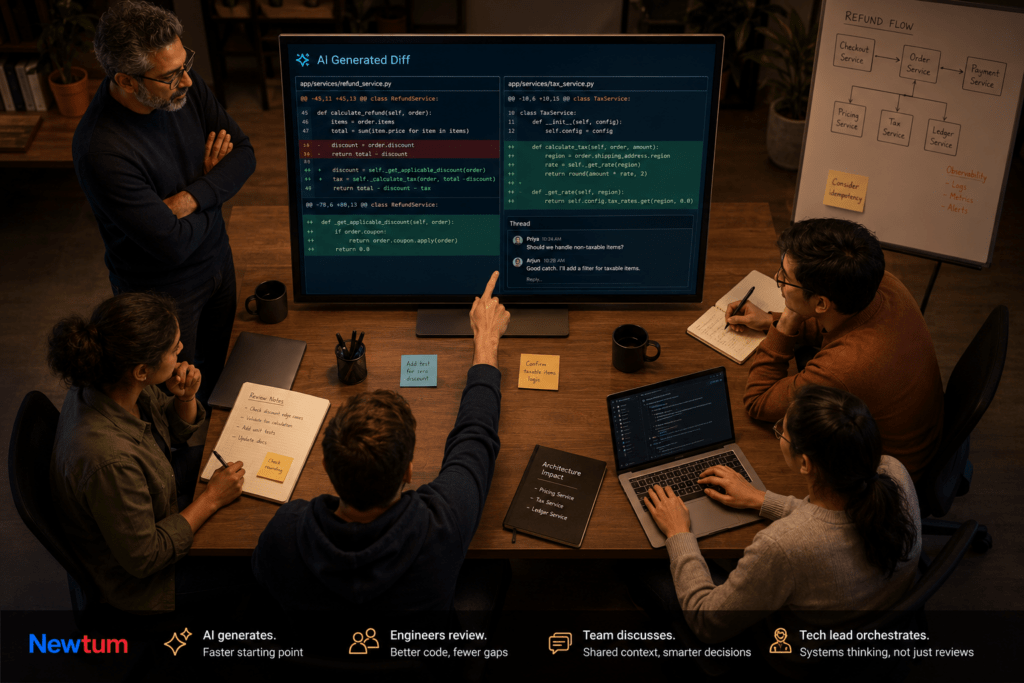
In the AI era, this multiplication effect is even more pronounced. A tech lead who establishes sound norms for how the team uses AI tools — what to generate, what to review, what to never accept without a second pass — is setting a standard that applies to every line of code the team ships. That influence shows up in production reliability, review quality, and team capability over time.
Mentoring in the AI Era: What It Looks Like Now
Mentoring looks different when AI tools are part of the workflow. The classic model — senior developer reviews junior developer’s code and explains what to fix — still matters. But it is no longer sufficient.
The new mentoring work that tech lead skills AI era practice requires includes:
- Teaching prompt discipline.
Junior developers using AI tools often prompt for the answer rather than for the reasoning. A tech lead mentors by asking “before you accept that output, can you explain why the AI made that choice?” — not to gatekeep AI use, but to ensure the junior developer retains the judgment layer the AI is not providing. - Calibrating confidence in AI output.
Junior developers tend to either over-trust or under-trust AI-generated code based on recent experience rather than structural reasoning. Tech leads build the framework: trust AI for well-defined, bounded problems; verify carefully for anything touching system boundaries or business logic; never trust AI for security-sensitive code without independent review. - Making failure visible and recoverable.
In an AI-accelerated environment, teams generate a lot of code quickly — which means failures are also generated quickly. Tech leads who create psychological safety around AI-assisted mistakes build teams that catch problems early and improve continuously.
Delivery Ownership: The Accountability Shift That Defines Tech Leads
The most definitive of the tech lead skills AI era demands is full delivery ownership — being accountable not just for your own code, but for whether the team ships something that works, is maintainable, meets the business requirement, and leaves the codebase in better shape than it found it.
Delivery ownership means the tech lead notices when a sprint is off track before the retrospective. It means having a position on whether a deadline should be renegotiated or hit at reduced scope. It means being the person who has the conversation with the product manager when an original estimate turns out to be wrong — and explaining why in terms of business impact rather than technical detail.
This accountability surface is broader than most senior developers are used to. It is also where career leverage accumulates fastest. Engineers who own delivery outcomes — not just personal deliverables — become the people organizations cannot afford to lose.
Building These Skills Without a Title Change
The behaviors and thinking patterns in this post can be practiced at the senior developer level, in the context of existing projects — no title change required.
- Listen at the system level in sprint planning, not just in ticket review.
- Volunteer to run the architectural review on the next significant feature.
- Draft the COST review for the next AI-generated proposal your team adopts.
- Run the three-question checkpoint before your team starts implementing something significant.
- Mentor one junior developer explicitly on how to evaluate AI output, not just how to generate it.
These practices build the credibility, the judgment, and the organizational visibility that tech lead roles require. They are also the practices that make senior developers irreplaceable in an environment where AI handles more and more of the implementation work.
Conclusion
The senior developers who will define the next decade of engineering are not those who write the most impressive code. They are the ones who make the best decisions, review AI-generated work with structured judgment, grow the people around them, and own outcomes end-to-end.
The tech lead skills AI era demands are not about becoming less technical. They are about applying technical depth at a higher level of leverage — where the impact is architectural, organizational, and compounding rather than individual and contained.
The ceiling has moved. The question is whether you move with it.
Learn to adapt AI with Newtum for a better career.
About The Author