
Modern development has fundamentally changed. AI tools can now generate code, suggest APIs, and even scaffold full services. But despite this, one thing remains non-automatable: system design thinking.
This is where system design for junior developers AI becomes critical. Developers who rely only on prompting AI without architectural understanding quickly hit a ceiling systems break at scale, not at syntax.
The reality is simple: system design for junior developers AI is no longer an advanced topic; it is an early-career requirement.
Here is a cleaned, structured, and more professional version of your section with better flow, reduced repetition, and stronger conceptual clarity while preserving your intent.
What “System Design for Junior Developers AI” Really Means Today
Traditionally, system design was treated as an advanced topic reserved for senior engineers who already had experience with distributed systems and production-scale architectures. However, in the AI era, that boundary has effectively dissolved.
Today, system thinking is no longer optional for junior developers—it is foundational.
At its core, this shift means junior developers are expected to move beyond writing isolated features and start understanding how entire systems behave, scale, and fail.
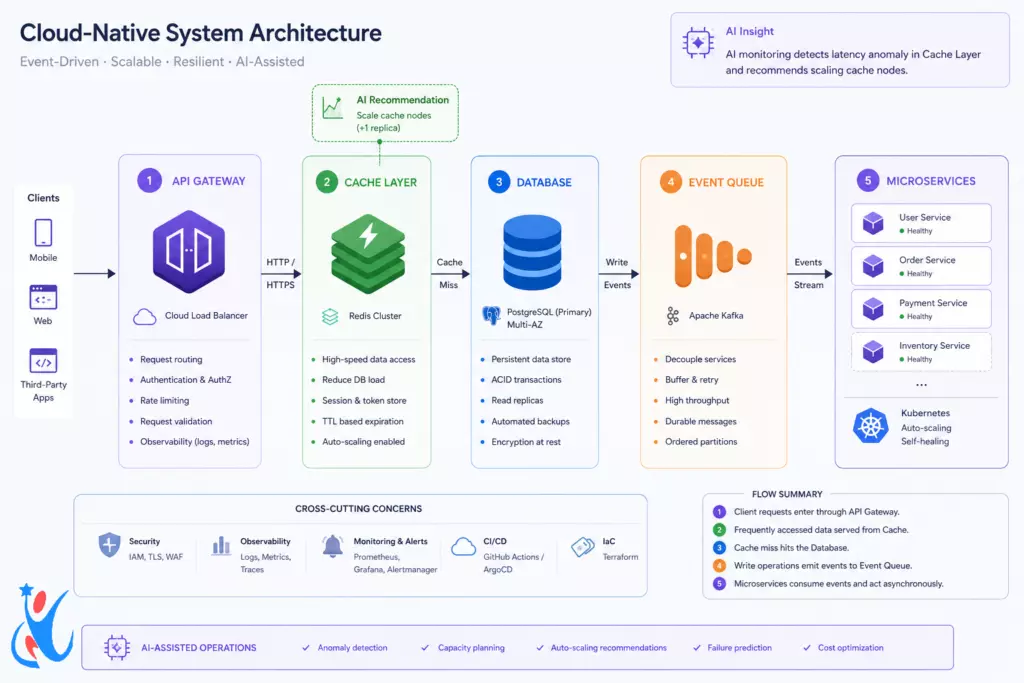
What This Actually Means in Practice
Modern system design expectations for junior developers include:
- Understanding how multiple services interact within a system
- Designing APIs as contracts, not just endpoints
- Thinking in distributed system patterns early in their career
- Evaluating trade-offs such as latency, consistency, availability, and cost
- Recognizing how data flows across services, not just within a single application
Instead of asking AI to “build a backend,” developers now need to define what the backend should look like, how it should behave, and how it should scale. That distinction is what separates coding from engineering.
Why AI Has Changed the Learning Order for Developers
AI has fundamentally inverted how developers learn and grow.
Earlier Learning Path (Traditional Model)
- Learn syntax
- Learn frameworks
- Learn system design
This worked when experience accumulated gradually through manual coding and production exposure.
Modern Learning Path (AI-Augmented Model)
- Learn system design fundamentals early
- Use AI to accelerate implementation
- Iterate using feedback, testing, and architecture refinement
The key shift is this: AI now handles implementation speed, not architectural correctness.
Without system thinking, AI becomes a code generator rather than a reasoning partner.
Even advanced tooling built on platforms like Kubernetes-style container orchestration systems can generate scalable deployments—but they cannot validate whether the architecture itself is sound without human design input.
Core Building Blocks Every Junior Developer Must Master Early
Modern software systems are composed of a few fundamental primitives. Understanding these early is essential.
APIs: The Communication Layer
APIs define how systems communicate and interact. In modern engineering, they are not just endpoints—they are explicit contracts between services.
Poor API design typically leads to:
- Tight coupling between services
- Difficult versioning and backward compatibility issues
- Scaling bottlenecks due to rigid interfaces
Strong API thinking focuses on clarity, stability, and evolution over time.
Databases: The System Memory
Databases such as PostgreSQL form the backbone of most applications.
Key design considerations include:
- Choosing between relational and non-relational models
- Indexing strategies for performance optimization
- Read vs write scaling patterns
- Consistency models and data integrity trade-offs
Understanding data architecture is central to building reliable systems.
Caching: Speed at Scale
Caching systems like Redis play a critical role in reducing latency and system load.
Core concepts include:
- Cache-aside and write-through patterns
- TTL (Time-To-Live) design strategies
- Cache invalidation challenges and strategies
Caching is often the difference between a system that works and a system that scales.
Queues: Decoupling System Workflows
Message streaming systems like Apache Kafka enable asynchronous, event-driven architectures.
They are essential for:
- Decoupling tightly connected services
- Handling traffic spikes gracefully
- Enabling event-driven workflows across distributed systems
Queues introduce resilience and flexibility into system design.
Scalability: Thinking Beyond a Single Machine
Modern systems must be designed with growth in mind from day one.
Key scalability principles include:
- Horizontal scaling instead of vertical scaling
- Load balancing across services
- Stateless service design for elasticity
Scalability is not a feature—it is a design constraint.
Observability: Understanding Production Reality
Observability ensures that systems are understandable once deployed.
It includes:
- Structured logging for debugging
- Metrics for system health monitoring
- Distributed tracing for request flow analysis
Without observability, systems become black boxes that are impossible to debug under real-world conditions.
AI-Assisted System Design: The New Learning Accelerator
AI is not replacing system design for junior developers AI—it is fundamentally amplifying how it should be learned and applied.
The real shift is that AI has moved from being a code generator to a thinking partner, but only for developers who already understand system fundamentals.
Instead of using AI for random prompting or boilerplate generation, junior developers should deliberately use it to strengthen architectural reasoning.
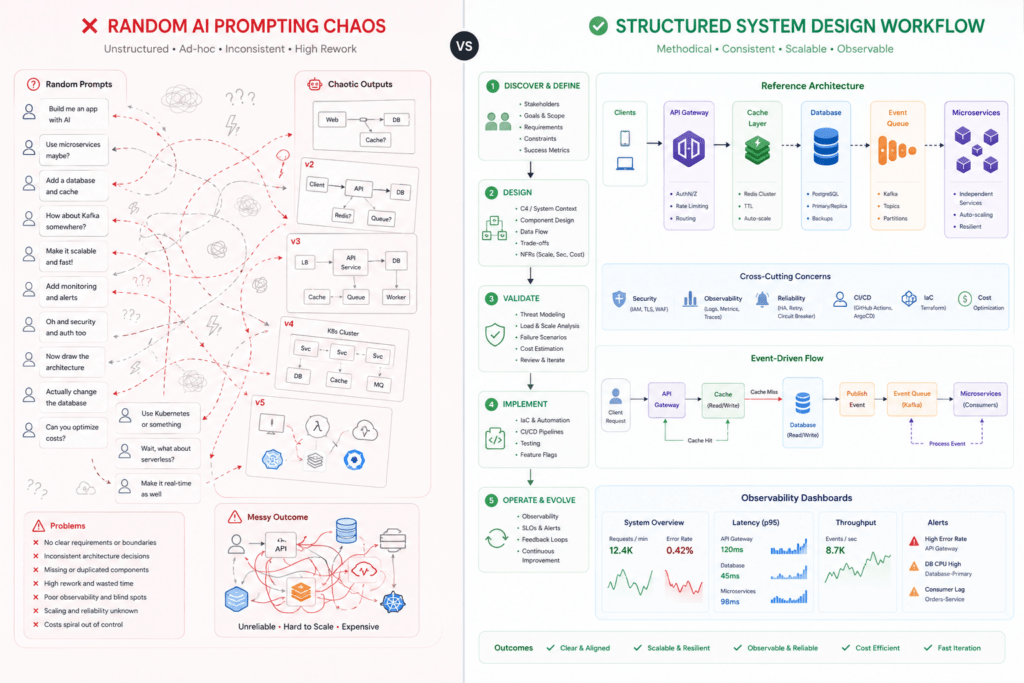
How to Use AI Effectively in System Design
Rather than asking AI to “build a system,” juniors should focus on structured design interactions such as:
- Asking AI to critique an existing architecture and identify bottlenecks
- Simulating failure scenarios like database outages, traffic spikes, or cache breakdowns
- Comparing multiple architectural approaches (e.g., monolith vs microservices, synchronous vs asynchronous systems)
- Stress-testing design assumptions around scalability, latency, and cost
This transforms AI from a shortcut tool into a design review engine.
The ultimate goal of system design for junior developers AI is not faster code generation—it is stronger design reasoning and better engineering judgment.
Learn more: https://blog.newtum.com/how-to-become-ai-augmented-backend-developer/
Common Mistakes Junior Developers Make Without System Design Thinking
When system design for junior developers AI is missing from a junior developer’s skill set, certain predictable failure patterns emerge. These issues are not syntax-related—they are architectural.
- Overusing Monolithic Architectures
Many juniors default to monoliths because they are easier to build, but they often fail to recognize scalability and maintainability constraints. Without system thinking, decomposition strategies are not applied correctly. - Ignoring Latency and Performance Costs
A frequent blind spot is assuming all service calls are “instant.” In real distributed systems, network latency, serialization overhead, and database access patterns significantly impact performance. - Skipping Caching Strategies Entirely
Without exposure to system design for junior developers AI, caching is often omitted completely, leading to unnecessary database load and poor response times under scale. - Over-Reliance on AI-Generated Scaffolding
Junior developers increasingly depend on AI-generated project structures without understanding underlying trade-offs. This creates fragile systems that are difficult to debug or scale. - Failure Under Real-World Load Conditions
Tutorial applications work in controlled environments, but production systems behave differently under:
- High traffic spikes
- Concurrent user loads
- Partial system failures
Without system design grounding, these failures are unexpected and often catastrophic.
These mistakes rarely appear in learning environments. They only surface in production systems—exactly where engineering maturity is tested. At its core, system design for junior developers AI exists to prevent these gaps between “it works locally” and “it works at scale.”
Practical Learning Path for “system design for junior developers AI”
A structured approach:
- Learn HTTP and REST deeply
- Understand database fundamentals
- Study caching patterns
- Learn event-driven systems
- Practice designing small systems (URL shortener, chat app)
- Use AI to review your designs
This progression ensures system design for junior developers AI becomes instinctive, not theoretical.
Hands-on Architecture Thinking with Real-World Stack Examples
A typical production-grade system in system design for junior developers AI often includes:
- API Layer: Node.js or Python-based services
- Database: PostgreSQL for structured data storage
- Cache Layer: Redis for low-latency access optimization
- Event Streaming: Apache Kafka for asynchronous processing
- Orchestration: Kubernetes for container management and scaling
This is not advanced or niche engineering—it represents the baseline literacy expected in modern system design for junior developers AI workflows.
Final Takeaway: Think in Systems, Not Snippets (50 words)
The biggest shift in modern engineering is simple: AI writes code, but systems define success. Without system design for junior developers AI, developers remain dependent on tools rather than understanding architecture. Those who invest early in system design for junior developers AI evolve from implementers into true system thinkers. Learn to adapt AI with Newtum for a better career.
About The Author