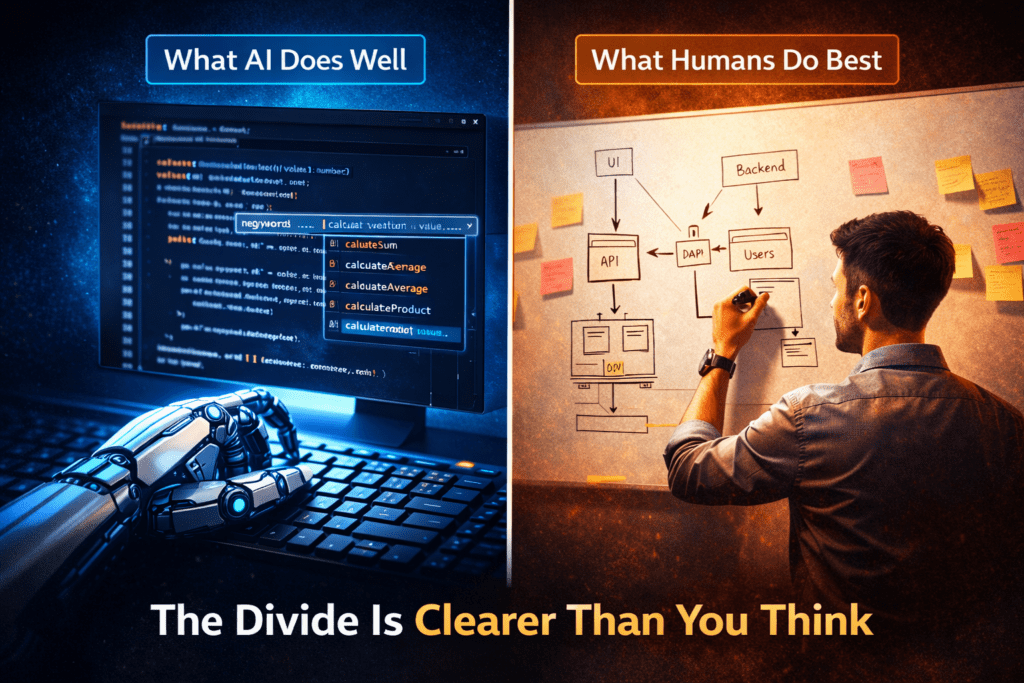
Artificial intelligence is writing functions, generating boilerplate, catching syntax errors, and even suggesting entire modules. Tools like GitHub Copilot, Cursor, and Claude are reshaping how software gets built, and the industry knows it. But here is the question every developer is quietly asking: Which parts of my job are truly mine?
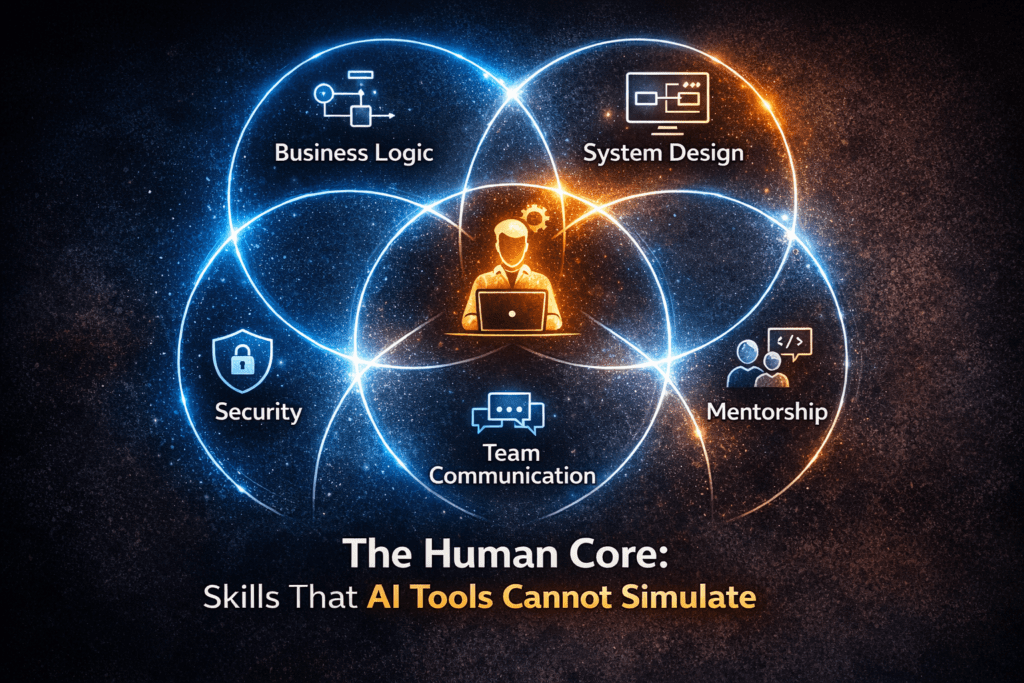
The answer is more reassuring than most headlines suggest. While AI has become a powerful co-pilot for routine coding tasks, there is a clear and growing category of coding skills AI cannot replace, skills rooted in judgment, context, creativity, and human accountability. These are the skills that determine whether a system survives its first year in production, whether a team ships something users actually trust, and whether a developer grows into a senior engineer or stays stagnant.
This blog walks you through exactly 10 of those irreplaceable skills, and why developing them is the smartest career move you can make right now.
1. System Design & Architecture Thinking
When you are building a feature, AI can help. When you are designing a system that needs to scale to ten million users without becoming a maintenance nightmare three years from now, that is a different conversation entirely.
System design requires understanding tradeoffs that are unique to your team’s size, your company’s budget, your users’ behavior, and your infrastructure constraints. No prompt can capture all of that context. The ability to choose between a monolith and microservices, decide when eventual consistency is acceptable, or know that your current database will buckle under write pressure in eighteen months, this is one of the core coding skills AI cannot replace because it demands lived, contextual judgment over raw pattern recognition.
2. Debugging Complex, Real-World Systems
AI is decent at spotting bugs in isolated code snippets. It is considerably less useful when your bug lives at the intersection of a race condition, a misconfigured load balancer, and a third-party API that behaves differently under high load on Thursday afternoons.
Real-world debugging is detective work. It requires forming hypotheses, eliminating variables, reading logs with intuition, and knowing which corner of the codebase to even look in. These are coding skills AI cannot replace because they depend on mental models of living systems, not clean, decontextualized code.
3. Security Mindset & Ethical Coding
AI tools can flag common vulnerabilities like SQL injection or cross-site scripting. What they cannot do is reason about trust boundaries in your specific application, evaluate whether an API design creates subtle authorization leaks, or ask the uncomfortable question: Should we even be collecting this data?
Security is partly technical, but it is fundamentally a mindset one shaped by curiosity about how systems can be abused and a deep ethical commitment to protecting users. Ethical coding decisions about privacy, accessibility, and fairness in algorithms require human moral reasoning. This is an area of coding skills AI cannot replace, not because the tools lack data, but because they lack accountability and conscience.
4. Cross-Team Technical Communication
A senior developer’s greatest leverage is not the code they write- it is the clarity they bring to ambiguous situations. Explaining to a product manager why a feature will take three weeks, not three days. Aligning engineering, design, and legal on a data handling decision. Walking a non-technical executive through the tradeoffs of two architecture choices.
AI can draft a technical document. It cannot navigate the room, read who is frustrated, who is confused, who has an unstated objection, and adapt in real time. Communication at the intersection of technical depth and human dynamics remains one of the coding skills AI cannot replace.
5. Domain-Specific Business Logic Judgment
Every industry has rules that live in no textbook. Healthcare has compliance edge cases that evolved over decades of litigation. Fintech has risk models tied to regulatory interpretations. E-commerce has pricing logic baked in from a business decision made in 2017 that nobody documented.
Understanding why the code is written the way it is, and whether a proposed change breaks a business invariant that no test currently covers, is one of the most underrated and most human coding skills AI cannot replace. Domain fluency combines technical knowledge with institutional memory, and that cannot be generated from a prompt.
6. Code Review with Contextual Judgment
Automated linters and AI review tools can catch style inconsistencies and flag potential bugs. But a meaningful code review goes far deeper. It asks: Does this change fit the existing patterns of the codebase? Does this abstraction make sense given where the product is heading? Will the next developer who reads this understand what was intended?
Good code review is mentorship in disguise. It transfers taste, standards, and architectural vision. These are coding skills AI cannot replace because they are anchored in the long-term health of a specific codebase, not a generalized notion of “clean code.”
7. Performance Optimization Under Real Constraints
AI can suggest general performance improvements, such as memoization, indexing, and lazy loading. But squeezing 40% more throughput out of a legacy pipeline that handles payroll for 80,000 employees, while keeping a two-hour deployment window and zero tolerance for data loss, is a very different challenge.
Real performance work requires profiling under production-like conditions, understanding hardware behavior, knowing which bottleneck to tackle first, and accepting that the theoretically optimal solution might not be the safely deployable one. This level of constrained, high-stakes optimization places performance tuning among the coding skills AI cannot replace in professional environments.
8. Legacy Code Interpretation & Refactoring
Every experienced developer has opened a file and thought, “What was this person thinking?” – only to realize, twenty minutes later, that they were solving a very hard problem in a very clever, if undocumented, way.
Interpreting legacy code requires patience, historical curiosity, and the ability to reconstruct intent from implementation. Refactoring it safely requires understanding the blast radius of every change. AI tools can read code. They cannot understand the organizational history, the product pivots, or the production incidents that shaped it. This makes legacy code work a deeply human skill, and firmly part of coding skills AI cannot replace.
9. Creative Problem-Solving & Algorithmic Invention
AI models are excellent at recombining patterns they have seen before. When the solution space is genuinely novel, when you are building at the edge of what has been done, they reach their limit quickly.
Inventing a new data structure to solve a performance problem that nobody has framed quite this way before, designing a distributed coordination mechanism for a unique failure mode, or finding an elegant algorithm where brute force is unacceptable – these require creative leaps that are still fundamentally human. Original algorithmic thinking is one of the most intellectually exciting coding skills AI cannot replace and one of the most career-defining.
10. Mentorship & Knowledge Transfer
The most underestimated skill in software development is the ability to grow the people around you. Answering questions in a way that builds long-term understanding rather than providing a quick fix. Knowing when to let a junior developer struggle and when to step in. Creating a culture of craft.
AI can explain concepts. It cannot build the psychological safety that allows a junior developer to ask “stupid” questions without fear. It cannot notice that someone on the team is losing confidence and needs encouragement, not documentation. Mentorship is relational at its core, and it will always remain one of the coding skills AI cannot replace.
Conclusion
The rise of AI coding tools is not a threat to developers who understand where human judgment begins. The 10 skills covered here, system design, real-world debugging, security ethics, communication, domain knowledge, contextual code review, constrained optimization, legacy code work, creative problem-solving, and mentorship, define the irreplaceable human layer in software development.
These are not soft skills bolted onto a technical career. They are the skills that determine architectural quality, production reliability, team culture, and long-term product health. They are the reason experienced developers are paid more, trusted more, and promoted more – AI or not.
If you want to future-proof your career, double down on these coding skills AI cannot replace. Build systems that survive. Debug things that are actually broken. Mentor people who will outlast any tool. The developers who do this will not just survive the AI era – they will define it. Visit Newtum for more informative blogs.
About The Author