What if your career growth was mapped in real time—just like a fitness tracker monitors your health?
Instead of guessing your next move or waiting for an annual review, imagine seeing your skills evolve continuously, with clear signals on where to improve and what opportunities lie ahead.
Continuous skill assessment using AI enables organizations to track evolving employee skills, personalize learning, and guide career growth beyond the hiring stage.
Unlike traditional assessments that end once a candidate is onboarded, AI-driven assessments function as living systems—constantly learning, adapting, and evolving alongside the employee. They transform assessment from a one-time checkpoint into an ongoing career companion.
Problem Statement: Why Traditional Assessments Fail Post-Hiring
Most organizations invest heavily in assessments during recruitment, but once the offer letter is signed, measurement stops.
This creates several critical challenges:
- Assessments end at hiring, leaving no structured way to track skill progression afterward
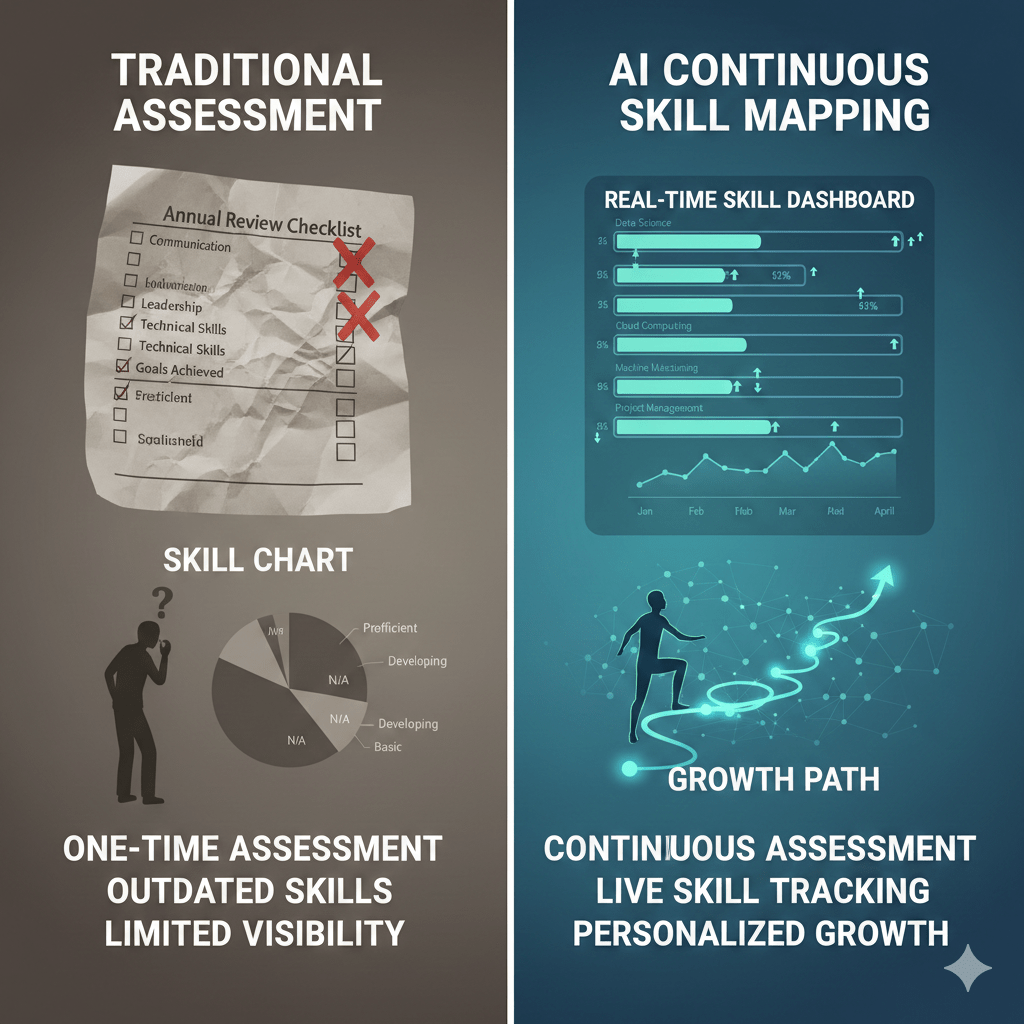
- Skills evolve faster than annual performance reviews, making evaluations outdated almost immediately
- Managers lack visibility into hidden or emerging skills, especially in fast-changing roles
- Employees feel stuck, unsure of what skills to build or how to move forward in their careers
As roles change and new technologies emerge, this disconnect leads to stagnation—for both employees and organizations.
This gap between hiring and long-term growth is where AI-powered continuous skill mapping changes everything.
AI-Powered Solution: Continuous Skill Mapping in Action
🔹 What Is Continuous Skill Assessment Using AI?
Continuous skill assessment using AI is an ongoing, data-driven approach to understanding employee capabilities over time. Instead of relying on static tests, AI evaluates skills through:
- Micro-assessments embedded into daily work
- Behavioral, cognitive, and performance data analysis
- Adaptive models that evolve as roles and business needs change
This allows organizations to maintain a real-time skills inventory that reflects reality—not outdated job descriptions.
🔹 Personalized Learning Recommendations
AI doesn’t just identify gaps—it actively guides improvement. Based on assessment insights, AI can recommend:
- Targeted courses aligned with individual skill gaps
- Real-world projects that reinforce learning through practice
- Mentorship opportunities matched to career aspirations
The result is a learning journey that aligns employee ambitions with business priorities, making development purposeful rather than generic.
🔹 Predictive Career Pathing
One of the most powerful advantages of AI-driven skill mapping is its predictive capability. By analyzing trends over time, AI can:
- Identify future leaders early, before titles or promotions appear
- Detect reskilling needs before performance declines
- Enable internal mobility, reducing dependence on external hiring
Instead of reacting to talent gaps, organizations can proactively shape career paths—benefiting both employees and the business.
Benefits for All Stakeholders
Continuous skill assessment using AI creates value across the entire talent ecosystem. By turning skills into measurable, evolving data, organizations unlock benefits that extend far beyond individual performance reviews.
👩💼 Benefits for Employees
For employees, AI-driven skill mapping brings clarity to career growth—something traditional systems often fail to provide.
- Clear visibility into strengths and skill gaps
Employees gain a real-time understanding of where they excel and which skills need development, eliminating guesswork from self-improvement. - Personalized career roadmaps
Instead of generic training plans, AI creates tailored growth paths aligned with individual goals, role requirements, and future opportunities. - Faster, data-backed growth decisions
Promotions, role changes, and learning investments are supported by objective insights, helping employees progress with confidence and purpose.
🏢 Benefits for Employers
From an organizational perspective, continuous skill assessment using AI transforms talent management into a proactive strategy.
- Reduced attrition and hiring costs
When employees see clear growth pathways, engagement improves—lowering turnover and decreasing the need for expensive external hiring. - Stronger succession planning
AI identifies high-potential talent early, ensuring leadership pipelines are built well before critical roles become vacant. - Better ROI on L&D investments
Learning initiatives become targeted and measurable, ensuring resources are spent on programs that deliver real skill impact.
Industry-Wide Impact
At a macro level, AI-powered skill mapping supports workforce resilience in a rapidly changing economy.
- An agile workforce prepared for fintech innovation
- Reskilling at scale for climate tech transformation
- Adaptability amid rapid digital disruption
By continuously aligning skills with emerging industry demands, AI assessments help future-proof not just organizations—but entire sectors.
Case Study Angle: How a Fintech Firm Used AI Assessments to Grow Leaders from Within
Consider a mid-sized fintech company operating in a highly competitive market where technology, compliance, and customer expectations evolve rapidly. Like many growing organizations, the company relied on traditional performance reviews and one-time skill assessments conducted at the time of hiring.
To move beyond reactive talent decisions, the firm introduced AI-powered assessments on a quarterly basis—not as exams, but as lightweight, continuous skill check-ins integrated into daily workflows.
What Changed?
Over time, the leadership team began to notice patterns that had previously gone unnoticed.
- High-potential employees were identified early
AI-driven insights revealed consistent growth in problem-solving, decision-making, and adaptability—traits often associated with future leadership—long before formal promotions were considered. - The leadership pipeline strengthened from within
Instead of searching externally for senior roles, managers could confidently invest in internal talent already aligned with the company’s culture and long-term goals. - Hiring costs gradually reduced
With internal mobility improving, the organization became less dependent on frequent external recruitment, saving both time and resources. - Employee retention improved through transparency
Employees reported greater confidence in their career progression because growth paths were visible, measurable, and backed by data rather than subjective opinion.
Key Takeaway
By using continuous skill assessment as a developmental tool—not a gatekeeping mechanism—the fintech firm shifted from talent replacement to talent cultivation, creating a more resilient and engaged workforce.
Future Outlook: AI Assessments as Living L&D Systems
AI assessments are rapidly evolving from standalone tools into living systems—deeply embedded within the broader Learning & Development ecosystem. The future isn’t about testing employees periodically; it’s about continuously understanding, supporting, and guiding their growth.
What’s Next?
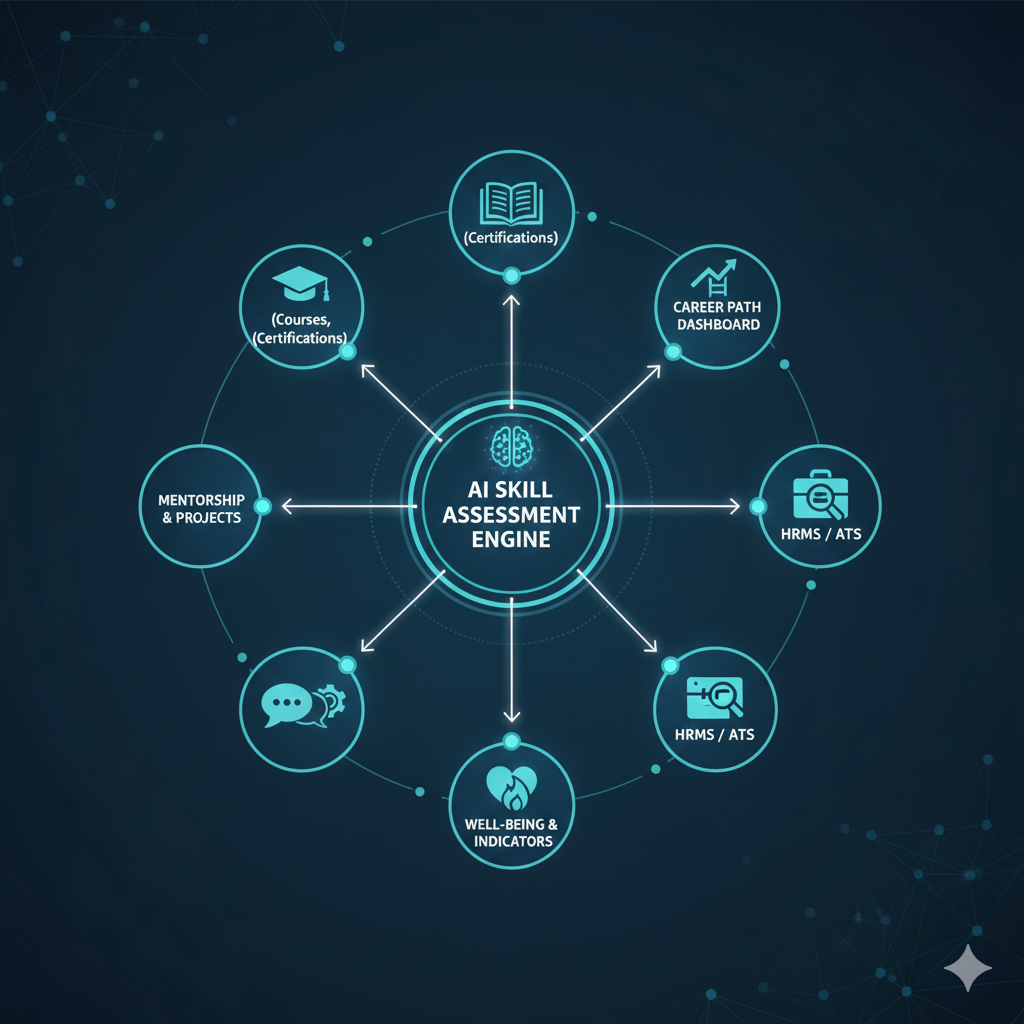
In the coming years, AI-powered assessments will become seamlessly integrated into core workplace platforms, including:
- Learning Management Systems (LMS)
Skill insights will directly inform learning content, enabling just-in-time upskilling rather than scheduled training programs. - HRMS & ATS platforms
Employee skills will remain visible from onboarding through leadership development, creating continuity across the entire talent lifecycle. - Career dashboards
Employees will have real-time access to their skill progression, growth opportunities, and readiness for future roles—turning career planning into a data-driven experience.
Emerging Integrations
The next wave of AI assessments will go beyond technical skills to support holistic development.
- Skill tracking combined with mental well-being indicators
AI systems will help identify learning fatigue, disengagement, or overload—ensuring growth remains sustainable. - Burnout risk detection
Patterns in performance, engagement, and cognitive load can signal burnout early, allowing organizations to intervene proactively. - Holistic employee development ecosystems
By connecting skills, learning, performance, and well-being, AI assessments will support people as complete individuals—not just job roles.
Closing Thought
AI assessments will no longer ask, “Is this person qualified?”
They will ask a far more powerful question:
“How can this person grow next?”
In doing so, they redefine assessment—not as a judgment, but as a continuous partnership in career development. For more information, visit our official site- Newtum
About The Author