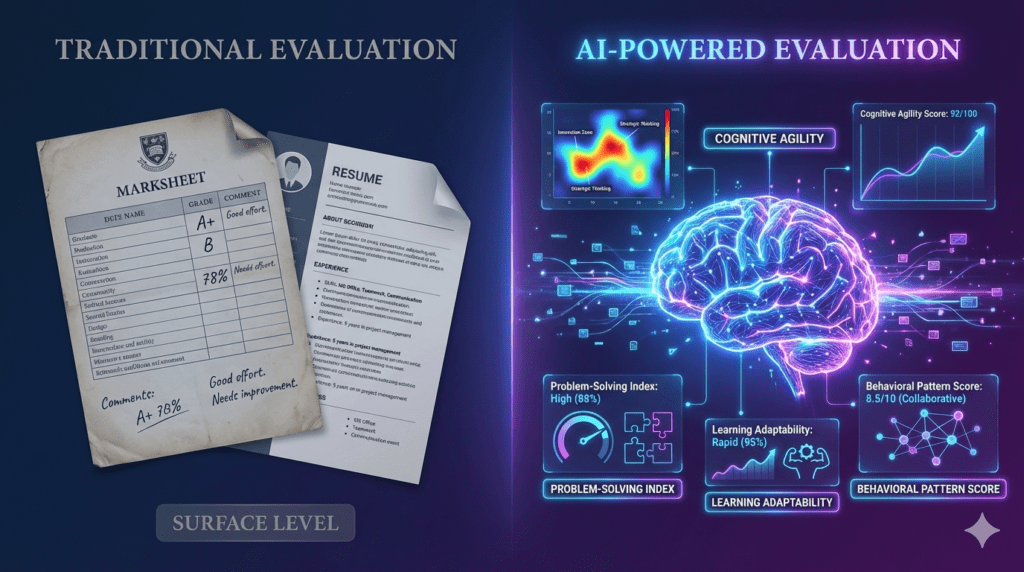
In today’s competitive landscape, hiring managers and educators face a critical challenge: traditional evaluation methods only scratch the surface of a candidate’s true potential. Marksheets display grades. Resumes list achievements. But neither reveals how someone thinks, adapts, or solves complex problems in real time.
This is where AI assessment tools are transforming talent evaluation. Instead of focusing only on past performance, AI-powered assessment platforms analyze cognitive patterns, behavioral responses, and learning agility. Organizations across industries are now using AI assessment tools to uncover hidden strengths that traditional credentials fail to capture.
As skills-based hiring and performance-based education gain momentum, intelligent evaluation systems are becoming essential for identifying true capability — not just academic history.
Organizations and institutions are increasingly adopting AI assessment tools to evaluate real-world capability. If you’re exploring how these platforms shape long-term growth, read our detailed guide on AI assessment tools for career guidance.
The Limitations of Traditional Evaluation Methods
What Grades Don’t Tell You
Academic transcripts measure memorization, exam performance, and structured learning. However, they rarely capture creativity, adaptability, or real-world problem-solving skills.
A student with high grades may struggle in ambiguous situations, while someone with average scores might possess exceptional analytical thinking that traditional exams never measured. Marksheets show outcomes — not thinking processes.
The Resume Blind Spots
Resumes present a curated narrative of experience. They highlight achievements but cannot demonstrate:
- Decision-making under pressure
- Learning agility
- Collaboration style
- Ethical reasoning
Additionally, resume embellishment makes it difficult to distinguish presentation skills from actual competence.
Unconscious Bias in Manual Evaluation
Human reviewers often carry unconscious bias. University prestige, employment gaps, or unconventional career paths may influence perception.
AI assessment tools reduce such bias by focusing on structured performance data rather than subjective interpretations of credentials.
Traditional Evaluation vs AI Assessment Tools
| Feature | Marksheets & Resumes | AI Assessment Tools |
| Measures real-time thinking | ❌ | ✅ |
| Adaptive testing | ❌ | ✅ |
| Multi-skill evaluation | Limited | Comprehensive |
| Bias reduction | Limited | Data-driven |
| Predicts future performance | ❌ | ✅ |
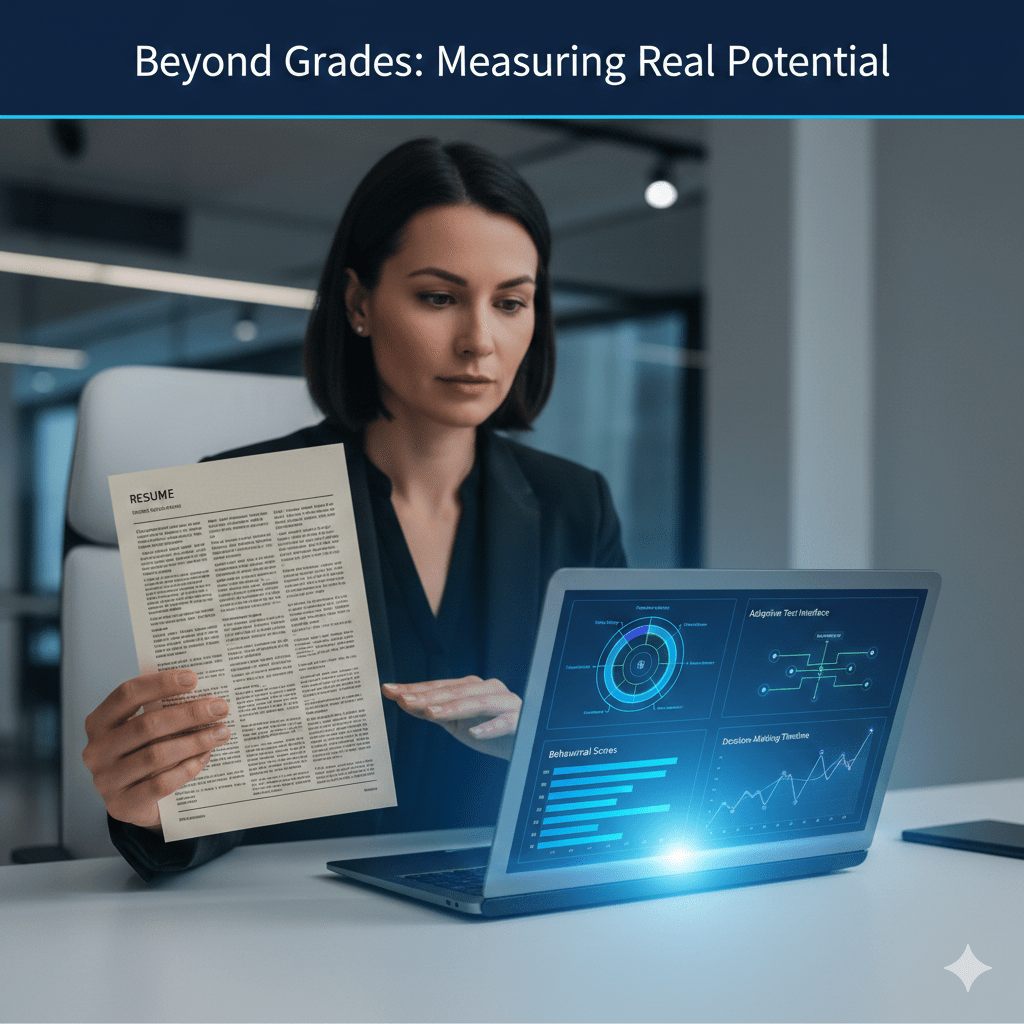
This shift from static documentation to dynamic performance measurement is redefining evaluation standards.
How AI Assessment Tools Work Differently
Unlike static credentials, AI assessment tools observe how individuals approach problems in real time. These AI-driven skill assessment platforms use machine learning and behavioral analytics to evaluate multiple dimensions simultaneously.
1. Behavioral Pattern Recognition
Instead of measuring just the final answer, intelligent evaluation systems analyze:
- Time taken per decision
- Strategy shifts
- Risk tolerance
- Error correction patterns
This reveals cognitive style and problem-solving approach — something a resume cannot capture.
2. Adaptive Testing Models
Advanced AI assessment tools adjust difficulty based on responses. If a candidate answers correctly, the system increases complexity. If they struggle, it recalibrates.
This ensures accurate measurement of true capability rather than standardized, one-size-fits-all testing.
3. Multi-Competency Mapping
Modern AI talent assessment platforms evaluate:
- Logical reasoning
- Emotional intelligence
- Learning agility
- Technical aptitude
- Communication style
All within simulated real-world scenarios.
4. Predictive Analytics
According to industry research, organizations using AI-powered assessment platforms report up to 30% improvement in hiring efficiency.
By analyzing thousands of performance data points, AI assessment tools predict future performance more accurately than resumes or transcripts alone.
LinkedIn reports that 76% of recruiters now prioritize skills over degrees, reinforcing the shift toward AI-based evaluation methods.
Key Insights AI Assessments Provide
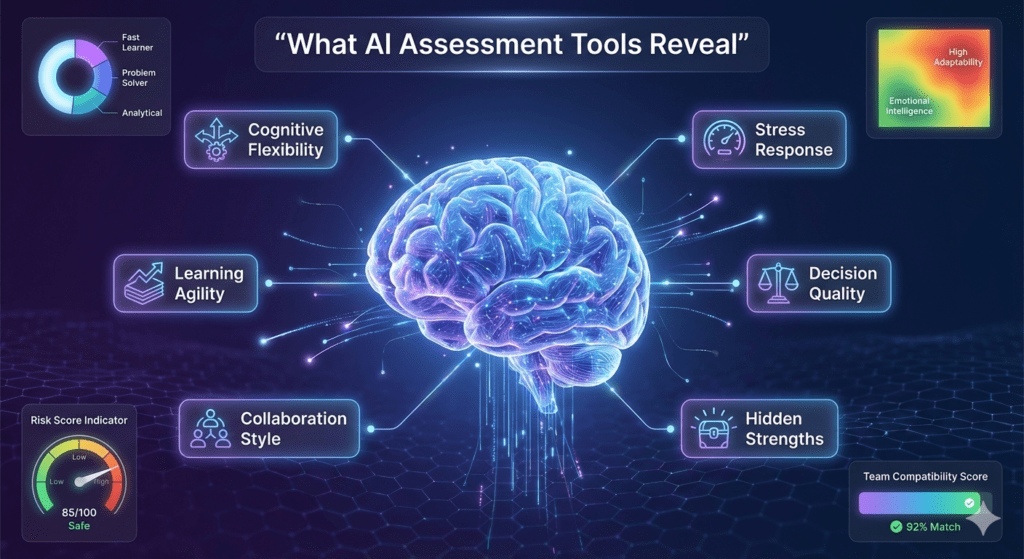
1. Cognitive Flexibility
AI assessment tools measure how quickly individuals adapt to new information and changing scenarios. This learning agility is critical in fast-evolving industries but invisible on a marksheet.
2. Problem-Solving Approach
Do candidates break problems into components? Do they explore alternative strategies?
AI-driven assessment platforms map cognitive pathways, revealing structured thinking, creativity, or risk-taking behavior.
3. Decision-Making Under Pressure
Through controlled time constraints and complexity variables, AI assessment tools evaluate stress response and judgment quality — key indicators of leadership potential.
4. Collaboration & Communication Style
Simulated team-based scenarios assess how individuals:
- Share information
- Resolve conflicts
- Contribute to collective goals
This insight is impossible to derive from individual academic records.
5. Hidden Strengths & Untapped Potential
One of the most powerful aspects of AI talent assessment is its ability to uncover overlooked abilities.
For example:
- Strong spatial reasoning in non-technical candidates
- Systems thinking in humanities graduates
- Analytical aptitude in career switchers
These discoveries expand talent pools beyond traditional academic filters.
Real-World Applications of AI assessment tools
Organizations across sectors are implementing AI assessment tools to improve decision-making:
- Technology companies identify coding aptitude beyond formal degrees.
- Healthcare institutions evaluate diagnostic reasoning through simulation-based AI-driven assessment.
- Financial firms assess risk analysis and ethical judgment in dynamic scenarios.
- Educational institutions use AI-powered assessment platforms to personalize learning pathways.
The global AI in HR market is projected to grow at over 20% CAGR, signaling strong adoption of intelligent evaluation systems.
The Future of AI Assessment
The future of AI assessment tools lies in continuous evaluation models rather than one-time testing. Emerging trends include:
- AI combined with neuroscience-based cognitive mapping
- Real-time workplace performance analytics
- Personalized skill development recommendations
- Continuous adaptive learning assessments
As organizations move toward capability-based ecosystems, AI-powered assessment platforms will become foundational to workforce strategy.
FAQs About AI Assessment Tools
1. Are AI assessment tools accurate?
Yes. When trained on high-quality data models, AI assessment tools provide predictive insights by analyzing behavioral and cognitive patterns rather than static credentials.
2. Do AI assessment tools replace interviews?
No. They enhance interviews by providing objective performance insights that guide deeper discussions.
3. Can AI assessments reduce hiring bias?
Yes. By focusing on structured performance data, AI-driven assessment platforms reduce unconscious bias related to background or pedigree.
4. Are AI assessment tools useful for students?
Absolutely. They help students identify strengths, learning styles, and career-fit pathways beyond grades.
5. Are AI assessment tools only for hiring?
No. They are used in education, leadership development, workforce planning, and performance management.
Conclusion
Marksheets reflect the past. Resumes summarize experience. But AI assessment tools reveal thinking patterns, adaptability, and true potential. As organizations shift toward skills-based evaluation, adopting AI-powered assessment platforms is no longer optional — it’s strategic. If you’re exploring how AI assessment tools can transform hiring, education, or workforce development, now is the time to move beyond credentials and unlock capability-driven decision making. For more information, visit more blogs on Newtum.
About The Author