

Type modifiers in C++ are keywords that change the size, range, or sign of basic data types. The main type modifiers in C++ are signed, unsigned, short, and long. They are most commonly used with int and char to control memory usage and value limits.
Type modifiers still matter because modern C++ is widely used in system software, embedded devices, and performance-critical applications. Interviewers frequently test this concept, and using the wrong modifier can cause overflow bugs or wasted memory. If you’ve noticed int behaving differently across systems, type modifiers explain why.
Key Takeaways of Type modifiers in C++
Type Modifier → Purpose
- signed → Allows both positive and negative values
- unsigned → Stores only non-negative values, increasing range
- short → Uses less memory for smaller numbers
- long → Supports larger numeric values
What Are Type Modifiers in C++?
Type modifiers in C++ are keywords that adjust the size, range, or sign of fundamental data types. Instead of creating new data types, they fine-tune how much memory a variable uses and what values it can store.
C++ needs type modifiers to give developers control over memory and performance. This is especially important in system-level programming, embedded systems, and high-performance applications where every byte and computation matters.
List of Type Modifiers in C++
signed in C++
By default, most integer types in C++ are signed, meaning they can store both positive and negative values. The highest bit is used to represent the sign.
Value range:
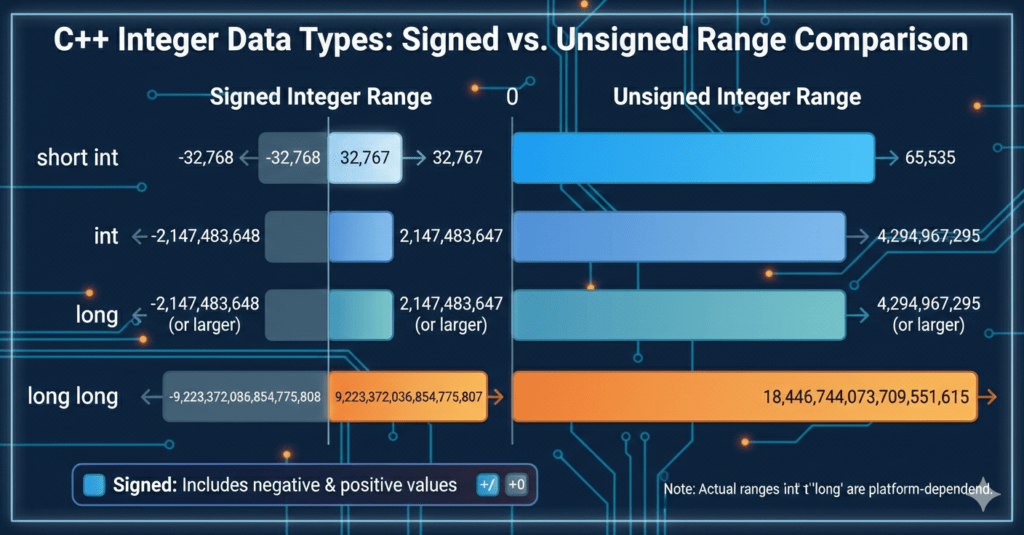
For a signed int, the range is typically −2,147,483,648 to 2,147,483,647 (on most systems).
Example code:
signed int temperature = -25;
cout << temperature;
unsigned in C++
The unsigned modifier removes the ability to store negative values. This allows all bits to represent positive numbers, which effectively doubles the maximum range.
Why the range doubles:
Since no bits are reserved for the sign, the entire bit range is used for value storage.
Common pitfalls:
- Unsigned variables can cause unexpected results in comparisons with signed values.
- Subtracting from zero can lead to large wraparound values.
When to use it:
Use unsigned for counters, indexes, or values that can never be negative.
unsigned int count = 4000000000;
short in C++
The short modifier reduces the memory size used by a variable compared to a regular int.
Memory usage:
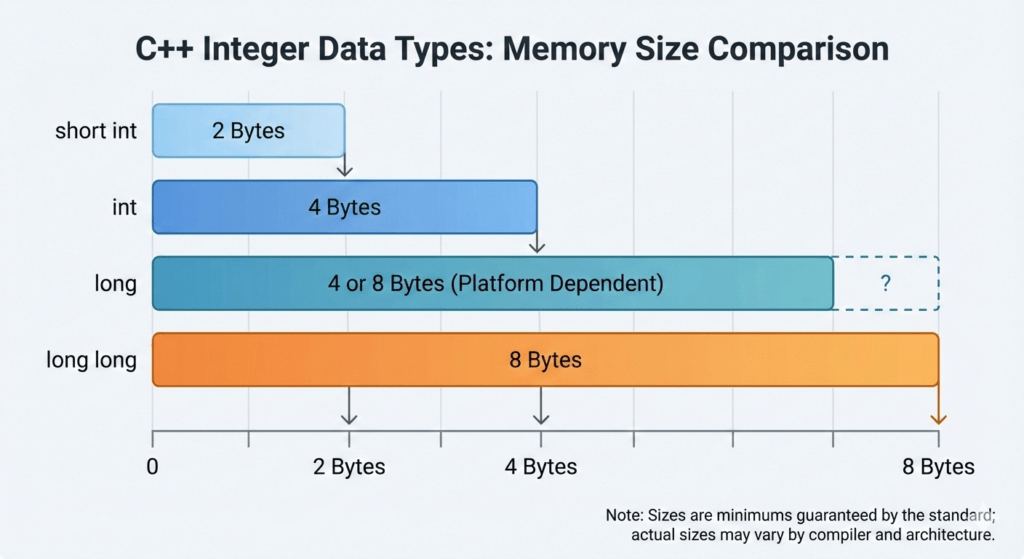
A short int typically uses 2 bytes of memory.
Typical size:
Range is usually −32,768 to 32,767 for signed short.
Best use cases:
- Memory-constrained systems
- Storing small numeric values
- Embedded and low-level applications
short int age = 18;
long in C++
The long modifier increases the size and range of integer values compared to int.
Difference between long and long long:
longis at least 4 byteslong longis at least 8 bytes and used for very large numbers
Platform dependency:
The size of long can vary between systems (32-bit vs 64-bit), which is why long long is preferred for portability.
long long population = 7800000000;
Which Data Types Support Type Modifiers?
Can type modifiers be used with float or double?
No. Type modifiers such as signed, unsigned, short, and long are primarily designed for integer types. Floating-point types like float and double already have fixed internal representations and do not support these modifiers.
Why are modifiers mostly used with int and char?
Because int and char are the most flexible and commonly used primitive types in C++. Modifiers allow developers to adjust their memory usage and value range precisely, making them ideal for performance-critical and system-level programming.
Comparison of Type Modifiers in C++ Comparison Table
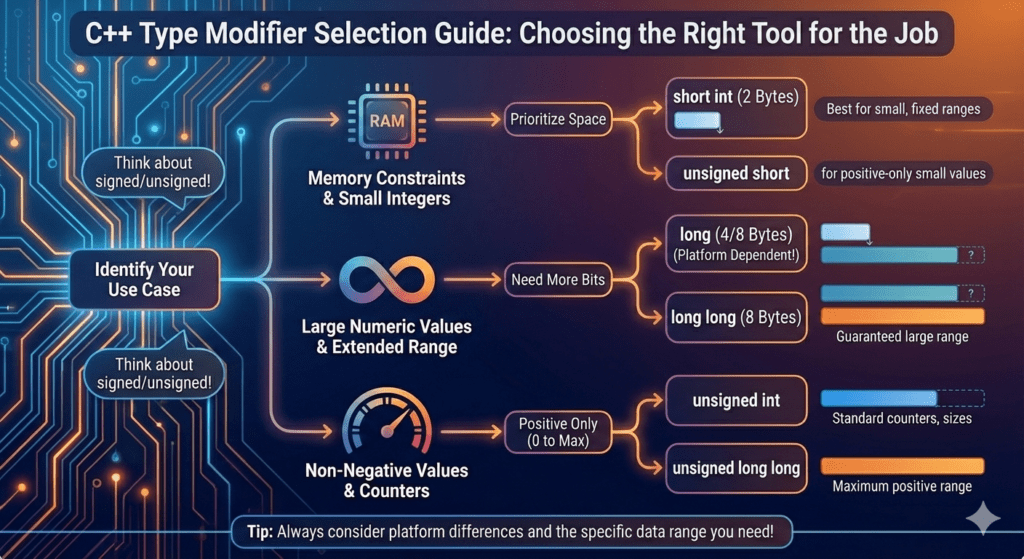
| Modifier | Memory Use | Value Range | Best Use Case |
|---|---|---|---|
| signed | Standard | ± values | General use |
| unsigned | Same | Larger +ve | Counters |
| short | Low | Smaller | Memory limits |
| long | High | Very large | Big numbers |
Practical Uses of Type Modifiers in C++
- Google’s Search Algorithm Optimization
Google employs a plethora of C++ features, including type modifiers, to fine-tune its search algorithms for efficiency and speed. Type modifiers like `unsigned` ensure data types hold only positive values, squeezing extra performance from their code.
By using `unsigned int`, Google optimises their memory usage and reduces bugs caused by negative values during algorithm calculations.unsigned int page_rank = 0; - Facebook’s Data Processing
Facebook handles massive data volumes, and accuracy matters. Using `long double` type modifiers improves the precision of calculations involving numerous social interactions.
This precision ensures that when computing engagement scores, they derive highly accurate results without rounding errors affecting the output.long double engagement_score = 0.0; - Amazon’s Inventory Management System
To effectively manage stock levels, Amazon uses `short` type modifiers for small numbers, like quantities of items stored in each warehouse section.
Implementing `short` means Amazon can keep the system running smoothly, as it reduces memory consumption for handling relatively low numerical values.short warehouse_stock = 12; - Netflix’s Streaming Analytics
To analyse viewership data, Netflix often relies on `long long` for large integers representing total streaming minutes collected from users worldwide.
Using `long long` helps Netflix track comprehensive viewing data with accuracy and efficiency, accommodating their extensive global user base.long long total_minutes_watched = 0LL;
C++ Type Modifiers
Understanding type modifiers in C++ can be a bit tricky, but they’re super useful once you get the hang of them. Here’s a list of some of the most frequently asked questions about type modifiers that you won’t find answered all over the internet. I’ve pulled these from places like Google, Reddit, and Quora. Let’s delve into them and clarify things a bit:
- What’s the purpose of a type modifier in C++?
Type modifiers in C++ are used to alter the properties of the built-in data types. They allow us to adjust things like the range of values a type can hold, for example, usingunsignedto only represent non-negative numbers. - Can you combine type modifiers in C++?
Yes, combining type modifiers is possible in C++. For example, you can useunsigned longto increase the size and extend the range of values that the integer type can store. - What’s the difference between
signedandunsignedtypes?Signedtypes can hold both negative and positive values, whileunsignedtypes can only hold non-negative values but have a larger positive range. - How does the
shorttype modifier affect memory usage?
Theshorttype modifier reduces the size of an integer data type to 16 bits in most systems, thus optimising memory usage for storing smaller numbers. - Can type modifiers be used with non-integer types?
Generally, type modifiers are meant for integer and floating types. However, for floating-point numbers,long doubleis commonly used to increase precision, not necessarily a range. - Is there any performance impact when using type modifiers?
There can be a performance impact since operations on smaller data types likeshortmay be faster on some hardware due to less data being processed at once, although this heavily depends on the system architecture. - Do all compilers interpret type modifiers the same way?
While C++ has a standard definition for type modifiers, their actual implementation and size can vary between different compilers and platforms. - How does the
longmodifier affect data types?
Thelongmodifier extends the capabilities of an integer type by increasing its size, allowing it to hold larger numbers. - Is it possible to have
long longand what does it do?
Yes,long longis an extension oflongand provides even greater range for integer storage in C++. - How can type modifiers affect program robustness?
By carefully choosing type modifiers, you can ensure your program manages resources efficiently, reduces errors related to overflows/underflows, and uses memory wisely, making it more robust.
// Example: Combining type modifiers
unsigned long population = 7500000000;
Experience the future of coding with our AI-powered cpp online compiler. It allows you to write, run, and test your code instantly with the help of AI. Perfect for learners and professionals alike, it streamlines the coding process, making programming smoother and more efficient.
Conclusion
“Type modifiers in C++” enhance your coding skills by providing greater control over data. Mastering these empowers precise programming and opens new avenues for development. Feel accomplished and ready to tackle more. For further learning in Java, Python, and more, explore resources at Newtum.
Edited and Compiled by
This article was compiled and edited by @rasikadeshpande, who has over 4 years of experience in writing. She’s passionate about helping beginners understand technical topics in a more interactive way.
About The Author