
Form Validation in PHP is the process of verifying user input before processing it on the server. It ensures required fields are filled, data formats are correct, and malicious input is blocked to keep applications secure and reliable.
With increasing data breaches and stricter compliance standards, validating form input is no longer optional. PHP form validation helps prevent SQL injection, XSS attacks, and broken user experiences in modern web applications.
Key Takeaways / Quick Summary (Scannable Box)
- Client-side validation → Fast feedback but not secure alone
- Server-side validation (PHP) → Essential for security
- Built-in PHP functions → filter_input(), preg_match()
- Best practice → Combine client + server validation
What is Form Validation in PHP?
Definition
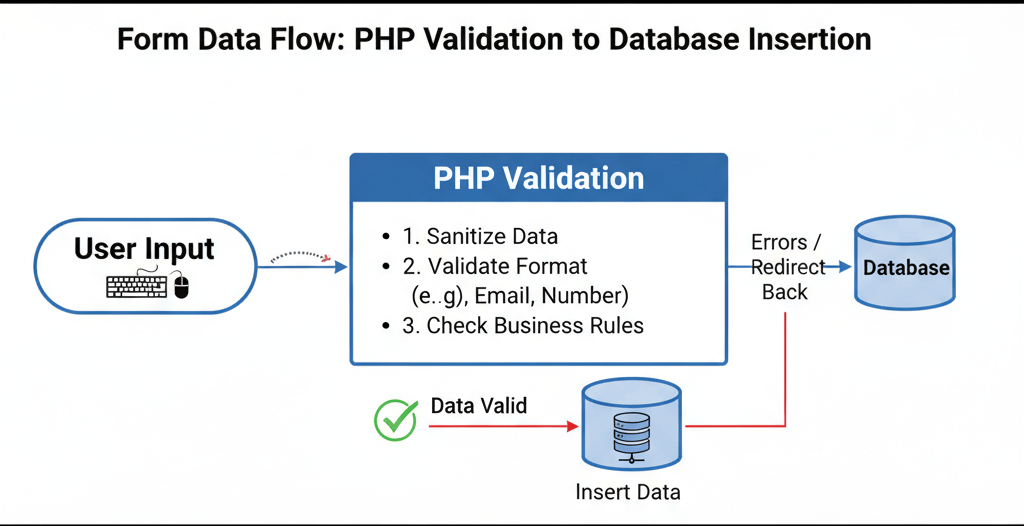
Form validation in PHP is the process of checking user-submitted form data on the server before it is processed or stored. It ensures the input is complete, correctly formatted, and safe to use within the application.
Why PHP Validation Is Mandatory
Client-side validation can be bypassed easily by disabling JavaScript or sending forged requests. PHP validation runs on the server, making it essential for preventing SQL injection, XSS attacks, invalid data storage, and application crashes.
Common Validation Mistakes
- Relying only on JavaScript validation
- Not sanitizing input before database insertion
- Displaying raw error messages to users
- Skipping validation for optional fields
- Trusting hidden form fields
Types of PHP Form Validation
Required Field Validation
Checks whether mandatory fields like name, email, or password are not empty before form submission.
Email & URL Validation
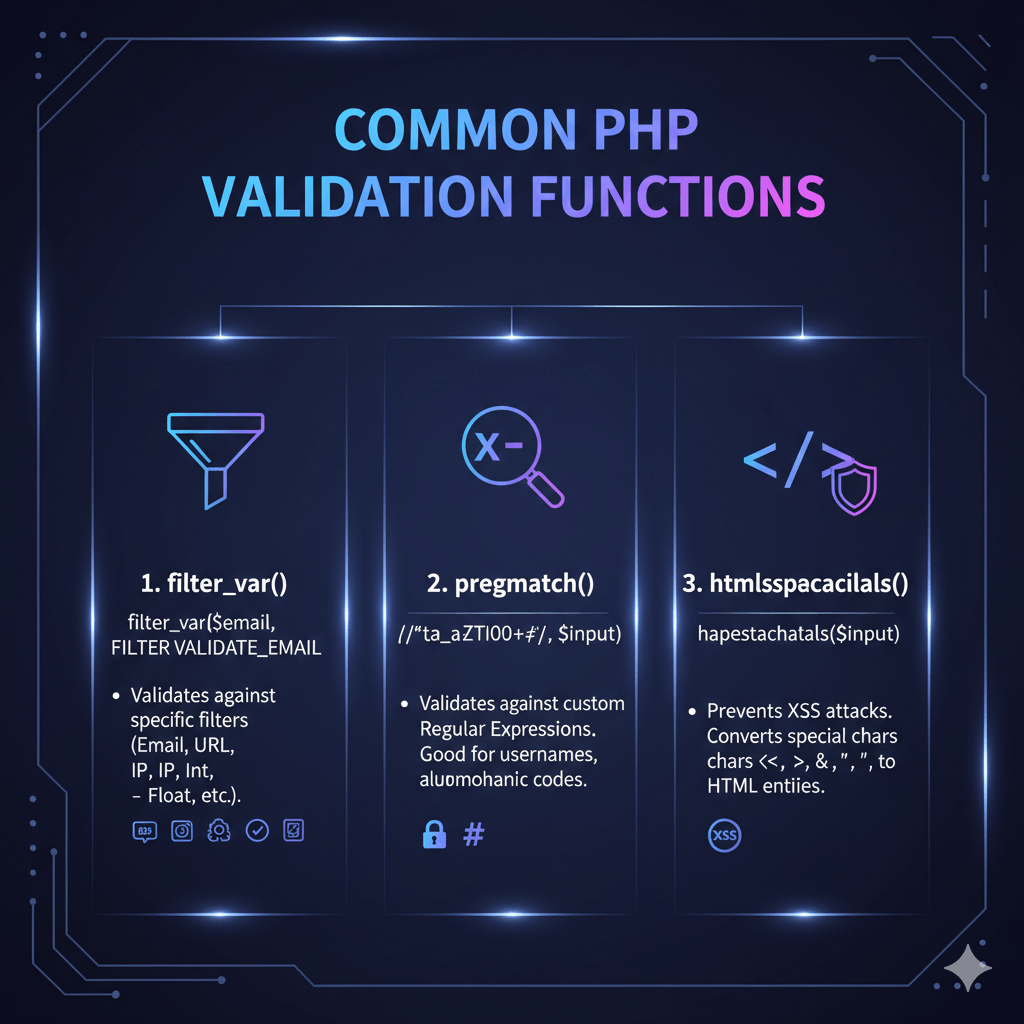
Ensures email addresses and URLs follow valid formats using PHP’s built-in validation filters.
Numeric & String Length Validation
Validates numbers, minimum and maximum string length, and allowed characters to prevent incorrect data entry.
File Upload Validation
Verifies file type, size, and extension to prevent malicious file uploads and server exploitation.
How do you validate required fields in PHP?
PHP validates required fields using empty() and isset() functions.
isset()checks whether a field existsempty()checks whether the field has a value
if (isset($_POST['username']) && !empty($_POST['username'])) {
    echo "Username is valid";
} else {
    echo "Username is required";
}
This approach ensures the field exists and is not submitted with an empty value.
How does PHP validate email addresses?
PHP validates email addresses using the filter_var() function with the FILTER_VALIDATE_EMAIL filter.
$email = $_POST['email'];
if (filter_var($email, FILTER_VALIDATE_EMAIL)) {
    echo "Valid email address";
} else {
    echo "Invalid email address";
}
This method checks the email structure against standard formats and is recommended for production-grade applications.
Practical Applications of PHP Form Validation
- User Registration Forms at Facebook
Facebook, with its vast user base, employs PHP Form Validation to ensure that data entered during registration is accurate and secure. It checks for valid email formats and strong passwords, which helps in providing a seamless experience for new sign-ups.
PHP Form Validation reduces the number of fake registrations and enhances account security, ensuring users have a smooth onboarding process.
if (!filter_var($email, FILTER_VALIDATE_EMAIL)) {
    echo "Invalid email format";
} - Checkout Process at Amazon
Amazon uses PHP Form Validation during the checkout process to validate customer input for shipping details. This ensures that addresses are correctly formatted and phone numbers meet specific criteria before an order is processed.
This ensures prompt and accurate deliveries while enhancing customer satisfaction by reducing order errors.
if (preg_match("/^[0-9]{10}$/", $phone) == 0) {
    echo "Invalid phone number";
} - Feedback Forms at BBC
The BBC employs PHP Form Validation to process feedback forms on their website. By checking the validity of fields like email and message content, they ensure that they only receive valuable insights from real users.
This leads to more reliable and useful feedback, assisting the BBC in improving their services and programming content over time.
if (empty($message)) {
    echo "Message field cannot be empty";
}
Pros & Cons of PHP Form Validation vs JavaScript Validation
| Feature | PHP Validation | JavaScript Validation |
|---|---|---|
| Security | High | Low |
| Server-side | Yes | No |
| User feedback | Slower | Instant |
| Best use | Final validation | UX improvement |
PHP Form Validation FAQs
- How can I check if an input field is empty in PHP during form validation?
To check if a field is empty, you can use PHP’s `empty()` function. This is an example for a POST input:
      if (empty($_POST['fieldname'])) {
          echo "The field is empty.";
} - What is the Best way to escape special characters in PHP Form Inputs?
Use PHP’s `htmlspecialchars()` function to escape special characters, preventing HTML injection.$safeInput = htmlspecialchars($_POST['inputname'], ENT_QUOTES, 'UTF-8'); - Can I customize error messages for invalid inputs in PHP?
Absolutely! Assign custom error messages to variables based on validation checks.How do I validate email addresses in PHP Form Validation?
Use `filter_var()` with the `FILTER_VALIDATE_EMAIL` filter to ensure the email format is correct.
      if (!filter_var($email, FILTER_VALIDATE_EMAIL)) {
          echo "Invalid email format.";
} - What function should I use to validate URLs in PHP forms?
Like emails, validate URLs using `filter_var()` with `FILTER_VALIDATE_URL`. - Are there built-in PHP functions for number validation?
Yes, `is_numeric()` checks if a variable is a number or a numeric string. - How can I implement a minimum length check for a text input?
Use `strlen()` to compare the input length to your required minimum length. - What’s the simplest way to trim whitespaces from form input in PHP?
Use `trim()`, which removes spaces from the start and end of a string.
Our AI-powered php online compiler offers a seamless coding experience. Instantly write, run, and test your ‘php’ code with the help of AI. It’s designed to streamline your coding process, making it quicker and more efficient. Try it out, and see the difference AI can make!
Conclusion
PHP Form Validation is an essential step that ensures secure, error-free data collection, giving you confidence in your web applications. Mastering it not only enhances your coding skills but also boosts your employability. Explore more programming wonders at Newtum and elevate your coding abilities today.
Edited and Compiled by
This article was compiled and edited by @rasikadeshpande, who has over 4 years of experience in writing. She’s passionate about helping beginners understand technical topics in a more interactive way.
About The Author