The job market for developers has changed dramatically. In 2026, companies are not just scanning for degrees or a list of programming languages on a resume. Hiring managers are looking for something more nuanced — proof that a candidate can actually contribute from day one, communicate clearly, and grow inside a team.
If you are just starting out or recently graduated, the question on your mind is probably: “What do I actually need to get hired?” This guide breaks down 10 real, observable signals that separate junior developer candidates who get callbacks from those who don’t. Each one is grounded in what real hiring teams evaluate today.
Understanding junior developer skills for getting hired is the first step to building a career — not just a resume.
1. A GitHub Profile That Tells a Story
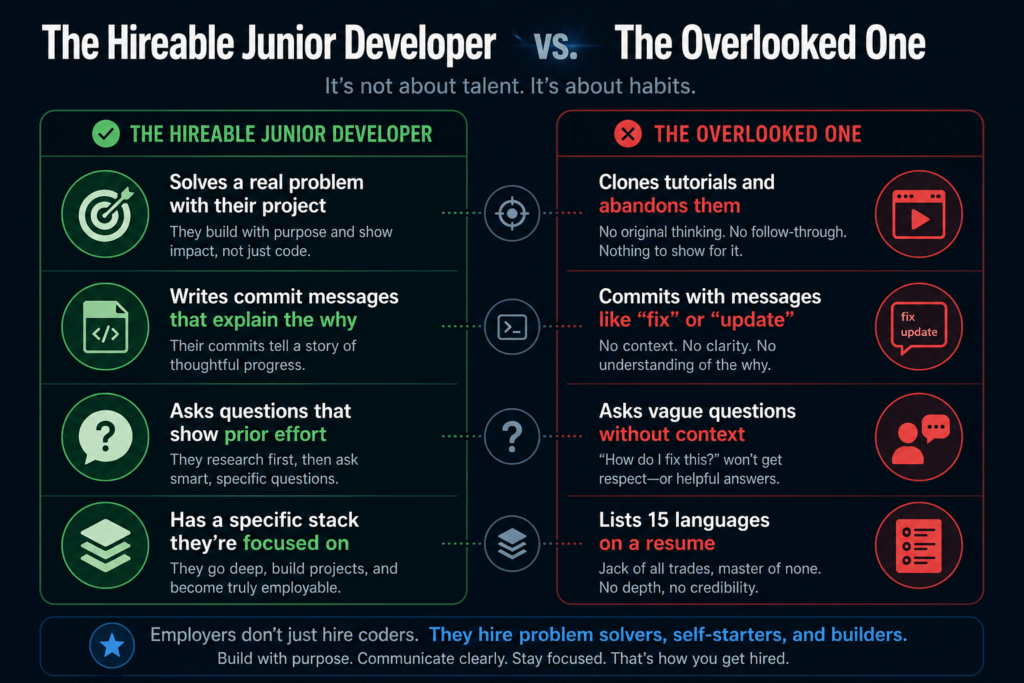
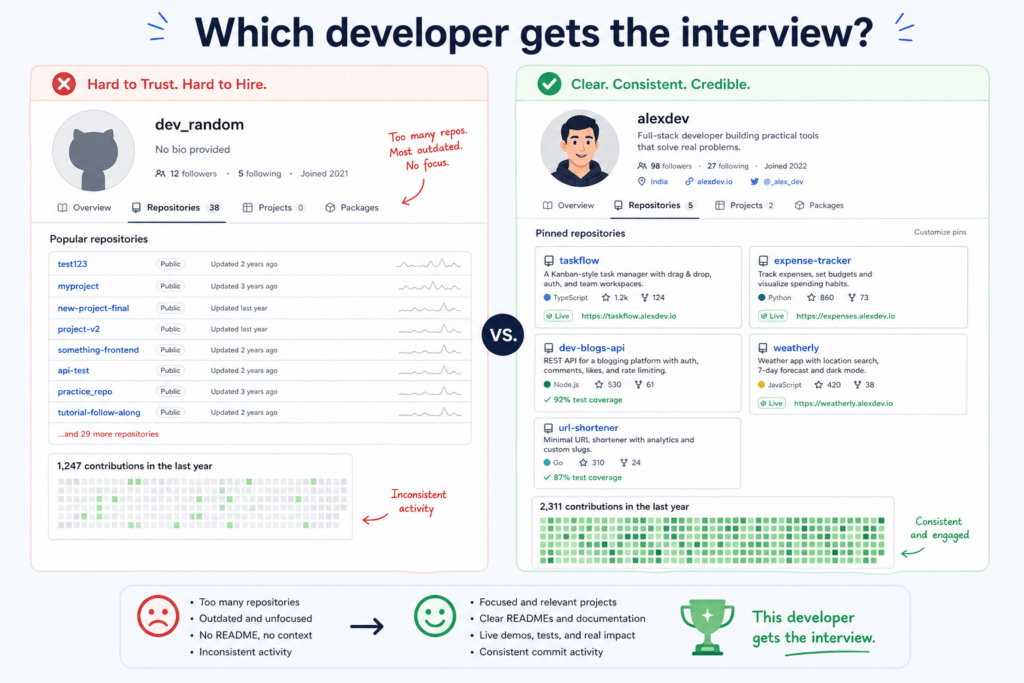
Your GitHub is your portfolio, your proof of work, and often the first thing a technical recruiter opens after your resume. But a profile cluttered with tutorial clones and half-finished to-do apps does not tell a compelling story.
What hireable junior developers do differently is complete things. Even a small, well-scoped project with a proper README, clear commit history, and meaningful variable names says more than twenty abandoned repositories. Think of your GitHub as a conversation starter. Recruiters want to see how you think, how you organize code, and whether you care enough to document your work.
2. Demonstrated Ability to Read and Work with Existing Code
One of the biggest misconceptions junior developers have is that job interviews and job reality are about writing code from scratch. In truth, most of your time as a junior developer will be spent reading code someone else wrote, modifying it, and not breaking what already works.
Candidates who demonstrate this skill early stand out enormously. Contributing to an open-source project — even fixing a documentation error or resolving a small bug — shows you can navigate an unfamiliar codebase. It proves one of the most valuable junior developer skills for getting hired: the ability to work within existing systems rather than demanding a clean slate.
If open-source feels intimidating, look for “good first issue” labels on GitHub. Start small. The contribution matters less than the mindset it demonstrates.
3. Basic Git Fluency Beyond Just Commits
Most junior developers know how to git commit and git push. Hireable ones know why branching matters, what a pull request is supposed to communicate, and how to write a commit message that actually explains the change.
In 2026, almost every team uses Git-based workflows. If you cannot create a feature branch, open a meaningful PR, or understand what a merge conflict is, you will slow teams down from day one. This is not advanced knowledge — it is table stakes.
Practice by treating your personal projects like collaborative ones. Write PR descriptions as if another developer has to review them. This single habit is one of the most underrated junior developer skills for getting hired because it signals professional readiness before you have professional experience.
4. Communication That Doesn’t Require Hand-Holding
Technical ability alone does not get junior developers hired — especially in remote and hybrid environments that dominate in 2026. Hiring managers consistently cite communication as one of their top concerns with junior candidates.
This is not about being a great speaker. It means writing a clear Slack message about a blocker. It means asking a question that shows you have already tried something before escalating. It means responding to a code review comment without becoming defensive.
In interviews, pay attention to how you explain your thought process. Saying “I tried X, it gave me Y error, so I looked at Z and found that…” shows structured thinking. Candidates who go silent and just type, or who give vague answers under pressure, raise flags even when their code is correct.
5. A Specific Technology Stack, Not a Scattergun Approach
Junior developers often make the mistake of listing every language and framework they have ever touched on their resume. Recruiters see this as a red flag, not a strength. It suggests shallow knowledge across the board.
In 2026, the developers getting hired fastest have a clear stack they are focused on. Whether that is React with Node.js, Python with Django and PostgreSQL, or Flutter for mobile — depth matters more than breadth at the junior level. You will learn more stacks on the job. What companies want to know is that you can go deep enough in one to be useful quickly.
When you identify the specific role and company type you are targeting, align your projects and resume to that stack. This focus is one of the clearest junior developer skills for getting hired that candidates miss.
6. Understanding of the Basics of Deployment and the Dev Lifecycle
Five years ago, it was acceptable for a junior developer to know nothing about deployment or cloud infrastructure. That is no longer true. The barrier between “I write code” and “I ship working software” has moved.
You do not need to be a DevOps engineer. But knowing how to deploy a project to a platform like Vercel, Render, or Railway — or how environment variables work — or what a CI/CD pipeline does conceptually — puts you ahead of candidates who treat deployment as someone else’s problem.
This knowledge also helps you in interviews. When a technical question touches on how software works end-to-end, candidates with deployment exposure answer with far more confidence and practicality.
7. Evidence of Debugging Discipline
Every developer breaks things. The signal hiring teams look for is not whether you make mistakes — it is how you handle them. Candidates who describe a debugging process coherently in interviews are far more impressive than those who either claim they never get stuck or who describe chaos and guesswork.
Develop a repeatable approach to debugging: read the error message carefully, isolate the problem, form a hypothesis, test it, repeat. When you explain this in an interview, you are demonstrating one of the most critical junior developer skills for getting hired — the capacity to solve problems independently without requiring constant supervision.
Document your debugging experiences in a personal log or blog. This is also excellent interview preparation material.
8. A Portfolio That Includes a Real Problem Solved
Recruiters see hundreds of weather apps and to-do lists. While building these is a valid learning exercise, a portfolio that includes a project solving a real (even small) problem is far more memorable.
Did you build a tool that scraped and visualized local bus schedules because the city website was hard to use? Did you create a budget tracker that your family actually uses? Did you automate a repetitive task that used to take you 20 minutes each week? These projects stand out because they show initiative, product thinking, and the understanding that software is ultimately for people.
This is the kind of differentiation that makes junior developer skills for getting hired translate into actual job offers rather than just interview callbacks.
9. Proof of Learning Speed and Adaptability
Technology moves fast. Hiring managers know that the specific tools a junior developer knows today may be secondary in three years. What they are really evaluating is: does this person learn quickly and adapt?
The clearest way to demonstrate this is through the trajectory of your projects. If your first project was a simple HTML page and your latest one uses a React front end with an API and database integration, that progression tells a story. Document it. Write about what you learned building each project. This can be on a personal blog, in a portfolio case study, or even in the README itself.
Candidates who can articulate what they learned — and what they would do differently — are demonstrating one of the highest-value junior developer skills for getting hired in the current market.
10. Professional Online Presence and Responsiveness
This last signal is often invisible until it matters, and then it matters enormously. When a recruiter or hiring manager looks you up, what do they find?
A LinkedIn profile that is current, has a short clear summary, and shows your projects and learning journey is a significant advantage. A personal website even a simple one that links your GitHub, your blog posts, and your contact details signals professionalism. And when a recruiter reaches out, responding promptly and clearly is itself a form of communication competence.
Junior developers sometimes underestimate how much the hiring experience is evaluated from the recruiter’s side. Being easy to reach, responding to emails with clarity, and showing up to interviews on time with your environment set up — these soft signals compound and influence hiring decisions more than candidates realize.
Pulling It All Together
What makes a junior developer hireable in 2026 is not one single thing. It is a combination of signals that, taken together, paint a picture of someone who is reliable, growth-oriented, and ready to contribute.
Here is a quick summary of the 10 signals:
- A GitHub profile with complete, documented projects
- Experience reading and working with existing codebases
- Git fluency beyond basic commits — branches, PRs, clear messages
- Communication skills that work in async and written environments
- A focused technology stack with demonstrated depth
- Familiarity with the deployment lifecycle and dev environment basics
- A systematic approach to debugging described clearly
- At least one project that solves a real, specific problem
- Evidence of learning speed through a visible progression of work
- A professional online presence and responsive, clear communication
Each of these junior developer skills for getting hired is buildable. None requires years of experience. What they require is intentionality — working on the right things, in the right way, and making sure that work is visible.
The developers who get hired are not always the most technically advanced. They are the ones who have made it easiest for a hiring team to say yes.
Final Thoughts
If you are a junior developer job hunting in 2026, start by auditing yourself against these 10 signals. Where are you strong? Where are there obvious gaps? Pick one or two gaps to close deliberately over the next month.
Building junior developer skills for getting hired is a process, not a single event. The developers who approach it systematically – treating their portfolio, communication, and professional presence as things worth investing in — consistently outperform those who wait until they feel “ready.”
You already have more to offer than you think. Make sure that is visible. For a more informative blog, visit Newtum.
About The Author