“If else in C programming” is a vital tool in a coder’s toolkit, allowing you to make decisions within your code. Mastering this concept can help solve problems like determining user input outcomes or handling error conditions. Keen on enhancing your skills and solving real-world coding challenges? Keep reading!
What is If Else in C Programming?
Conditional statements in C are control structures that allow a program to make decisions based on conditions. They evaluate an expression and execute specific blocks of code depending on whether the condition is true or false. The if else statement is one of the most commonly used conditional constructs.
Why Decision Making is Important in C
Decision-making enables programs to behave dynamically instead of executing code sequentially. With if else, you can:
- Control program flow based on user input
- Validate data before processing
- Implement logic like comparisons, ranges, and branching
Without conditional logic, programs would lack flexibility and real-world applicability.
Basic Syntax Explanation
The if else statement checks a condition and executes code accordingly:
if (condition) {
    // code executes if condition is true
} else {
    // code executes if condition is false
}
condition: An expression that evaluates to true (non-zero) or false (0)- Curly braces
{}define the block of code to execute
How Does If Else Work in C?
Flow of Execution
- The condition inside the
ifstatement is evaluated - If the condition is true → the
ifblock executes - If the condition is false → the
elseblock executes - The program continues with the next statement after the block
Condition Evaluation (True vs False)
- In C, 0 = false
- Any non-zero value = true
Example:
if (5 > 3)   // true
if (0)       // false
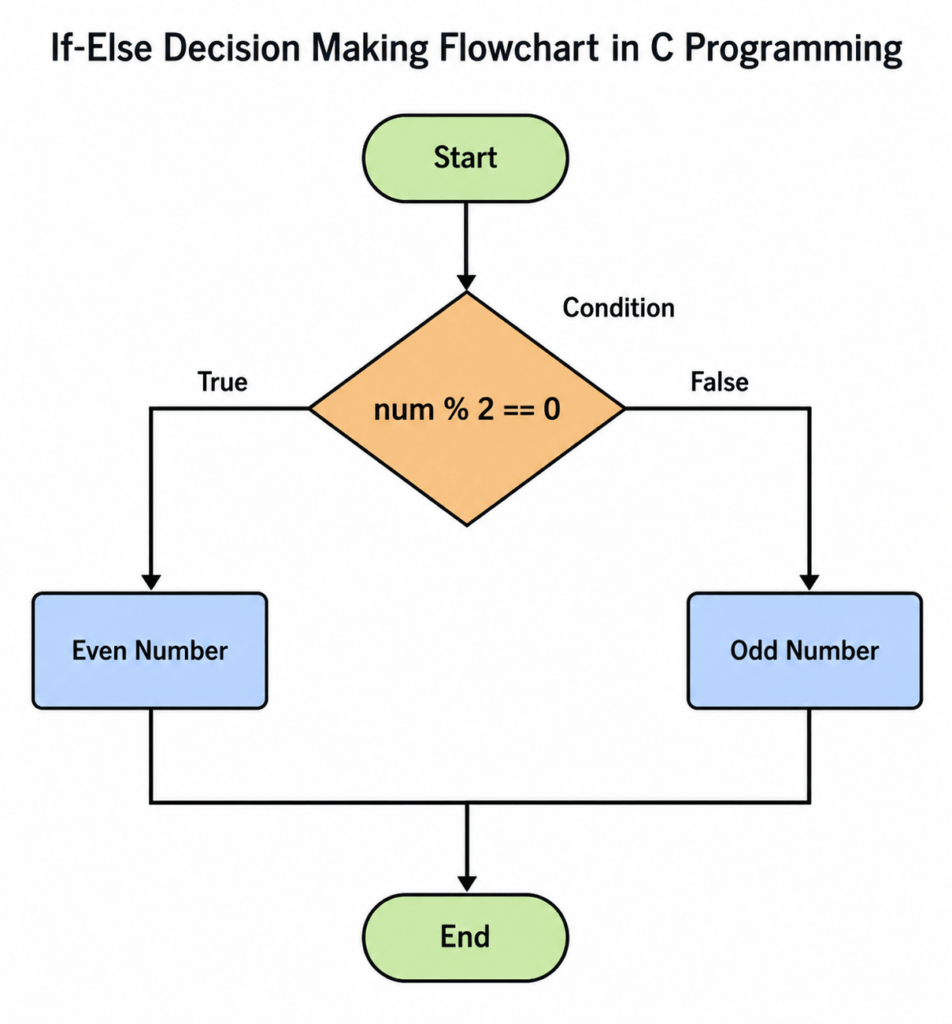
Simple Flowchart Explanation
- Start
- Check condition
- If true → execute block A
- If false → execute block B
- End
This logical branching is the foundation of decision-making in programming.
Syntax of If Else Statement in C
Standard Syntax
if (condition) {
    // statements
} else {
    // statements
}
Explanation of Each Component
if: Keyword used to test a condition(condition): Logical or relational expression{}: Group multiple statements into a blockelse: Executes when the condition is false
Code Example
#include <stdio.h>

int main() {
    int number = 10;

    if (number % 2 == 0) {
        printf("Even number");
    } else {
        printf("Odd number");
    }

    return 0;
}
Output:
Even number
Types of If Else Statements in C
Simple If Statement
Executes a block only when the condition is true.
if (x > 0) {
    printf("Positive number");
}
If-Else Statement
Provides an alternative block when the condition is false.
if (x > 0) {
    printf("Positive");
} else {
    printf("Not positive");
}
If-Else If Ladder
Used when multiple conditions need to be checked sequentially.
if (marks >= 90) {
    printf("Grade A");
} else if (marks >= 75) {
    printf("Grade B");
} else {
    printf("Grade C");
}
Nested If Statements
An if statement inside another if for more complex logic.
if (x > 0) {
    if (x % 2 == 0) {
        printf("Positive Even");
    }
}
Using If-Else in C
c #includeExplanation of the Codeint main() { int number; printf("Enter a number: "); scanf("%d", &number); if (number % 2 == 0) { printf("%d is even. ", number); } else { printf("%d is odd. ", number); } return 0; }
Let’s dive into this C program step by step and see how it works.
- The program begins by including the standard input-output library, `
`, which allows us to use the `printf` and `scanf` functions. These functions help in displaying messages and taking input, respectively.
- Within the `main` function, we declare an integer variable called `number`. This variable will store the value entered by the user.
- Next, the program prompts the user to “Enter a number: “. The user’s input is then read and stored inside the `number` variable using `scanf(“%d”, &number)`. The `%d` denotes we’re expecting an integer.
- An `if…else` statement checks if the number is even or odd. `number % 2 == 0` evaluates to true for even numbers and prints the corresponding message. Otherwise, the `else` statement executes, indicating the number is odd.
- Finally, the statement `return 0;` indicates that the program has successfully completed.
Output
Enter a number: 4 is even.
Practical Examples of If Else in C
Even or Odd Number Check
This is a classic example where a number is evaluated using the modulus operator %.
#include <stdio.h>

int main() {
    int num;

    printf("Enter a number: ");
    scanf("%d", &num);

    if (num % 2 == 0) {
        printf("Even number");
    } else {
        printf("Odd number");
    }

    return 0;
}
Logic:
If the remainder when divided by 2 is 0 → even, otherwise odd.
Largest of Three Numbers
This example compares three values using multiple conditions.
#include <stdio.h>

int main() {
    int a, b, c;

    printf("Enter three numbers: ");
    scanf("%d %d %d", &a, &b, &c);

    if (a >= b && a >= c) {
        printf("Largest number is %d", a);
    } else if (b >= a && b >= c) {
        printf("Largest number is %d", b);
    } else {
        printf("Largest number is %d", c);
    }

    return 0;
}
Logic:
Use logical AND (&&) to ensure one number is greater than or equal to both others.
Grade Calculation Program
Assigns grades based on marks using an if-else if ladder.
#include <stdio.h>

int main() {
    int marks;

    printf("Enter marks: ");
    scanf("%d", &marks);

    if (marks >= 90) {
        printf("Grade A");
    } else if (marks >= 75) {
        printf("Grade B");
    } else if (marks >= 50) {
        printf("Grade C");
    } else {
        printf("Fail");
    }

    return 0;
}
Logic:
Conditions are evaluated top-down, and the first true condition executes.
Common Mistakes to Avoid– if else in C programming
Missing Curly Braces
Omitting {} can lead to unintended behavior, especially with multiple statements.
❌ Incorrect:
if (x > 0)
    printf("Positive");
    printf("Check complete");
✔ Correct:
if (x > 0) {
    printf("Positive");
    printf("Check complete");
}
Assignment (=) vs Comparison (==)
Using = instead of == is a common logical error.
❌ Incorrect:
if (x = 5) // assigns 5, always true
✔ Correct:
if (x == 5) // compares value
Incorrect Condition Logic
Improper use of operators can break logic.
❌ Incorrect:
if (marks > 50 && marks < 40)
✔ Correct:
if (marks > 50 && marks < 100)
Tip: Always validate condition ranges carefully.
Best Practices for Writing if else in C programming
Keep Conditions Simple
Avoid overly complex expressions. Break them into smaller checks if needed.
✔ Better:
if (age > 18) {
    if (citizen == 1) {
        printf("Eligible");
    }
}
Use Meaningful Variable Names
Readable code reduces errors and improves maintainability.
❌ Poor:
int x;
✔ Better:
int userAge;
Avoid Deep Nesting
Too many nested if statements make code hard to read and debug.
❌ Complex:
if (a > 0) {
    if (b > 0) {
        if (c > 0) {
            printf("All positive");
        }
    }
}
✔ Improved:
if (a > 0 && b > 0 && c > 0) {
    printf("All positive");
}
Practical Applications of if else in C programming
-
User Authentication in Facebook:
Facebook uses “if else” in C programming for handling login authentication. When a user attempts to log in, the system checks if the provided credentials match the database entries.
Output: Depending on the credentials, users are either granted access or prompted with an error message.int authenticateUser(char* username, char* password) { if (checkDatabase(username, password)) { return 1; // Successful login } else { return 0; // Failed login } } -
Transaction Process in Paypal:
In a transaction process, Paypal may adopt “if else” to verify transaction amounts and account balances before proceeding.
Output: The transaction is either processed or an error message indicates insufficient funds.float balance = getAccountBalance(userAccount); if (transactionAmount <= balance) { processTransaction(userAccount, transactionAmount); } else { displayError("Insufficient funds."); } -
Traffic Management in Google Maps:
Google Maps may implement "if else" in managing traffic data by evaluating current congestion levels and suggesting alternative routes.
Output: Users receive either the standard route or an alternate suggestion based on traffic conditions.int currentTraffic = getTrafficCondition(route); if (currentTraffic > THRESHOLD) { suggestAlternateRoute(); } else { displayRoute(route); }
Mastering if else in C programming
- What's the difference between using if-else and switch-case in C?
While both are used for decision-making, if-else is great for evaluating logical conditions or complex expressions. In contrast, switch-case is perfect for handling multiple specific values of a single variable, making the code sometimes cleaner and faster.
- How can you nest if-else statements right without causing confusion?
Nesting if-else statements can get tricky, but using proper indentation helps. Visual code editors also help you match brackets to ensure clarity. Here's a simple example:if (condition1) { if (condition2) { // Do something } else { // Do another thing } } else { // Do something else } - Why might an else statement in C be skipped unexpectedly?
This usually happens if there's no matching if, or a semicolon sneaks in after your if condition, creating an empty if block. Always check your syntax!
- Can I use an assignment in an if condition?
Yes, though it's risky and can cause bugs if not done mindfully! Using `=` instead of `==` is a common error, but valid in specific use cases like checking the result of an assignment.
- How do I handle multiple conditions in an if-else statement?
You can use logical operators like && (AND) and || (OR) to connect multiple conditions. For instance:if (age > 18 && age < 30) { // young adult } - What's the best way to return a value from an if-else statement?
Simply use the return statement within each block where the condition is true. It exits the function and returns the needed value.
- Can you mix if-else with loops effectively in C?
Definitely! Combining these can create powerful logic. You can control the flow within loops using if-else, like responding to each loop iteration uniquely.
- Why should you avoid using too many nested if-else statements?
They can make the code hard to read and debug. Instead, consider breaking them into simpler functions or using switch-case for clarity.
- Is it possible to use an else statement without an if in C?
No, every else must follow an if, otherwise it doesn't make sense logically or syntactically.
- How can I ensure the if-else statements are tested thoroughly?
Use test cases that cover all scenarios, including edge cases, to ensure every if-else path is executed as intended.
With our AI-powered c online compiler, you can instantly write, run, and test your C code seamlessly. Powered by intelligent algorithms, our compiler optimises coding efficiency, making it quicker and more intuitive for users to bring their coding ideas to life without any hassle.
Conclusion
The 'if else in C programming' hugely boosts your logical thinking and problem-solving skills. It’s a milestone in your coding journey, paving the way for tackling complex programming tasks. So, why not give it a shot? For further learning, take a look at Newtum for more exciting programming knowledge.
Edited and Compiled by
This article was compiled and edited by @rasikadeshpande, who has over 4 years of experience in writing. She's passionate about helping beginners understand technical topics in a more interactive way.
About The Author