Every developer has asked the question at least once in the last year: Will AI replace programmers? Not as a philosophical thought experiment, but as a genuine career concern. And in 2026, that concern has never felt more urgent or more complicated.
The tools have changed drastically. GitHub Copilot, Claude Code, and GPT-based code generators are no longer novelties. They are daily instruments used by junior and senior developers alike. The question is no longer whether AI can write code; it clearly can. The question is whether that means will AI replace programmers as a profession entirely.
This blog cuts through the noise and gives you an honest, grounded answer based on the latest expert forecasts, real productivity data, and a landmark statement from one of the most credible voices in the AI industry today.
The Statement That Shook the Tech World
In January 2026, at the World Economic Forum in Davos, Dario Amodei, CEO of Anthropic, the company behind Claude, dropped a prediction that rippled through every developer community on the internet.
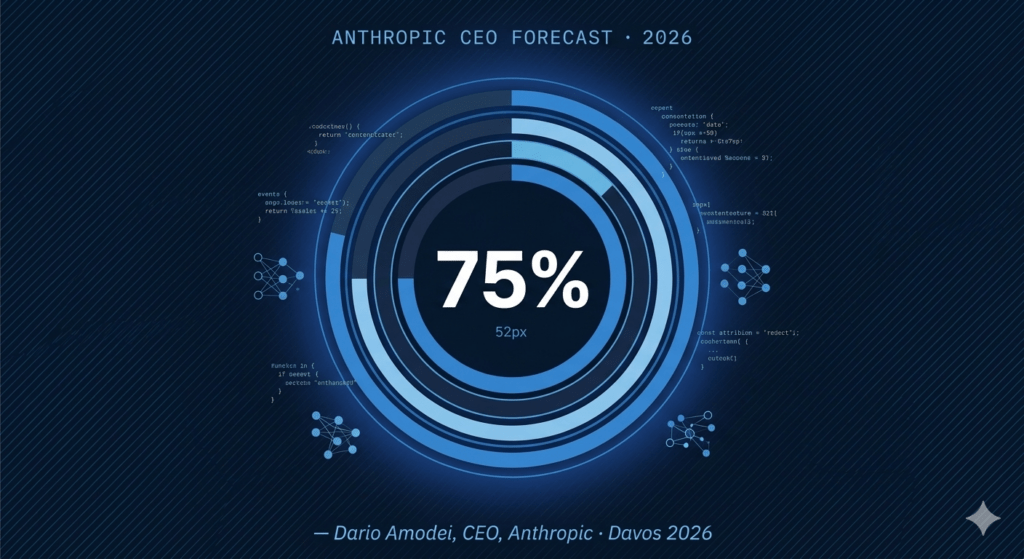
We might be six to twelve months away from when the model is doing most, maybe all of what software engineers do end-to-end.
Dario Amodei, Davos 2026
Amodei didn’t stop there. He revealed something even more striking about his own company: engineers at Anthropic had already stopped writing code manually. “I have engineers within Anthropic who say I don’t write any code anymore. I just let the model write the code. I edit it,” he said.
This isn’t a speculative forecast from a futurist blogger. This is the CEO of a $380 billion AI company, a former VP of Research at OpenAI, and a co-inventor of reinforcement learning from human feedback, speaking from direct operational experience. When Dario Amodei says will AI replace programmers is no longer hypothetical, the industry takes notice.
He had made a similar forecast in early 2025, predicting AI would write 90% of code within three to six months. By Davos 2026, he indicated that the loop was closing faster than expected, constrained only by chip manufacturing timelines and model training speeds, not by the AI’s ability to code.
What the Data Actually Shows in 2026
So will AI replace programmers based on what the numbers say? Here’s what has already happened, not what might happen.
Benchmark performance on SWE-bench, verified the gold standard for measuring AI coding ability on real-world software tasks, has jumped from 33% resolution rates in early 2024 to over 70% by early 2026. That is not a linear improvement. That is an acceleration. Claude 4.5 Sonnet can autonomously code for 30+ hours without meaningful performance degradation, handling complexity that once required cross-functional engineering teams.
GitHub reported a 25% year-over-year increase in code commits in 2025, and the majority of that growth is attributed to AI-assisted development. Google CEO Sundar Pichai has confirmed that over 25% of code written at Google is now AI-generated. At Meta, Mark Zuckerberg revealed the company is actively working toward AI that can function as a mid-level engineer.
The answer to will AI replace programmers is already partially yes – it has replaced the mechanical act of typing code. What remains is the question of whether AI can replace the thinking, the judgment, and the architectural vision behind the code.
The Role Transformation Nobody Talks About Honestly
Here is what most articles on will AI replace programmers miss entirely: replacement is not binary. Entire roles don’t vanish overnight. They transform, compress, and re-stratify.
At Anthropic, the shift is already visible. Engineers aren’t unemployed; they are reviewing, directing, and editing AI output rather than generating code from scratch. Their role has shifted from code author to code curator. The skill set required is different, not absent.
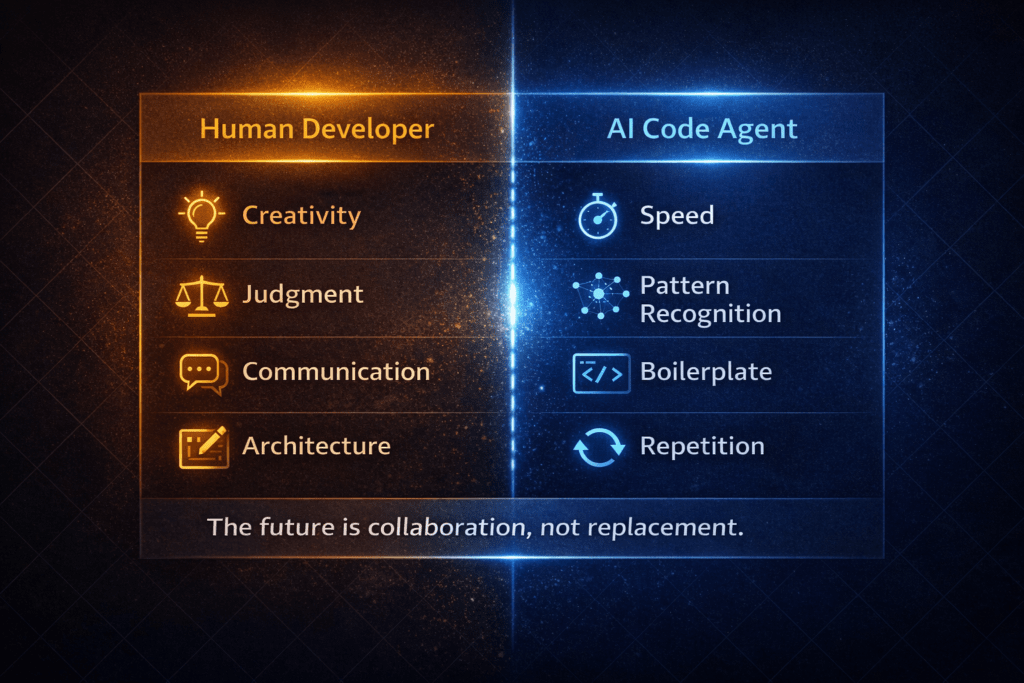
This is the model that Amodei himself endorsed at the Dreamforce 2025 summit, where he noted that human engineers could become ten times more productive with AI, which actually means companies may need fewer engineers to ship the same volume of work. Will AI replace programmers as a headcount? In junior and mid-level roles, very likely yes – partially and progressively.
Palo Alto Networks found that after deploying Claude for 2,500 developers, junior developers with zero prior AI experience completed complex integration tasks 70% faster. That productivity gain is simultaneously a career advancement tool and a structural justification to hire fewer junior developers at scale.
What Type of Programmers Are Actually at Risk?
Not all programming jobs face equal exposure. Will AI replace programmers who primarily transfer information or generate boilerplate? Absolutely. Will AI replace programmers who architect systems, define product vision, manage stakeholder tradeoffs, or build security-critical infrastructure? Not in the near term.
The programmers most at risk are those whose daily work looks like a pattern the AI has seen before: standard CRUD applications, repetitive scripting, template-based web development, or routine bug fixing. These are real, valuable jobs, but they are the jobs where AI has already reached or exceeded human speed and accuracy.
The programmers least at risk are those who operate at the intersection of deep domain knowledge and engineering: developers building novel algorithms, engineers working at the hardware-software boundary, professionals in regulated industries where legal and ethical accountability is non-delegable, and those who lead technical strategy at an organizational level.
Amodei himself acknowledged the nuance: “Humans will still be needed to specify the app’s purpose, make design decisions, and oversee the process.” The question of will AI replace programmers depends entirely on which part of the programming job you are actually doing.
What This Means If You Are a Beginner Developer in 2026
If you are just starting out, the question will AI replace programmers before I even start is a fair one. Here is the honest answer: the entry-level job market is already contracting. Companies are not hiring junior developers in the same volumes they were in 2021 or 2022. The leverage that AI gives to senior engineers means fewer seats are opened for people learning the fundamentals.
However, this does not mean learning to code is pointless. The opposite is true. What has changed is what you need to learn. Today’s beginner developer must understand not just syntax but systems, how to prompt effectively, how to review and validate AI-generated code, how to identify when an AI has made a subtle architectural mistake, and how to communicate technical tradeoffs to non-technical stakeholders.
The beginner who learns to work with AI coding tools as a force multiplier rather than competing against them is in a far stronger position than the one who treats coding as a typing skill. Will AI replace programmers who think this way? No. It will make them dramatically more productive.
What This Means If You Are a Senior or Experienced Developer
For experienced developers, will AI replace programmers is less existential and more strategic. Your years of context, your understanding of why systems were built the way they were, and your judgment about what will break in production, these are not things an AI can replicate from a prompt.
What AI does change for you is your expected output. A senior developer in 2026 who ignores AI tooling is voluntarily handicapping themselves. The bar for what constitutes a full day’s work has risen sharply. Teams that have adopted AI-assisted development are shipping code at speeds that would have seemed implausible two years ago. To stay relevant, senior developers must become the humans who know how to get the most out of AI while catching its consistent failure modes.
Your career advantage in a world where will AI replace programmers is a daily question lies in what AI still cannot do: navigate organizational politics, make ethical tradeoffs, design for long-term maintainability, and explain complex decisions to business stakeholders in plain language.
The Feedback Loop That Changes Everything
One of the most important insights from Amodei’s Davos remarks is the concept of a self-reinforcing acceleration loop. AI models write better code, which creates better AI models, which write even better code. This is not a metaphor; it is already happening.
Will AI replace programmers faster because of this loop? Almost certainly. The timeline that would have taken a decade is now measured in years, possibly months. Amodei noted that the loop is not yet fully closed; chip manufacturing timelines and model training costs still act as bottlenecks. But those are engineering constraints, not theoretical limits.
By 2026–2027, Amodei projects AI reaching what he calls “Nobel-level” intelligence across multiple technical fields. If that projection holds, the question will AI replace programmers becomes less about whether and more about at what pace, in which roles, and with what transition path available to those whose jobs are displaced.
The Honest 2026 Answer
So, will AI replace programmers? Here is the most honest answer available in 2026, assembled from the best data and the most credible expert opinion:
Yes, AI will replace a significant portion of programming tasks, particularly in junior and mid-level roles focused on code generation, bug fixing, and routine development. This is not a future concern. It is a present reality at companies like Anthropic, Google, and Meta.
No, AI will not fully replace programmers who combine engineering expertise with judgment, domain knowledge, communication ability, and architectural thinking. The human role in software development is narrowing in some dimensions and expanding in others.
The programmers who will thrive are those who stop asking will AI replace programmers as a threat and start asking how AI reshapes my role, and what must I do today to evolve ahead of that reshaping. The transition is real, the timeline is accelerating, and the outcome depends entirely on how proactively individual developers respond.
Dario Amodei did not say this to frighten engineers. He said it because he believes the industry deserves honesty. And in that spirit, the most useful thing any developer, beginner or senior, can do right now is take the question will AI replace programmers seriously enough to act on it, and not so seriously that they lose sight of the irreplaceable value of human judgment in technology.
Final Takeaway
The era of AI as a passive assistant is over. In 2026, whether AI will replace programmers is no longer a hypothetical debate it is a structural shift underway in real engineering organizations around the world. The developers who will define the next decade are not those who resisted the change, but those who understood it earliest and adapted with the most clarity.
Learn the tools. Master the judgment. Become the engineer that AI still cannot replace. For more, visit Newtum.
About The Author