You polish your résumé, craft a compelling cover letter, and hit submit, but the first pair of eyes reviewing your application is not human. It is an algorithm. Welcome to 2026, where the AI hiring process has become the default playbook for companies of every size. By this year, roughly 70% of businesses use AI somewhere in their recruitment pipeline, with 82% deploying it to screen résumés and 64% using it to evaluate candidate assessments. For freshers entering the job market, this is not a distant future scenario; it is the reality of Day One.
Understanding how the AI hiring process works and how to prepare for it is no longer optional. It is a career survival skill.
What Exactly Is the AI Hiring Process?
The AI hiring process refers to the use of artificial intelligence tools at various stages of recruitment, from sourcing and screening candidates to scheduling interviews and scoring assessments. Rather than replacing the entire recruitment team, AI augments it, handling the repetitive, high-volume tasks that would otherwise take hours of human effort.
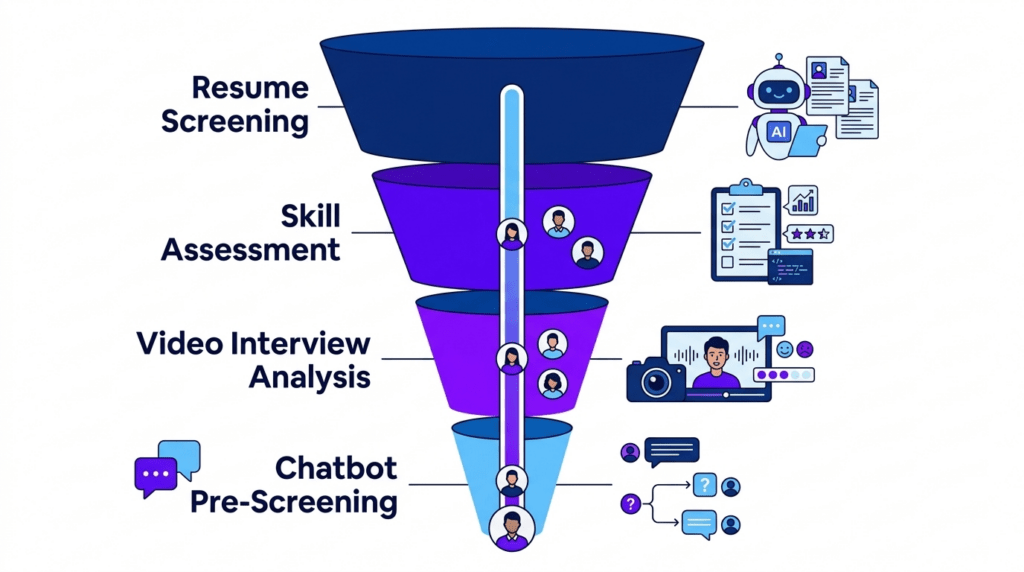
Here is what a typical AI-powered recruitment funnel looks like in 2026:
- Resume Parsing and Screening: AI tools scan thousands of applications in seconds, ranking candidates based on keyword matches, experience levels, and role relevance.
- Automated Skill Assessments: Platforms run coding challenges, aptitude tests, and situational judgment tasks, all evaluated by AI without a human reviewer.
- Video Interview Analysis: Some companies use AI to analyse speech patterns, facial expressions, and word choice during recorded video interviews.
- Chatbot-Led Pre-Screening: Conversational bots gather basic information, answer FAQs, and ask qualifying questions before a human recruiter ever gets involved.
Why Have Companies Embraced the AI Hiring Process So Rapidly?
Speed and scale are the two biggest drivers. A mid-sized company posting a single job opening might receive hundreds, sometimes thousands, of applications. Manually reviewing each one is neither efficient nor cost-effective. The AI hiring process solves this by automating the funnel, so recruiters spend their time only on the most promising candidates.
Beyond efficiency, AI also offers data-driven objectivity. When configured correctly, AI tools evaluate candidates on measurable criteria, skills, qualifications, and assessment scores rather than gut instincts. This can reduce unconscious bias and standardise evaluation, which is especially important for companies hiring at scale across different geographies.
There is also a cost argument. Reducing time-to-hire and lowering recruiter overhead can significantly save companies. Industry estimates suggest AI-assisted hiring can cut recruitment costs by up to 30%, making adoption a financially sound decision for organisations of all sizes.
What Does the AI Hiring Process Mean for Freshers?
If you are a fresher stepping into the job market in 2026, the AI hiring process is your first gatekeeper. Before a single human reads your name, an algorithm has already scored your resume, ranked your profile, and in many cases decided whether you advance to the next round.
This changes the rules of job hunting in some fundamental ways:
- Keyword optimisation matters more than ever. ATS (Applicant Tracking Systems) scan for terms that match the job description. If your résumé does not mirror the language of the role, it risks being filtered out before a human ever sees it.
- Assessment performance is now a primary filter. In the AI hiring process, automated assessments often serve as the key qualifying round. How you perform on these tests can be the difference between advancing and being eliminated.
- Soft skills are being measured differently. AI tools are now sophisticated enough to evaluate communication clarity, problem-solving approach, and critical thinking through written responses and video prompts.
How to Prepare Yourself for the AI Hiring Process
Preparing for the AI hiring process requires a different approach than traditional job hunting. Here are the steps freshers should prioritise:
1. Optimise Your Resume for ATS
Use clean formatting, no tables, graphics, or unconventional fonts. Match your resume language to the job description. Use standard section headings like Education, Experience, and Skills. Include relevant technical keywords and certifications that the role specifically calls out. The AI hiring process begins the moment you submit your application, and your resume is the first data point it evaluates.
2. Practice AI-Style Assessments Regularly
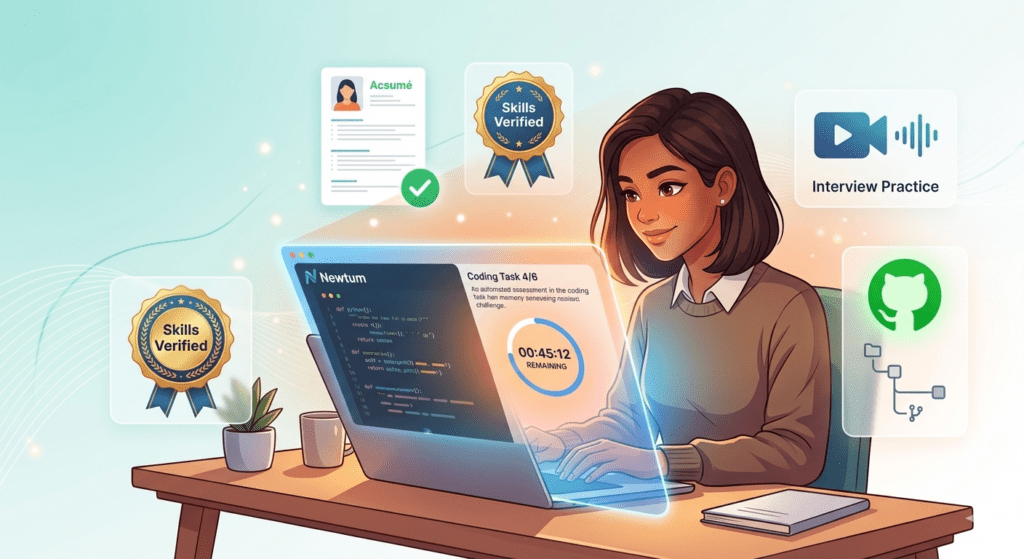
The assessment phase is where most freshers lose ground in the AI hiring process. Companies use AI-proctored tests to evaluate coding ability, logical reasoning, verbal skills, and domain knowledge. Consistent practice on platforms like Newtum, which is launching an AI Assessment Tool designed to mirror real hiring scenarios, can meaningfully improve both your confidence and your scores. Familiarity with the format matters as much as the knowledge itself.
3. Build a Verifiable Skill Portfolio
AI systems favour candidates with documented, verifiable achievements. Certifications, GitHub projects, hackathon participation, and completed courses all add credibility to your profile. The AI hiring process rewards evidence over claims, so let your portfolio do the talking.
4. Get Comfortable with AI-Led Interviews
Practise speaking clearly and concisely on camera. Structure your answers using the STAR method (Situation, Task, Action, Result). For text-based prompts, be precise and use relevant terminology. AI tools analyse both content and communication clarity in the AI hiring process.
Is the AI Hiring Process Fair?
This is a question worth asking. Critics of the AI hiring process point out that AI systems can replicate the biases embedded in historical hiring data. If past hires were predominantly from certain universities or demographics, the AI may inadvertently favour similar profiles. Regulatory bodies in the EU and the US are beginning to introduce guidelines around algorithmic hiring transparency.
For freshers, this means it is worth researching a company’s approach before applying. Companies that are transparent about their AI hiring process, what tools they use, how assessments are scored, and what criteria drive decisions are generally more trustworthy employers overall.
What Does the Future of the AI Hiring Process Look Like?
The AI hiring process is not slowing down – it is deepening. Over the next few years, expect AI tools that can predict long-term job performance, cultural fit, and career trajectory based on assessment data and behavioural signals. Some companies are already experimenting with adaptive assessments that adjust in real time based on a candidate’s responses.
On the positive side, AI is also democratising opportunity. Freshers from tier-2 and tier-3 cities who previously lacked access to top recruiters can now be discovered entirely on the basis of their skills and assessment performance – a meritocratic shift that levels the playing field in the AI hiring process.
Start Preparing for the AI Hiring Process Today
Knowing that the AI hiring process stands between you and your first interview is powerful. It means you can prepare strategically rather than leaving things to chance.
Newtum is building tools designed precisely for this era of recruitment. Our upcoming AI Assessment Tool is crafted to help students and freshers experience and ace the same kind of AI-evaluated tests that leading companies now use as standard. By practising in a realistic, AI-powered environment, you build both the skills and the composure needed to perform when it counts most.
The AI hiring process is not the enemy. It is the new standard. And like every standard, it rewards those who prepare for it.
Conclusion
The AI hiring process has moved from experimental to essential in under a decade. For the class of 2026, this is simply the world you are entering. Employers are using AI to find efficiency, consistency, and scale and as a candidate, your job is to make sure the algorithm sees your best self before the human interviewer ever does.
Optimise your resume, sharpen your assessment skills, build provable competencies, and stay informed about the tools driving the AI hiring process. The freshers who understand this shift and act on it will not just survive the algorithm. They will stand out because of it. For more information about AI assessment, visit our Newtum website
About The Author